Both frontier labs filed to go public. Anthropic submitted a confidential S-1 on June 1 at a $965 billion valuation, and OpenAI followed on June 8, targeting up to $1 trillion. These valuations price the labs as software companies at 20 to 34 times revenue, versus roughly 1.2 times revenue for a listed consulting company. In the same quarter, the EU deferred the AI Act high-risk deadline to December 2027; A quarter of McKinsey's revenue is from outcome-based pricing. KPMG cut advisory jobs as Accenture trained its 700,000th employee in AI. Both labs also opened certification networks to court the consulting firms they are now compete with.
TL;DR
• The Council of the EU approved the Digital Omnibus on June 29, 2026. Annex III stand-alone high-risk obligations move to December 2, 2027 and Annex I embedded systems to August 2, 2028
• Article 50, the AI Act's transparency layer requiring disclosure of chatbots, deepfakes, and AI-generated content, took effect on August 2, 2026
• 2% drop in Agent deployment in enterprises from 55% in Q1 2026 to 53% in Q2 2026. Multi-agent orchestration doubled from 9% to 18% where only 26% of organizations reported full real-time visibility into AI cost
• Cognizant announced Project Leap on April 29, 2026, a $230M to $320M program with $200M to $270M in severance and personnel costs
• Accenture bookings fell 2% to $19.3B with a book-to-bill ratio of 1.0, after the record $22.11B Q2 FY26 quarter 136. Accenture guides to an estimated 1% full-year revenue impact from its US federal business
• McKinsey's 57% to Forrester's 6% was the wide-range of impact of AI automation on total consulting jobs as each analysis measured tasks a model could perform versus jobs actually eliminated
• McKinsey disclosed roughly 25% of 2025 global fees as outcome-based, the highest in the field, while most large firms remained cautious
• Outcome-based pricing was the preferred pricing model for 21.7% of enterprises, at parity with per-user per-month models for the first time
• KPMG signed a global Anthropic alliance on May 19, 2026, embedding Claude inside Digital Gateway for its 276,000+ workforce and becoming Anthropic's preferred private equity consultant
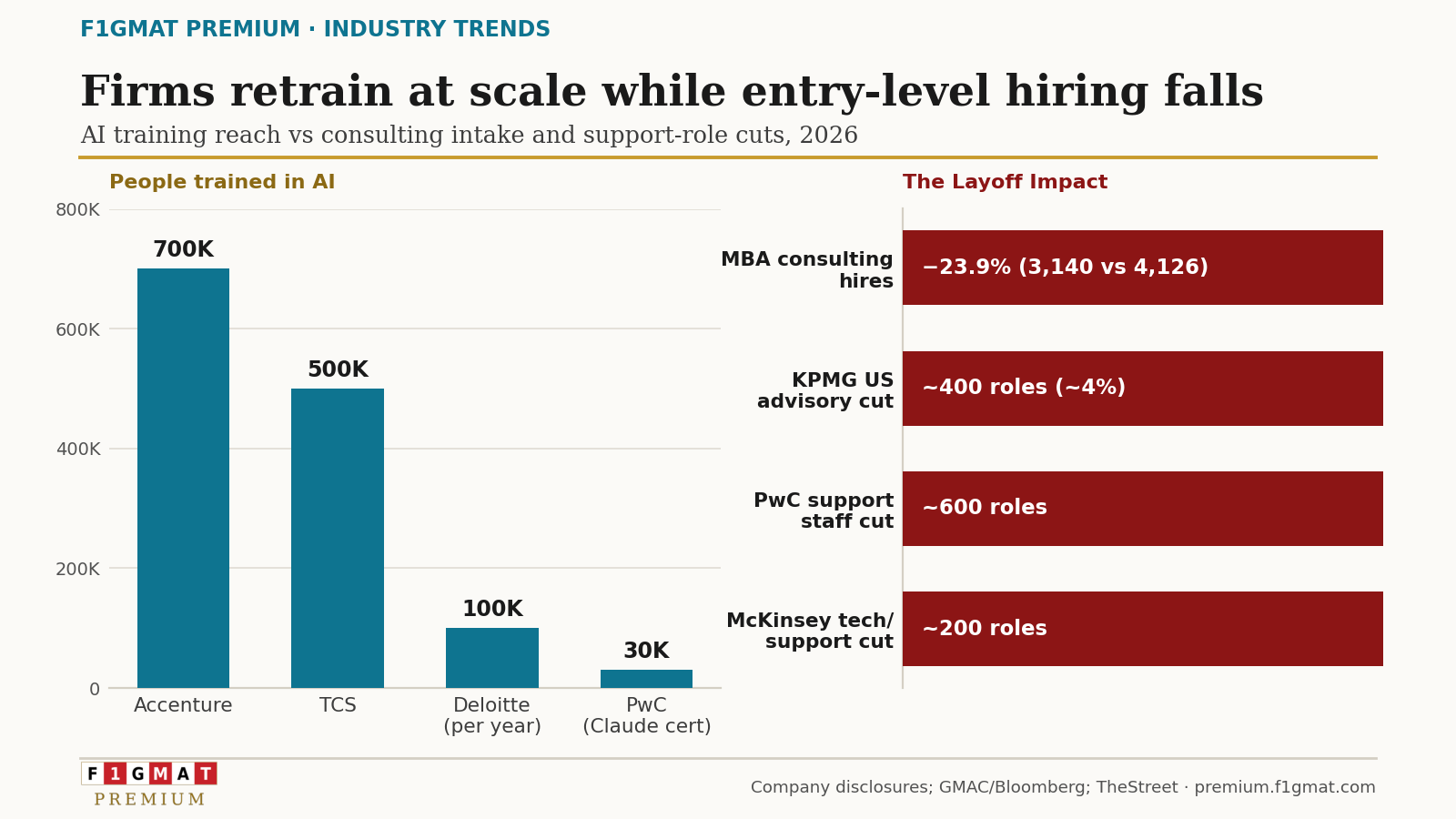
• PwC expanded its Anthropic alliance on May 14, 2026 with a joint Center of Excellence and a program to certify 30,000 professionals on Claude
• BCG X fields more than 3,000 technologists embedded alongside consultants, so the gap against the labs is the commercial model
• Deloitte's job title replacement took effect June 1, 2026 and impacted 181,500 US employees
• Anthropic filed a confidential S-1 on June 1, 2026 at a $965B post-money valuation on a $47B run-rate; OpenAI filed on June 8, 2026 at a $852B last private valuation targeting up to $1T
• Accenture opened 2026 near $259 per share and traded near $125 by late June, a decline above 50% and roughly $80B of equity value, against $5.5B of total capital committed to both lab ventures
• Open Weight vs. Proprietary AI: Twenty-five technology companies including NVIDIA, Microsoft, Meta, IBM, and ServiceNow published an open-weights letter on July 24, 2026. OpenAI and Anthropic did not sign, splitting the vendor landscape the consulting firms committed to in Q2
• Moonshot AI changed the economics of AI with roughly 80% lower token cost when it released Kimi K3 on July 16, 2026 at 2.8 trillion parameters
• Bain & Company, BCG, and McKinsey joined the OpenAI Partner Network launch cohort on June 14, 2026, accepting tiered certification with co-selling incentives from a model vendor they also advise clients to select
• A June 2 Section 301 determination covering 60 trading partners is the latest Trump tariff tool, since it carries no rate cap and no sunset. The Supreme Court voided IEEPA on February 20, 2026 and the 10% Section 122 surcharge that replaced IEEPA expired on July
• Anthropic announced an AI services firm backed by approximately $1.5B on May 4, 2026 with Blackstone, Hellman & Friedman, and Goldman Sachs 8, launched under the name Ode with Anthropic on July 15, 2026
• OpenAI launched DeployCo on May 11, 2026 at a $14B post-money valuation. McKinsey, Bain & Company, and Capgemini invested in the entity that competes with them
• The OpenAI Partner Network opened June 14, 2026 with $150M and a target of 300,000 certified consultants by year end 15. Anthropic's Claude Partner Network launched March 12, 2026 with a stated $100M commitment
Contents
- Overview
- Trend #1: Frontier Labs Builds Consulting Firms
- Trend #2: Outcome-Based Pricing Finds Momentum
- Trend #3: The Agentic AI Adoption Plateau
- Trend #4: Layoffs, Retraining, and Which Consulting Jobs Are Actually at Risk
- Trend #5: Regulation Chaos and Trump Tariff Drives new Consulting Opportunities
- Related F1GMAT Premium Reads
- References
Overview
In Q2 2026, Anthropic submitted a confidential S-1 on June 1 at a $965 billion valuation, and OpenAI followed on June 8, targeting up to $1 trillion. The valuations price the labs as software companies at 20 to 34 times revenue, against roughly 1.2 times the revenue of a consulting company - opening up the question of whether the labs actually want the consulting revenue their new services arms could capture.
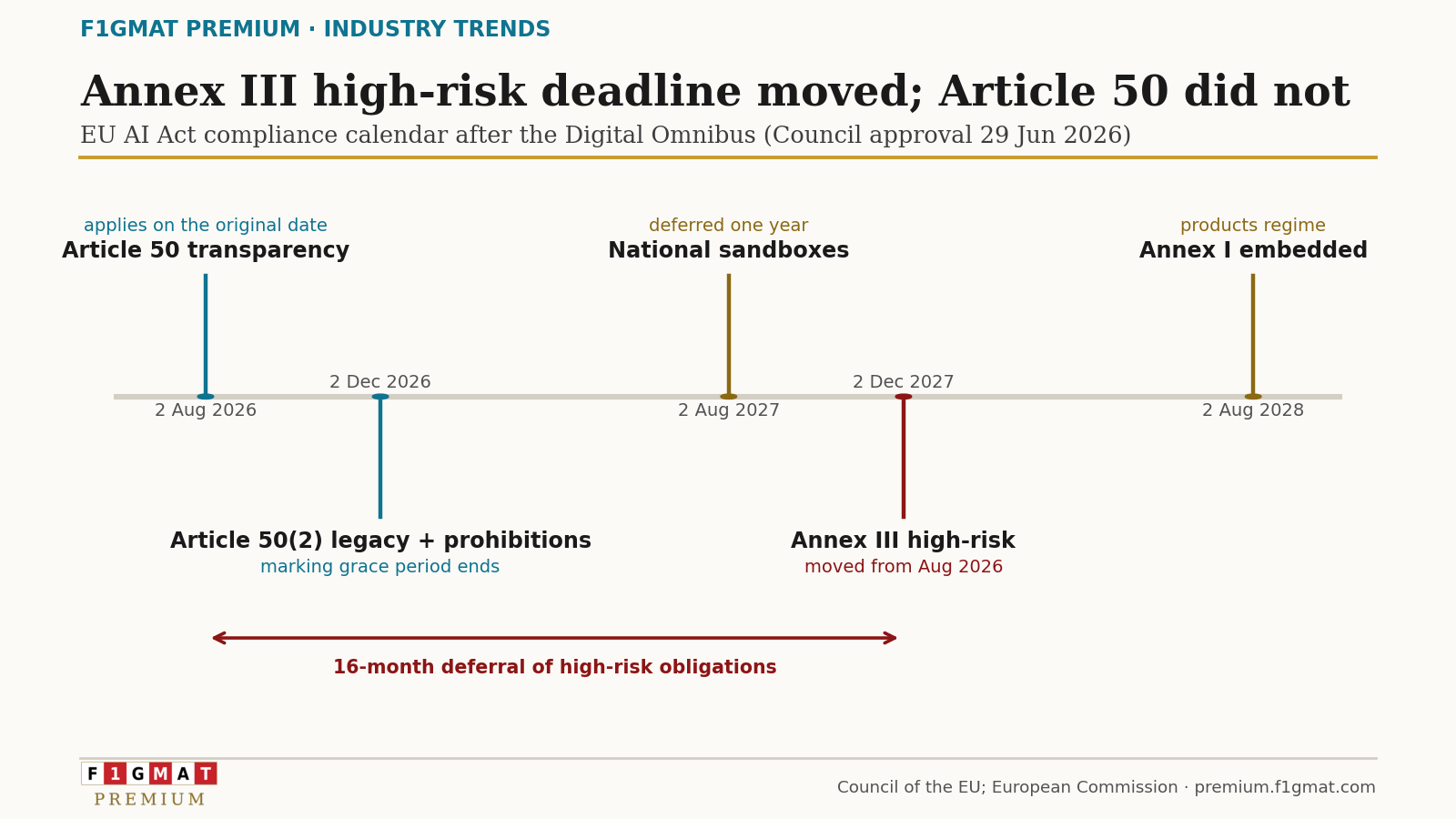
The second key development was the postponement of the EU AI Act deadline that anchored every governance roadmap, moved to 2027. The Council of the EU gave final approval to the Digital Omnibus on June 29, 2026. However, they deferred the stand-alone Annex III high-risk obligations to December 2, 2027 and AI embedded in Annex I regulated products to August 2, 2028. Consulting firms that scoped compliance engagements around a single August 2 deadline now have to compete for a deliverable with a 16-month deferral.
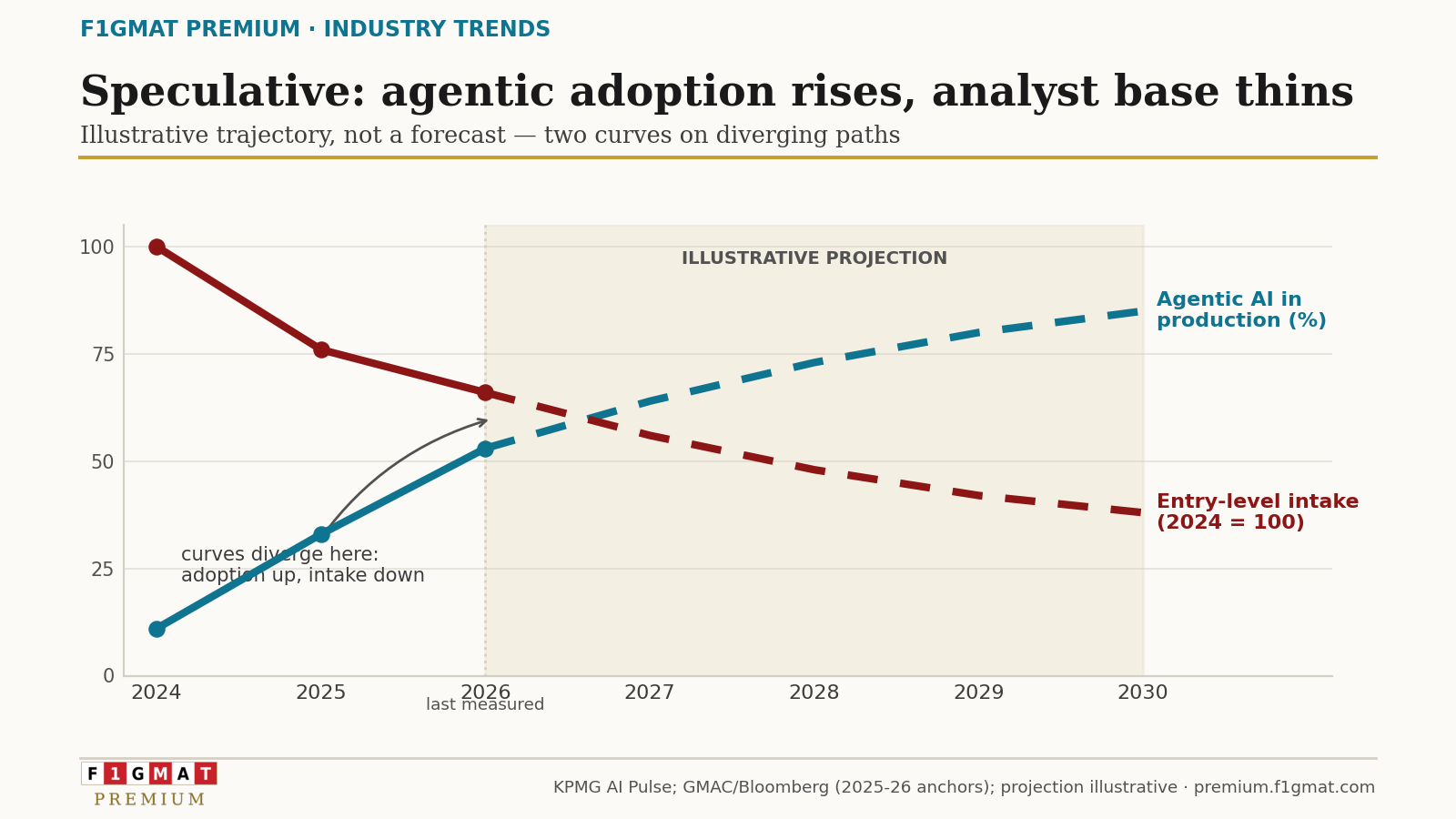
AI has started disrupting consulting jobs in Q2 2026. KPMG cut roughly 400 US advisory jobs in early May, roughly 4% of its advisory business, concentrated in regulatory risk, customer operations, and financial services, while it kept growing in AI, strategy, and transactions.
Trend #1: Frontier Labs Builds Consulting Firms
What Happened at Anthropic and OpenAI
Anthropic announced an AI-native enterprise services company with Blackstone, Hellman & Friedman, and Goldman Sachs on May 4, 2026, backed by approximately $1.5 billion, with Apollo, General Atlantic, GIC, Leonard Green, and Sequoia in the wider consortium [89].
Anthropic, Blackstone, and Hellman & Friedman each committed approximately $300 million, and Goldman Sachs approximately $150 million [10].
The venture launched as Ode with Anthropic on July 15, 2026, built on Fractional AI, acquired that May, with co-founders Chris Taylor and Eddie Siegel as CEO and CTO [9].
Seven days later, OpenAI launched the OpenAI Deployment Company with $4 billion committed at a $14 billion post-money valuation, majority owned and controlled by OpenAI [11][13].
TPG led, with Advent International, Bain Capital, and Brookfield as co-lead founding partners [11].
The private equity backers hold a guaranteed 17.5% annualized return over five years [13], while Bain & Company, Capgemini, and McKinsey & Company are among the investors [11][12].
OpenAI seeded it by acquiring Tomoro and its approximately 150 forward-deployed engineers [13].
Goldman Sachs is the only backer of both ventures [11].
Why the Ventures are positioned Outside the Labs
Anthropic filed a confidential S-1 on June 1, 2026, four days after a $65 billion Series H at a $965 billion post-money valuation, against a run-rate near $47 billion [71][72]. OpenAI filed on June 8 at a $852 billion last private valuation, targeting up to $1 trillion, on roughly $2 billion of monthly revenue [74][75][76].
That puts frontier model revenue at roughly 20 to 34 times. When you compare such valuation with a consulting stalwart like Accenture, which trades near $83 billion on a revenue base around $70 billion, roughly 1.2 times, at a P/E of 10.75 [77][78][1] and Thoughtworks sale at approximately 1.7 times revenue [61][62], you soon realize that the overvalued labs are not trying to capture consulting revenue.
The entire premise of the AI labs' valuation is based on token consumption. The longer the delay in integrating the AI models across the enterprise workflow, the slower will be the realization of the revenue. Even if the model capability improves dramatically, the bottleneck is still implementation. [15].
Forward Deployed Engineer - The Influencer in the AI Deployment Cycle
The bridge to fix the slow implementation cycle is a Forward Deployed Engineer (FDE). The engineering role's primary responsibility is reviewing potential AI applications inside the client environment, identifying the use cases with the largest return, and building capabilities within the client environment [12].
For them, the first thirty days are crucial as the engagement determines the workflow mapping and data integration.
The workflow mapping determines the power structure in the consulting engagement.
Whoever maps the workflow defines the scope of everything downstream, and whoever runs the system in production observes what it returns.
An embedded engineer, sometimes the Forward Deployed Engineers if the engineer is a client hire, sees both the consultant's advice and the actual result, making them the biggest influencer in the AI deployment cycle.
Do These Roles Exist Inside MBB and the Big Four?
BCG X operates with more than 3,000 technologists, designers, and data scientists embedded alongside BCG consultants, delivering AI strategy, rapid prototyping, product development, and data platform builds [85].
QuantumBlack, acquired by McKinsey in 2015, staffs deeper on modeling and engineering, and McKinsey assembles consultant and AI engineer hybrid teams [86].
Bain Vector is Bain's digital delivery arm, supported by an OpenAI services alliance first announced in February 2023 and expanded in October 2024 with a dedicated OpenAI Center of Excellence, making Bain the only MBB-tier firm to name OpenAI as a formal services alliance partner [87].
The engineers are already working with the consulting team.
The difference is the commercial model.
BCG X is strong at moving AI from concept to prototype, but moving from prototype to full production still relies heavily on client engineering teams [85]. That handoff is where the FDE model was designed to validate.
For the prototype to production, three structural differences influence outcome:
1) Staffing unit: A consulting engineer is staffed to a project with a fixed contract.
2) Revenue basis: A consulting engineer bills hours against an agreed scope. The time in production is a cost to the firm, but the AI model companies are subsidizing the token costs to encourage a longer deployment of FDE to permanently set a recurring revenue from each enterprise workflow with token consumption.
3) Completion definition: Consulting engagements complete at handover, when the prototype-to-production gap is fixed.
How Strategy Roles Changed with AI and FDE
The strategy specialist in consulting MBB, Kearney and Strategy& have responded by moving up, positioning their alliances on strategy and operating-model design over delivery volume [88].
The Strategy work is now positioned before the pre-deployment layer, before the FDE is integrated into the team.
Unlike traditional strategy consulting deliverables, where the work ended with a diagnostic, KPI, and an inventory of cost vs. return, strategy consulting now requires five deliverables: a value case tied to a P&L owner, workflow breakdown at task level instead of process level, a data readiness assessment, an operating model answering who supervises the agent and who is accountable when it makes an error, and the cost of running the model (month on month).
Pre-Workflow vs. Post-Workflow Consulting
A firm that is signed up after a lab has mapped the workflow is selling change management around another consulting firm's proposed architecture whereas a firm that owns the pre-deployment diagnostic sets the entire scope the deployment has to fit.
Earlier entry-level consultants used to do this job, which determined the scope of the deployment.
With entry-level roles slowly made redundant, with roughly 150 former consultants from McKinsey, Bain, and BCG were contracted to train AI models to perform entry-level consulting tasks [89], the risk it creates to the entire consulting engagement is substantial.
In addition to the concerns of having no option to gain experience as a an entry-level consultant, the bigger risk is the lack of specialists to diagnose any errors in models that could arise in the future, as the pathway from due diligence to scoping is entirely taken over by AI.
How the Big Four Firms Are Positioning
By late May 2026, every Big Four firm held a frontier lab partnership [88].
We observed three distinct strategies from the firms:
Platform embedding: KPMG and Anthropic signed a global alliance on May 19, 2026, launching KPMG Digital Gateway Powered by Claude, with Claude Cowork and the Managed Agents API integrated into the Azure-hosted platform that already holds KPMG's tax content, proprietary tools, and client data [82][84].
All 276,000-plus KPMG employees gain Claude access, Anthropic named KPMG a preferred partner for private equity, and the two are co-developing products for portfolio companies [82].
A further offering, KPMG Blaze, embeds Claude Code into IT modernization [83].
KPMG is fully embracing Claude when its tax leadership cited a regulatory-compliance agent that previously took weeks being built in minutes inside the integrated platform 83 while the full Azure implementation of this Agent is planned for September 2026 [84].
Five days earlier, on May 14, PwC expanded its Anthropic alliance with Claude Code and Cowork rollouts, a joint Center of Excellence, and a program to train and certify 30,000 professionals on Claude.
Equity hedging: Bain & Company, McKinsey, and Capgemini took positions in the OpenAI Deployment Company [11], which converts a competitive threat into a shareholder to plan for a scenario where their consulting businesses might be displaced by OpenAI's Deployco.
Why fight them when you can join them?
Two-lab optionality: BCG hedged the risk by maintaining alliances with both Anthropic and OpenAI, with Accenture and Capgemini following a similar strategy where they appear in both ecosystems [88].
API vs. Platform Embedding - Model Labs’ MOAT
Platform embedding is what the AI model companies are prioritizing.
A decentralized architecture where a person can easily disconnect from the AI model by switching the API to cheaper alternatives is a risk.
Instead, AI companies are prioritizing architectures where the model become integral to the platform, with the model holding the client's data. The firm's proprietary content and the workflow don't work effectively without rebuilding the environment. These rebuilding costs are expensive and time-consuming.
KPMG, with its partnership instead of buying access to Claude, made Claude a component of its audit trail and satisfied any governance and data-residency questions that would arise from regulators. The value-add encourages clients to support such architecture, as they don't have to design separate components and assign budget to accommodate third-party vendor maintenance & audit costs.
Equity hedging is the weakest but the most popular strategy adopted by large consulting companies. A minority position in a competitor does not change what that competitor will do, but with access to the board, they can pivot early and create complementing services.
EY is the outlier; as of late May 2026 the only Big Four firm without a frontier-lab alliance. They are continuing with their Microsoft and Azure relationship.
Risk to Systems Integrator - Threat to Cognizant, Infosys, and TCS
In addition to the increased negative sentiment against Indian systems integrators from H1B visa affecting native US technology jobs, the AI integrators, including Cognizant, Infosys, and TCS, are in the line of fire where AI's scaling is likely to disrupt their services.
The worst they don't have the influence to direct the scope of the AI implementation timeline or direction.
The Big Four have some shield because of the penalty attached to audit and assurance errors, and because a signature of an accountant or an auditor carries legal liability, but they are equally exposed in every other specialization services.
Consulting has no equivalent statutory requirement and hence the risk to MBB is wider.
When the Lab's advantages Stop
Even though the Q2 2026 trends might give the idea that the labs are marching ahead with no resistance, the pilot to production gap highlighted in Q1 2026 trends analysis is a residue of a larger problem.
We identified five bottlenecks
1) The PE Headache
When the labs came to the market with primitive models with intelligence matching 4th graders, their own investors – mostly PE firms pushed the service to their portfolio companies. That produced deep insightful data on one type of company – PE owned and mid-market companies. Other companies fearing their proprietary data leaking to competitors, refused to entertain any lab-based models from embedding into their system. This has set a limit on where labs can expand.
2) Technical Optimization vs. Business Decision
The technical data can reveal latency, cost per task, and error rates, but investments are not made based on operational metrics alone. External factors like consumer sentiment, market dynamics and policy dictate where money is moving.
Gross margin and market share show up in financial statements over several years, long after a deployment engagement has ended. Even though labs are good at measuring operational performance, business outcome depends on other factors – a reason why strategy consulting companies are still hopeful that they can come back after the implementation hype dies down and a true upper limit of enterprise-level AI integration is reached.
3) Model Improvement is a Business Headache
Although AGI and model improvement is a boon for B2C customers, for an enterprise, such quarterly changes in model capability delays integration of models into the workflow, perpetuating a wait and watch strategy that can quickly dissipate the model company’s upper hand in the consulting engagements. One stabilizing factor is Agents as the primary model deployment enabler instead of relying on human consultants to scale the integration.
The Multi-agent orchestration alone doubled from 9% to 18% of deployments in a single quarter, suggesting that there is an entropy that is reaching within the tug of war between humans-in-the-loop for model scaling in enterprises and agentic AI enabling a faster AI integration [26].
4) Client Data – The Reason for Resistance
Unlike consulting engagements where the key consultants are identified and tracked for any data privacy violation, once the agents are allowed to access client data, there are no accountable single person to assign responsibility for any client contract violation around data, process or methodology.
An internal AI office [17] which tracks retention schedule and formal data-processing activity is the temporary solution, but as new regulation around AI audit is finalized in a year or two, consulting companies and enterprises with citizen’s data will face greater scrutiny and penalty for data violation. This risk prevents enterprise from wholeheartedly adopting Agentic AI across the workflow as they pose a systemic risk to their entire business.
The Pilot Results
Although Pilot results of massive AI integration should be evaluated with skepticism, the productivity gain is evident if the integration is thoughtful and employed based on the business’ strengths.
Paychex, a leading cloud-based human capital management (HCM) platform providing payroll, tax filing, HR outsourcing (PEO), and employee benefits for small-to-medium businesses worked with Bain through the network, and reported an 80% reduction in wait time on critical payroll workflows and a 30% cut in effort time for human-reviewed requests [15].
Agilent, an American company specializing in life sciences, diagnostics, and applied chemical market worked with BCG, and quoted the partnership as accelerating AI deployment across its business.
T-Mobile, the German owned US telecommunications company, partnered with Accenture, and evaluated real-time intent and sentiment intelligence through OpenAI's IntentCX work.
eBay is developing a next-generation customer service platform with the boutique AI specialist Artium [14].
Interestingly, two of the four engagements with measurable impact were delivered through boutique consulting firms.
Firm Platform and Alliance Position, Q2 2026
| Firm | Primary AI alliance | Certification position (Q2 2026) | Internal platform |
|---|---|---|---|
| McKinsey | Microsoft, OpenAI via QuantumBlack | Frontier Alliances partner; OpenAI Partner Network launch cohort; DeployCo investor | Lilli, approximately 25,000 AI agents alongside 40,000 humans |
| BCG | Anthropic, OpenAI via BCG X | Frontier Alliances partner; OpenAI Partner Network launch cohort | GENE, Deckster |
| Bain | OpenAI | OpenAI Partner Network launch cohort; DeployCo investor ; OpenAI relationship past three years | Sage, 19,000+ custom GPTs |
| Deloitte | NVIDIA | Zora AI rollout; $3B GenAI commitment through FY30 | Sidekick, Zora AI |
| PwC | OpenAI | OpenAI Partner Network launch cohort; OpenAI's largest enterprise customer | ChatPwC, Agent OS |
| EY | NVIDIA, Dell | Sovereign and on-premise positioning | EYQ, EY.ai |
| KPMG | Microsoft, Uniphore | First large consulting firm with ISO/IEC 42001 | Workbench |
| Accenture | NVIDIA, Google Cloud, Microsoft | Frontier Alliances partner; OpenAI Partner Network launch cohort | AI Refinery; Accenture Edge |
| Capgemini | OpenAI | Frontier Alliances founding member ; DeployCo investor | Sector integration tilt |
| IBM | Model-agnostic; Google Cloud practice | New Google Cloud Practice inside IBM Consulting | watsonx Orchestrate; IBM Autonomous Security |
MBB replacing systems-integrator
Indian companies took a large chunk of the technology implementation project from the low-cost of the talent and the currency hedge INR to USD offers, but with Bain & Company, BCG, and McKinsey joining a tiered certification program run by a model vendor on June 14, 2026 [14], they are entering a talent model the Indian IT giants had mastered over the past four decades.
Earlier, Strategy consulting firms had no conflicts on the ‘implementation strategy’ as the Systems Integrator took on the scope of the project with their own dedicated tools, processes and technology, but with the MBB and boutique consulting firm’s partnership with the frontier model, they are incentivized to sell the partner’s model.
When OpenAI or Anthropic runs a partner program, they rank the firms as Advanced, or Elite tier.
A firm earns a higher tier by certifying more of its people, selling more of the vendor's product, and hitting certain revenue thresholds.
Three Ethical Concerns:
1) Certification program: Higher tier brings rewards, co-selling, early access to reference architectures, leads, and a badge client can trust. This system creates direct conflict with assessing the commercial viability of a Lab model as saying no to an integration can directly affect the consulting company’s revenue. This would not have been a challenge when the markets were considering AI as just another tool. As intelligence grew and pilots showed credible productivity gain and value addition, enterprises will have no option but to push for end-to-end AI integration. With both demand and supply side influencing the choice of the model, consulting companies will have to deal with several ethical consideration and disincentivize the certification programs from influencing the model choice.
2) Technology Risk Assessment: An even more challenging circumstance that would arise in the next year or two would be around the risk Agentic AI poses. This depends on how far deep into the integration the clients have pivoted with Agentic AI. If the model running the agent, the workflow and the overall ethical parameters the models are based on creates systemic risk, the entire business is at risk of implosion. With alternative open source model too disruptive for the board to approve, and consultants’ connection with the Labs in direct conflict, certain advisory on risks can turn a blind eye and propagate the risk of inaction too far into the corners of the ecosystem the clients are serving. This risk is even more catastrophic if the markets the clients serve are B2C.
3) Vendor Selection: In addition to the advice of a direct model for the enterprise workflow, even vendor selection would also be influenced by the model they are working with as frontier model vs. open source gaps need specialist skills to overcome. With no standardized process to evaluate the gap, the choice of an open-source model will be dependent on the risk tolerance of intelligence stagnation, and the cost per million tokens KPI.
The Open-Weight Counterweight
Moonshot AI released Kimi K2.6 on April 20, 2026, a one-trillion-parameter open-weight model that ties GPT-5.5 on SWE-Bench Pro at 58.6% and costs roughly 80% less per million tokens at $0.95 input and $4.00 output [95]. It followed with Kimi K3 on July 16, at 2.8 trillion parameters the largest open-source model released to date, benchmarking close to the strongest proprietary systems from OpenAI and Anthropic [96].
While China’s AI is driven by ingenuity with lower tier NVIDIA chips, NVIDIA itself is not betting their entire chips on OpenAI and Anthropic as they plan to be the Intel of the AI era. This was evident when NVIDIA used CES 2026 to expand its open model families, Nemotron for agentic AI, Gr00t for robotics, and Cosmos for physical AI, with Jensen Huang stating that 80% of startups build on open models [97].
At ServiceNow Knowledge 2026 in May, Huang and Bill McDermott put NVIDIA's OpenShell, an Apache 2.0 secure runtime for autonomous agents, at the centre of ServiceNow's Project Arc, a long-running autonomous desktop agent governed through Action Fabric and AI Control Tower [98][99].
The American Laggards’ Strategic Pivot to Open Source
On July 24, 2026, twenty-five American technology companies published Open Weights and American AI Leadership, hosted on Microsoft's corporate responsibility site, arguing that US leadership depends on an open model ecosystem instead of a single guarded system [100].
Signatories include NVIDIA, Microsoft, Meta, IBM, Dell, ServiceNow, Palantir, CrowdStrike, Box, Mistral, Hugging Face, Mozilla, the Linux Foundation, Andreessen Horowitz, Y Combinator, Perplexity, and Replit [101].
While this might seem like a united effort to save humanity from a duopoly, each large signatories had tried their shot at building proprietary AI and failed to scale. But the collective effort is a sign that the position for 3rd leading AI lab outside OpenAI and Anthropic is open.
As expected, OpenAI and Anthropic did not sign the petition.
NVIDIA has an eye on both the open source and proprietary markets as they sell compute. Microsoft holds a position in OpenAI and signed anyway, as a hedge. ServiceNow wants agents executing on its workflow and governance layer instead of inside a lab's environment where the lab has access to proprietary data and an advantage in training their models.
Clearly, consulting firms that will win in the next 10 years of integration should understand the layer they are defending.
Competitor Dynamics: Why the Certification Bet is Wrong
The certification programs doesn’t create any MOAT for the labs.
Moonshot alone shipped five releases in twelve months: K2 in July 2025, K2 Thinking in November 2025, K2.5 in January 2026, K2.6 in April 2026, and K3 in July 2026.
With such a breakneck pace with new models releasing every quarter, one must wonder how OpenAI’s target of 300,000 certified consultants by the end of 2026 [15], PwC’s commitment to certifying 30,000 of its own professionals [84], and Deloitte’s more than 25,000 through structured industry learning programs [92] it itself will be an advantage, unless the certification has model-agnostic curriculum.
Implication for Consultants
3 Layers of Certification – Model-Agnostic Valued the Most
Certification program are divided into three layers with different rates of relevance as model progresses.
- Model-specific surface knowledge, including prompt patterns, parameter behaviour, tool-calling syntax, and the quirks of a particular release, is the fastest to depreciate – typically in 6 months.
- Platform-specific architecture, including specializations such as Codex or agent orchestration inside one vendor's SDK 15, has staying power of twelve to twenty-four months.
- Model-agnostic capability, including workflow decomposition, evaluation design, failure mode analysis, human oversight design, and cost attribution, barely become irrelevant at all.
3 skills to prioritize:
1) Evaluation design is the highest ROI skill: An eval suite is the artefact that tells you whether a system still works after the model underneath changes. When a client swaps a hosted frontier model for an open-weight one at roughly 80% lower token cost 95, the eval suite is what validates the decision.
2) Routing Skills: Migrating a model or evaluating the negative impact of a stale model is a full-time change management project. Clients will increasingly seek expertise in routing function where the solution routes to the open-source, proprietary or older proprietary models with fewer token consumption based on the tasks at hand.
3) AI Cost Planning: The fundamentals of costing has now moved from technology, talent and partnerships to AI. With planned spend near $202 million per organization and real-time cost visibility at 26% 26, token, retrieval, and tool-call accounting mapped to a P&L owner is skill consultants must master to persuade any leadership team.
For the Aspiring Consulting Applicant
Certification in AI helps but most of the strategy that you build should be durable for the next 3-10 years.
1) Implement a multi-agent project
The best way to show employers your skills in learning all the relevant concepts in AI deployment is by using a multi-agent project and showing the cost per completed task – before and after the agents were deployed. The skill aligns with the quarter trend that showed multi-agent orchestration doubling from 9% to 18% [26].
2) Learn evaluation design specifically: Building a golden dataset, writing a regression suite, and defining what acceptable output means for a business process are model-agnostic skills. They also transfer directly into AI governance work, where the EU regime now runs to December 2027 and August 2028 [18].
3) Choose a process domain early and go deep: Pre-MBA experience in supply chain, claims, underwriting, or revenue operations becomes more valuable as the technical layer commoditizes. The generalist archetype is being supplemented at the entry level [35], and domain depth is what separates you from a certified peer. Gain internship work experience on the operations side of your post-MBA industry where you plan to use your AI deployment consulting skills.
4) The FDE-equivalent roles inside consulting are real and recruit on the MBA calendar: Prioritize BCG X, QuantumBlack, and Bain Vector over Ode and DeployCo as the former hire the consultant-plus-engineer profile or the strong quant profile where Consulting is heading.
5) Gain Open weight Exposure: If you want sovereign, on-premise, or regulated-industry experience – especially in Finance and Manufacturing, prioritize EY's on-premise internship opportunities and KPMG's ISO/IEC 42001 certification
Trend #2: Outcome-Based Pricing Finds Momentum
Q1 2026 recorded outcome-based pricing as a federal-procurement event, forced through the GSA concessions package where three of the ten firms offered performance-based fees to retain contracts [54]. The Q2 question is whether outcome-based pricing will spread beyond the government mandate.
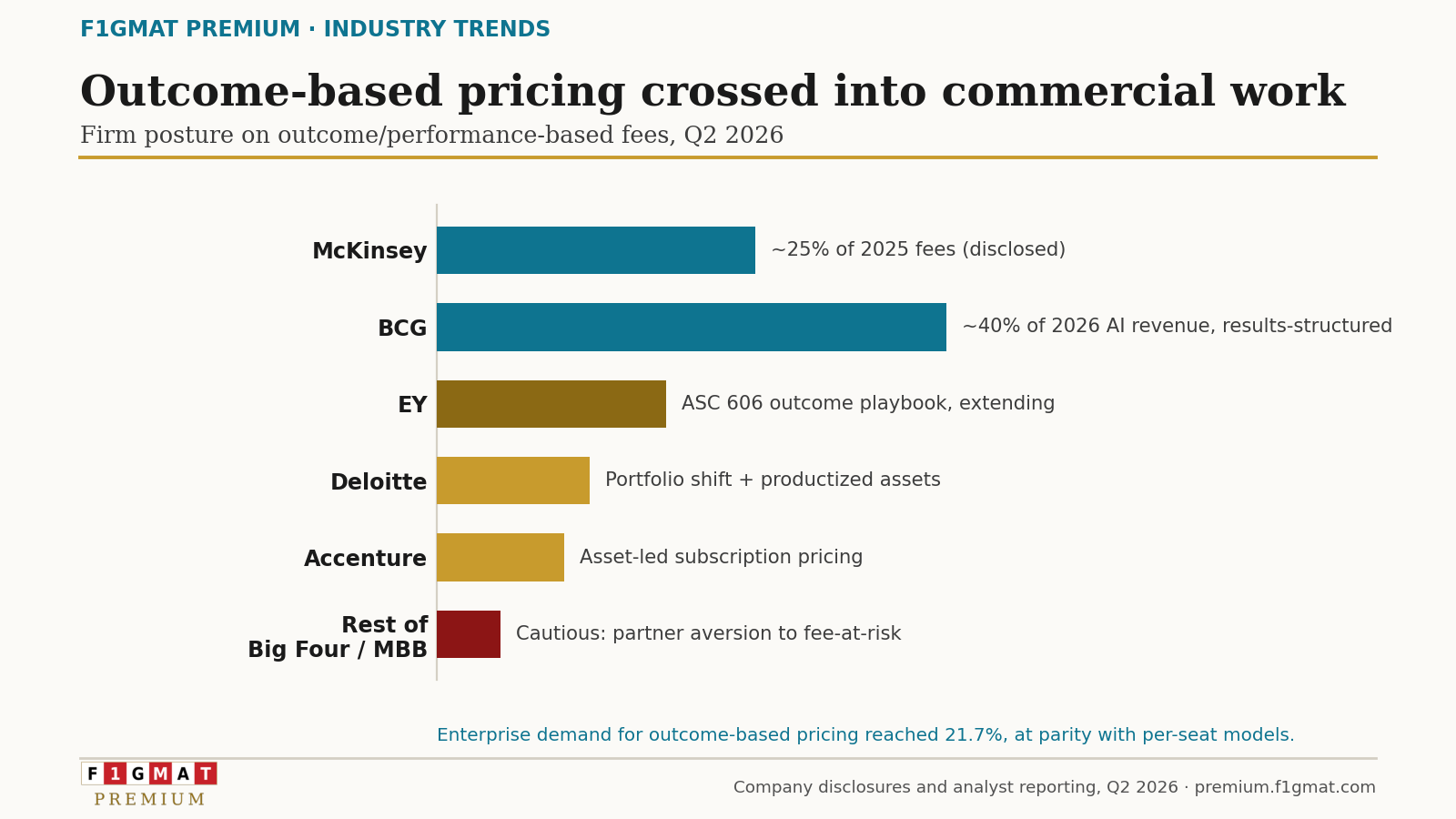
McKinsey is the clear leader and the only firm to disclose the numbers.
Roughly 25% of its global client fees in 2025 came from outcome-based contracts [103][104], which the firm attributes directly to AI forcing the consulting giant to reduce their hourly billing [105].
Top Consulting Companies – Outcome Based Pricing (% of Total Revenue) (2026)
| Firm | Q2 2026 outcome-pricing posture | Evidence |
|---|---|---|
| McKinsey | Committed. ~25% of 2025 global fees outcome-based, the highest disclosed share, paired with a partner-pay shift toward equity to absorb the revenue volatility 10310554 | Disclosed figure |
| EY | Experimenting, and first to formalize. Published a SaaS-style outcome-pricing playbook under ASC 606 in February 2026, billing only for AI interactions delivered without human intervention, now extending it to AI-enabled engagements 54105 | Published playbook |
| BCG | Structurally committed by default. AI work is guided to roughly 40% of 2026 revenue and is described as almost entirely structured around measurable results rather than hours 104 | Analyst-cited |
| Deloitte | Partial. Has shifted portions of the advisory portfolio toward performance-based fees and is productizing assets (Converge platforms) that lend themselves to subscription and outcome models 104106 | Portfolio shift |
| Accenture | Partial and asset-led. Productizing AI assets that support subscription-style pricing, consistent with managed-services revenue outpacing consulting 1061 | Asset productization |
| Big Four and MBB (rest) | Cautious. Outside McKinsey and a few others, most large firms are dipping into outcome pricing, held back by partner aversion to fee-at-risk and immature outcome-measurement skills 106 | Observed reluctance |
Futurum's 1H 2026 survey of 830 enterprise IT decision-makers found enterprise preference for outcome-based pricing climbed to 21.7%, reaching parity with per-user per-month models for the first time [105], and direct financial impact nearly doubled to 21.7% of primary ROI responses while productivity gains fell 5.8 points as the leading success metric.
Buyers stopped asking whether AI works and started asking what it returned.
Outcome pricing requires the buyer and the seller to agree on what a result is worth and what it costs to deliver, and only 26% of organizations hold real-time visibility into AI operating cost.
McKinsey's equity-weighted partner pay is the visible hedge against exactly that volatility [105].
For consultants in partner role, the traditional variable profit share with a fixed base salary has now an even more aligned incentive – equity share. "Equity-weighted" compensation for partner roles deprioritize guaranteed cash bonuses. For salaried consultants below partner role (analysts, consultants), the base salary continues to be the biggest draw but the bonus will see wide variations when outcome-based pricing becomes the norm.
| Firm (reporting period) | Revenue | Bookings | Segment detail | Strategic action in quarter | Headcount |
|---|---|---|---|---|---|
| Accenture (Q3 FY26, ended May 31, 2026) | $18.7B, +6% USD, +3% LC | $19.3B, -2% USD, -3% LC; book-to-bill 1.0 | Consulting bookings $10.26B; Managed Services bookings $9.06B | Dragos, runZero, NetRise at ~$4.175B EV; Accenture Edge launch June 23; FY26 acquisition target raised from $5B to $9B | ~799,000 |
| IBM (Q2 2026, ended June 30, 2026) | $17.2B, +1% | Consulting signings +6% | Consulting $5.33B flat, +1% CC; Software $7.76B, +5%; Infrastructure $3.84B, -7% | IBM Autonomous Security launch; Google Cloud Practice inside IBM Consulting; Bob coding tool adopted by 80,000+ employees | ~270,000 |
| Cognizant (Q1 2026, ended March 31, 2026) | $5.41B, +5.8% USD, +3.9% CC | TTM $29.6B, +11%, book-to-bill ~1.4x; quarterly bookings +21% | Seven large deals ≥$100M, one mega deal ≥$500M | Project Leap announced April 29, 2026, $230M-$320M program cost | 357,600 |
| Booz Allen Hamilton (Q4 FY26, ended March 31, 2026) | Q4 $2.8B, -6.4%; FY26 $11.2B vs $12.0B FY25 | Backlog expansion | Q4 EBITDA $305M vs $316M; net income $205M vs $193M | Move toward outcome-based contracts; ~40% of cost savings reinvested in physical AI, quantum, 6G | ~31,500 |
| Big Four (FY25 reference) | Deloitte $69.2B; PwC $55.4B; EY $51.2B; KPMG $40.4B | Not disclosed | Advisory mix rising through AI engagements | Deloitte title change live June 1, 2026; EA role reductions at PwC and EY | Deloitte 460,000; PwC 370,000; EY 400,000; KPMG 275,000 |
| MBB (2025 reference) | McKinsey ~$16B; BCG $14.4B; Bain ~$8B | Not disclosed | BCG AI work ~25% of 2025 revenue | McKinsey ~25,000 AI agents alongside 40,000 humans; Bain and McKinsey took DeployCo equity | McKinsey 40,000; BCG 33,000; Bain 19,000 |
LC = local currency. CC = constant currency. TTM = trailing twelve months. EV = enterprise value. Private firms disclose annual but not quarterly figures.
The Accenture Reversal
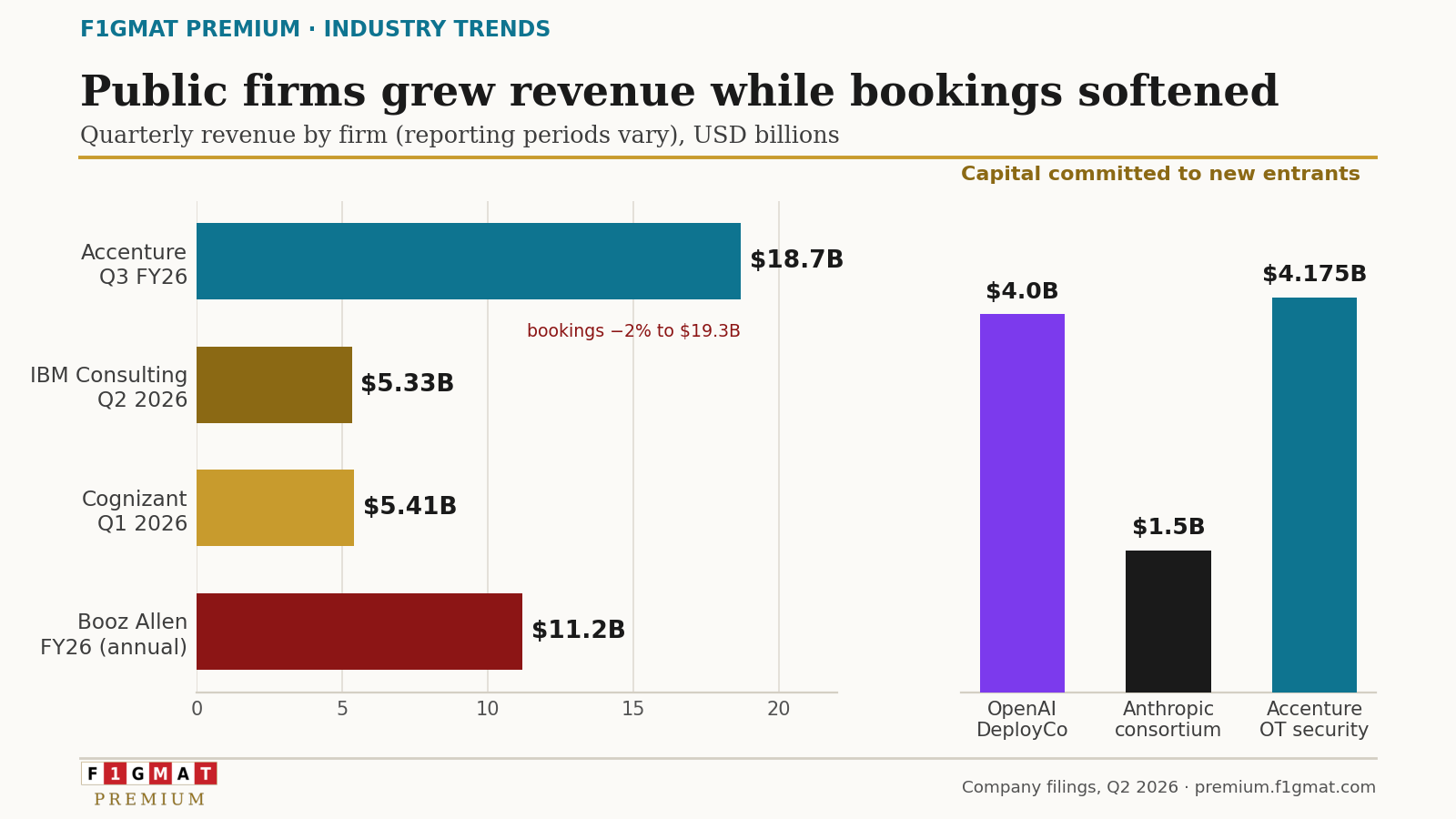
Accenture's Q2 FY26 quarter, reported March 19, 2026, set a record with $22.11 billion in new bookings, up 6% in US dollars and 1% in local currency [36][49]. Q3 FY26, reported June 18, 2026, delivered $19.3 billion against $19.7 billion in Q3 FY25, down 2% in US dollars and 3% in local currency, with a book-to-bill ratio of 1.0 [1][36].
Revenue was stable.
The quarter delivered $18.7 billion, an increase of $1.0 billion at 6% in US dollars and 3% in local currency, with operating margin expansion of 20 basis points to 17.0%, diluted EPS up 9% to $3.80, and free cash flow of $3.6 billion. Gross margin was 32.8% against 32.9% a year earlier.
The federal exposure is now quantified in guidance.
Accenture expects full-year fiscal 2026 revenue growth of 3% to 4% in local currency, or 4% to 5% excluding an estimated 1% impact from its US federal business.
The market response was severe. Accenture shares fell close to 50% from the start of 2026 through the June results, and the board authorized a new $2 billion share repurchase program.
Accenture returned $8.2 billion to shareholders year to date and raised its fiscal 2026 shareholder return commitment to at least $9.5 billion.
Accenture Enters Operational Technology & Cybersecurity Market
Accenture raised its full-year acquisition spending target to $9 billion from $5 billion.
The largest deployment of funds went to operational technology security.
Accenture an established leader in the OT (Operational Technology) cybersecurity services market, had the consultants who advise clients on securing industrial systems - physical infrastructure, the systems controlling power grids, pipelines, factory lines, water treatment, and distribution centers.
What it lacked was the software — the actual products (Dragos, runZero, NetRise) that do the detecting and monitoring. Buying the software under a services practice it already dominated means it can sell the product into relationships it already has established.
Once the gap in software stack is clear, it makes logical sense to see why Accenture entered agreements to acquire a majority stake in Dragos at a $3.2 billion valuation plus 100% of runZero and NetRise, at a combined enterprise value of approximately $4.175 billion, with closing expected September 2026 subject to regulatory approval [2][3]. Together the three businesses are estimated to generate approximately $208 million in annual recurring revenue as of June 2026, up 53% year over year.
With the acquisition, Accenture is moving into OT cybersecurity software, an estimated $27 billion opportunity in 2026 projected to reach nearly $59 billion by 2031 at approximately 16% CAGR 2. Accenture's cybersecurity business is a $10 billion business, grown from roughly $700 million in fiscal 2016.
Accenture also expanded the client base downward.
Accenture Edge launched June 23, 2026, targets mid-market companies with annual revenues between $300 million and $3 billion, a segment Accenture estimates at a $240 billion total addressable market growing at high single digits.
Julie Sweet described the design constraint as solutions that are faster to deploy, more repeatable, and right-sized for that scale, since mid-market companies face many of the same technology, data, AI, cybersecurity, and productivity challenges as large enterprises.
The mid-market push runs through partners with Accenture Edge and Google Cloud announcing they will bring scalable agentic AI solutions to mid-market companies, and Accenture Edge launches in priority markets with partner-focused solutions.
IBM's Flat Consulting Quarter
IBM announced second-quarter 2026 results on July 22, 2026, with revenue of $17.2 billion, up 1% 4. Consulting came in at $5.33 billion, flat on a reported basis and up 1% at constant currency, with consulting signings up 6%.
The mix inside IBM tells the sector story.
Software rose 5% to $7.76 billion, led by Hybrid Cloud with Red Hat up 11% and Data up 19%, while Infrastructure fell 7% to $3.84 billion with IBM Z down 42%.
IBM's Q2 consulting moves were channel plays.
The firm created a Google Cloud Practice within IBM Consulting, combining the IBM Consulting Advantage platform with Google Cloud's Gemini Enterprise AI platform, and launched IBM Autonomous Security, a multi-agent service with interoperable, vendor-agnostic digital workers operating across security operations.
IBM also introduced Bob, an AI coding tool running a mixture of generative models, with adoption from more than 80,000 employees.
What the Consulting Numbers Say in Q2 2026
Managed services and recurring revenue outperformed project consulting – a reason why revenue is growing but project bookings are not.
One reason is AI’s role in eroding the value of build-and-advise engagements. Since Agentic AI is yet to gain mass adoption like Generative AI, running a back-office operations or client security monitoring is much tougher to execute with AI than with human consultants.
The conclusive evidence is Accenture’s 6% revenue growth while its bookings declining by 2%.
In a cautious market, clients are more than willing to pay a firm to run and maintain a feature, and own the outcome.
The demand is shifting from "tell us what to do" toward "do it and keep doing it."
IBM's software grew 5% against flat consulting [4,] and Booz Allen named a deliberate move toward outcome-based contracts to avoid such flatlining of consulting service revenue.
The Equity Repricing
Accenture opened 2026 near $259 per share and traded near $125 by late June, a decline above 50%, leaving market capitalization near $83 billion at a P/E of 10.75 777879. The stock fell 16.8% in a single session on June 18.
Analysts cut targets hard, BMO to $150 from $230 and Citi to $135 from $195, and Indian IT stocks fell as much as 7% on the outlook, with the Nifty IT index down more than 5%.
Set that against the capital committed to both lab services ventures, approximately $1.5 billion for Ode and $4 billion for DeployCo, the equity value erased at one consulting firm in under six months is roughly fifteen times the total the labs have committed to competing with the industry.
The market through its pricing is showing an optimistic outlook on AI labs taking a large chunk of large consulting firm’s revenue, especially the ones projected by Systems Integrator.
History Repeats: Lessons from 2001 and 2009
The optimism of the market is not new. In an overvalued market, the companies that acquire the overpriced consulting firms tend to offload them in a down market.
For instance, Hewlett-Packard offered approximately $18 billion for PwC Consulting in September 2000.
IBM acquired the same business in July 2002 for approximately $3.5 billion, 0.7 times revenue on roughly $4.9 billion of revenue and 30,000 employees including 1,300 partners 5657 when the market crashed after the Dotcom bubble.
Another example was how Cap Gemini agreed to buy Ernst & Young's consulting business on February 29, 2000 in a transaction reported at $16.2 billion [58], and had to divest its North American consulting arm to Accenture by 2003 [70].
The same pattern continued with KPMG Consulting, which was listed in 2001, became BearingPoint, and filed Chapter 11 in February 2009 [59], with its European practice selling to its own management for $69 million [60].
All these consulting firms were overly optimistic about Y2K and ERP implementation but the revenue disappeared while the assets were priced on multiples of that revenue.
Every acquirer at the peak took the loss – a cautionary tale for Accenture and the likes.
Capital committed to consulting platforms at peak valuations is the risk for PE firms.
Private Equity Is Exposed to Consulting, Lab Joint Ventures and Labs
Sponsors are not above this risk exposure. Several of them are on three sides of the exposure – Consulting, Lab Joint Venture like Ode and DeployCo, and also as investors in frontier labs.
| Sponsor | Position in the lab ventures | Advisory asset already owned |
|---|---|---|
| Hellman & Friedman | Founding partner, Ode | Baker Tilly, approximately $1B with Valeas for just over 50% above a $2B valuation 6465 ; Moss Adams merger reported at $7B |
| Blackstone | Founding partner, Ode | Citrin Cooperman, from New Mountain above $2B, January 2025 |
| Bain Capital | Co-lead founding partner, DeployCo | Guidehouse, $5.3B, closed December 2023 |
| New Mountain Capital | Not in either venture | Grant Thornton, 60% of the non-audit business |
| TowerBrook | Not in either venture | EisnerAmper non-audit business, 2021 |
Since 2021 sponsors bought mid-market advisory platforms on a thesis of sticky clients and predictable cash flows priced against billable hours [65]. With AI, again backed up by the some of the same sponsors, created a scenario where their portfolio consulting firms can produce those same outcomes with fewer billable hours, PE firms started losing money.
They are in a catch-22 situation as US regulation requires that audit firms be owned and controlled by licensed CPAs. Because a private equity firm legally cannot own an audit practice, and an auditor beholden to a PE owner's return targets is an auditor with a reason to go easy on the numbers, the PE money is walled off from audit by law. To invest in consulting firms with an audit subsidiary, the sponsor has to leave audit in the CPA partnership and take ownership only in the advisory side.
Nearly every PE-into-accounting deal (Baker Tilly, Citrin Cooperman, EisnerAmper) uses this same two-entity structure for this reason.
With PE firms facing a "statutory moat" that protects a business from competition or disruption, a licensed CPA firm, which requires a human signature, can't be automated away with AI and can't be acquired by an unlicensed competitor.
Advisory has no such moat. Anyone can offer consulting. There's no license, no mandate, no signature requirement. It's higher-growth and more profitable, but it's exposed — to competition, to economic cycles, and recently to AI.
This is the reason why Grant Thornton's audit arm (Grant Thornton LLP) stayed a CPA partnership while advisory moved into the sponsor-backed parent, New Mountain Capital [68] . But sponsoring companies have set some protection against their investments. For instance, they are guaranteed a 17.5% return from DeployCo’s investments.
The risk is for OpenAI, which has pushed to go public early next year.
If Agentic AI driven integration keeps increasing as Q2 2026 suggests, the returns are feasible but otherwise, the exposure for Sponsors are three fold – risk on Service ventures like DeployCo, AI-driven portfolio companies underperforming, and advisory roll-up firms like Guidehouse or Baker Tilly not offering any value-add as specialist consulting & boutique companies.
Implication for Consultants
1) Book-to-bill is the number to watch on your own practice: Accenture's ratio reached 1.0 with bookings down 2%. When new bookings stop exceeding revenue, staffing decisions tighten within one to quarters.
2) Cybersecurity and operational technology are where the capital went: Accenture committed approximately $4.175 billion to OT security against a market size of $27 billion in 2026 with estimates showing a growth to nearly $59 billion by 2031 [2]. IBM launched Autonomous Security in the same quarter 4 showing specialization of AI agents in Industrial and manufacturing operations. Work experience in the two niches is set to grow.
3) Mid-market delivery is a different discipline: Although the infrastructure needs are similar for large and mid-market enterprises, the solutions’ scope is different, giving consultants unique opportunities to create faster and ready to deploy standardized solutions.
4) Federal-concentrated practices face another year of Downturn: Accenture put the drag at an estimated 1% of full-year revenue 1, and Booz Allen expects its growth trough in Q1 FY27. Move laterally to a commercial-sector practice before the layoffs are finalized
For the Aspiring Consulting Applicant
1) Read book-to-bill and bookings growth before you accept an offer: Accenture disclosed a 1.0 book-to-bill with bookings down 2%, Cognizant disclosed 1.4x with bookings up 21%, and IBM disclosed signings up 6%. Those numbers predict the consulting companies you must target post-MBA
2) Target the practices receiving capital: In Q2 2026 OT and cybersecurity at approximately $4.175 billion, along with managed services and operations, and mid-market delivery received most funds against a $240 billion Total Addressable Market (TAM)[3]. While selecting MBA programs, prioritize operations and supply chain depth in the curriculum.
3) Recognize the diversification signal: A firm that raises its acquisition budget from $5 billion to $9 billion [36] and launches a mid-market business is telling the market its historical growth engine has slowed. Don’t bet on investments alone. Study the underlying strategy of the consulting firm to recognize demand slowdown before applying.
Trend #3: The Agentic AI Adoption Plateau
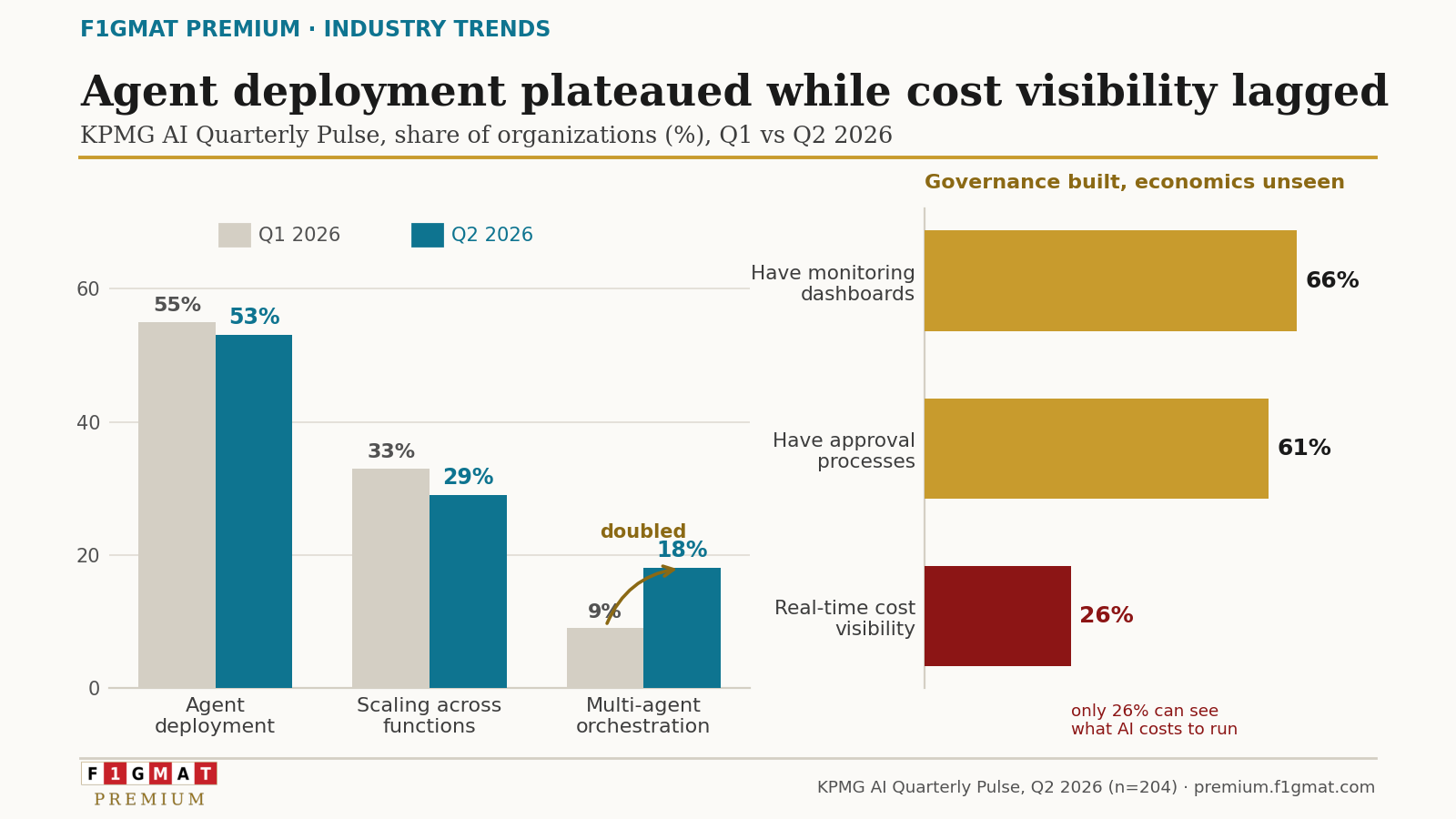
Agent deployment came in at 53%, against 55% in the prior quarter, for 204 US-based organizations with annual revenue of $1 billion or more (a third of them above $10 billion), after an incredible growth in agent deployment from 11% two years earlier to 55% in Q1 2026 [50].
While Organizations scaling AI agents across multiple functions fell from 33% in Q1 to 29% in Q2 27, Organizations orchestrating multiple AI agents across workflows doubled from 9% to 18%.
With the growth only in the orchestration layer, fewer organizations are ready to risk agents in multiple functions without connecting the agents they already run.
The Cost Visibility Gap
The slowdown is from the lack of cost visibility, as only 26% reported full real-time visibility into what their AI systems cost to operate despite 66% of the surveyed organizations reporting a monitoring dashboard.
This lack of predictability in cost is one reason why the planned investment held roughly flat at a weighted average of $202 million over the next 12 months, against $207 million in the prior quarter.
Per Seat Dashboard in a Multi-Agent Workflow
KPMG has characterized the Q2 phase as a shift from scaling adoption to managing execution with greater discipline, with the economics of running AI at scale as the emerging challenge [27].
Cost of deployment varies with prompt complexity, retrieval depth, and the number of tool calls an agent makes to complete a task, and a multi-agent workflow multiplies that cost by the number of agents in the chain. That cost is not predictable like the human per-seat license, which is how most enterprise finance functions track software spending.
The orchestration doubling from 9% to 18% makes the problem worse because each added coordination step adds inference cost that a seat-based dashboard, which most companies have deployed, cannot measure.
Where is the Consulting Demand
The engagement category that opened in Q2 2026 is cost management for inference and agent workloads, driven by the gap between 53% deployment and 26% cost visibility.
The most expertise was demanded in:
• Unit economics instrumentation: attributing token, retrieval, and tool-call cost to a business process and a P&L owner, which is the visibility 74% of organizations lack
• Model routing and tiering is the second valued skillset in Q2 2026
• Chargeback and allocating shared agent infrastructure to manage cost across business units is the 3rd valued skill [28]
• Agent portfolio rationalization - identifying deployed agents which give the best ROI is the 4th skill [27]
• Contract renegotiation where repricing based on inference commitments with actual token consumption data is the foundational skills for all Agentic AI deployment
The new consulting demand is categorized as a techno-accounting role between the technology practice and the CFO advisory practice.
Implication for Consultants
1) The pitch changed from deployment to unit economics: A client at 53% agent deployment with 26% cost visibility does not need another pilot. The consultant who can create a cost attribution model has a huge advantage this quarter.
2) Finance fluency is the differentiating skill in AI work now: KPMG's finding is that outcomes came from accountability, governance, and cost visibility.
Consultants can offer immediate value by building a chargeback model with cost accounting.
3) Failure Conversations: With scaling across multiple functions down from 33% to 29%, clients are already consolidating. Telling a client which deployed agents to shut down is the highest-trust act available in consulting
4) Talent Shortage in modeling Operations Metrics to Business Process Planning: Only 26% of organizations have real-time cost visibility. Currently, fewer talents exist to bridge the gap between KPI from an operational perspective to effectiveness from a business process perspective.
For the Aspiring Consulting Applicant
1) Take the cost accounting course: Cost allocation and pricing are the foundation with the most demand in Agentic AI
2) Build a small artifact that proves the skill: Create a personal multi-agent project, measure cost per completed task, and publish the before-and-after.
3) Expect the AI interview question to change: The interview questions will increasingly be around prioritizing the right AI agent and setting controls for cost management.
4) Prioritize MBA programs where the analytics core connects to the finance core: Q2 2026 Consulting conclusion is that accountability, governance, and cost visibility produced better outcomes than scale of the deployment. A data science elective that is integrated with P&L produces the most market-aligned skill set.
Trend #4: Layoffs, Retraining, and Which Consulting Jobs Are Actually at Risk
Cognizant Project Leap: 7000 to 15,000 Layoffs Estimated in 2026
Cognizant reported Q1 2026 revenue of $5.41 billion, up 5.8% year over year and 3.9% in constant currency, with trailing twelve-month bookings of $29.6 billion, up 11% at a book-to-bill of approximately 1.4x, and seven large deals of $100 million or greater, including one mega deal above $500 million 5. Quarterly bookings rose 21%[5].
To improve the margin, Cognizant introduced Project Leap alongside Q1 2026 results on April 29, 2026, describing it as a program to accelerate the transformation to its operating model of the future by funding investments in integrated offerings, AI capabilities, and partnerships, reshaping productivity, and upskilling the workforce.
Reporting from Indian financial outlets put the global reduction between 7,000 and 15,000, derived from the $270 million severance ceiling against a headcount of 357,600, of which approximately 250,000 are from India.
Cognizant has not confirmed those figures [29].
The Support Function Downsized at MBB and the Big Four
While a total of 150,000 technology and corporate jobs were cut globally in 2026 through May, McKinsey, PwC, and EY eliminated executive assistant roles across Q2 2026 as AI tools took over scheduling, expense, and travel work 23, saving a pay scale of $100,000 with bonuses [23].
A McKinsey spokesperson described the cuts as making support functions more efficient and effective, including by taking advantage of AI, while global managing partner Bob Sternfels has said non-client roles will see more cuts over the next two years.
McKinsey's own research found AI can remove more than 30% of the time required for research and synthesis on a typical project.
The same firms are paying up for AI engineers, applied scientists, and machine learning product managers at a premium. The shift is clearly on solving the Agentic AI scaling challenges.
Booz Allen Closes Its Hardest Year
Booz Allen Management described fiscal 2026 as the most challenging year Booz Allen has had as a public company, marked by unprecedented headwinds in the Civil business, attributed the bottom-line result to cost discipline, and named a deliberate move toward outcome-based contracts[30]. The firm expects the first quarter of FY27 to be the low point for growth with sequential improvement through the second half, and plans to reinvest approximately 40% of realized cost savings into physical AI, quantum computing, and 6G.
Deloitte's Title Change Goes Live
Deloitte's replacement of traditional job titles took effect June 1, 2026, across its US divisions, with approximately 181,500 US employees on its 2025 US Facts and Figures page [31].
The analyst, consultant, and manager progression is replaced by titles referencing a job family and sub-family, with examples including Software Engineer III, Project Management Senior Consultant, and Senior Consultant, Functional Transformation.
A new leadership class titled Leaders joins the senior ranks of partners, principals, and managing directors.
Internally, employees carry alphanumeric levels, with L45 for the current senior consultant band and L55 for managers.
How the Junior Consultant Job Cuts Can IMPACT the Consulting Industry
The economics of a consulting firm rest on a cross-subsidy model where the due diligence of junior consultants saves time for senior consultants to focus on client-facing talking points. Now with the junior layer gone, interactions with AI are the first step in most consulting engagements.
The Implementation revenue through slides gave the predictable cash flow for consulting firms that made partner compensation, training infrastructure, brand investment, research, and offices possible.
Strategy work alone rarely covered that wide revenue base.
Partner income moves in a sequence that disguises the problem. With the cost of junior consultants out, partners can demand larger billing per hour in the short-term, but soon price follows cost when competitors also increase the price of strategy. By then, the leverage strategy consultants had will be gone.
Here are three reasons:
1) The promotion Incentive is disrupted: Partners are built over 10 to 14 years by going through the analysis, advisory management, and selling.
When you look at the Consulting hires across top-ranked business schools, it fell to 3,140 in 2025 from 4,126 [34]. This means a smaller 2038 partner cohort will emerge with wider responsibilities; something partners relied on junior staff to bear. The high demands of travel and long hours could burn out the consultants steadily climbing the consulting ladder, further shrinking the partner base that has a direct impact on selling consulting solutions.
2) Unfunded partner obligations: Because the consulting base is automated with AI, the compensation commitment for partners, many of which are related to retirement funds through stock options, will carve out of the earnings, further decreasing the profitability of consulting firms. The mechanism is visible when Grant Thornton's stated use of the New Mountain Capital investment was to return capital to current partners and buy out retirement obligations to former partners [64].
3)Two-Tier Partners: Some partners are valuable because they bring in the work - clients trust them, and a CEO calls them first. Other partners are valuable because they run large teams of junior staff well, turning a project into profit by keeping everyone busy and billable. As Agentic AI takes on scheduling tasks and also junior teams’ research tasks, this group of partners will be vulnerable to layoffs.
Consulting Roles in Demand
Demand is moving toward AI strategists, prompt engineers, AI implementation managers, data ethicists, and change management specialists who can handle the human dimensions of adoption [89]. The same firms cutting support roles are paying up for AI engineers, applied scientists, and machine learning product managers [23].
Implication for Consultants
1) Prioritize Client-Facing Opportunities: Scheduling, expense, and travel work were made redundant first at McKinsey, PwC, and EY because it is repetitive and rules-based. Sternfels has flagged further non-client-related roles over the next two years. Prioritize any opportunities where you can influence client outcomes directly.
2) For federal-exposed consultants: Use Booz Allen's own guidance as the planning assumption - Management expects Q1 FY27 to be the growth trough with sequential improvement after 2030, and the reinvestment is going to physical AI, quantum computing, and 6G. Internally, move towards these project focus areas
For the Aspiring Consulting Applicant
1) The entry-level intake math changed: Consulting hires across top-ranked business schools fell to 3,140 in 2025 from 4,126, the previous year. Expect stronger competition for entry-level roles.
2) The direction of hiring is visible in the disclosures: McKinsey signaled a 12% hiring increase for 2026. BCG brought on 1,000 new employees specifically for AI-related work, though neither figure has been independently confirmed by the firms [35].
AI fluency has moved from a nice-to-have to a requirement at all three MBB firms, and McKinsey added an AI component to its final-round interview process.
3) If your background is engineering, data science, or product management, apply to the digital and analytics practices directly: BCG's 1,000 AI hires ran alongside limits on generalist MBA intake, and McKinsey's growth is skewed toward analytics and technology roles.
4) Expect Disruption in Entry-level to Partner Career Path: Deloitte's job-family structure took effect June 1, 2026, across 181,500 US employees. Although other firms have not made any drastic changes, expect disruptions.
Trend #5: Regulation Chaos and Trump Tariff Drives new Consulting Opportunities
The EU deferred the deadline for organized AI governance pipelines by a year, removing urgency from the largest compliance category in consulting.
Washington rebuilt tariff authority from the ground up after the Supreme Court struck it down, creating an administrative workload that was absent in Q1.
The EU AI Act Moves to December 2027
What Changed
Trilogue negotiations on April 28, 2026 ended without success.
The institutions returned and reached a provisional political agreement on May 7, 2026.
The European Parliament formally endorsed the text on June 16, 2026, and the Council gave final approval on June 29, 2026, with entry into force in July 2026.
The revised timetable 21:
• August 2, 2026: Article 50 transparency obligations apply, with Article 50(2) not applying to systems already on the market at that date
• December 2, 2026: Article 50(2) transparency requirements apply to legacy systems, and the new prohibited practices apply
• August 2, 2027: Member States must set up at least one national AI regulatory sandbox, deferred by one year
• December 2, 2027: high-risk obligations apply to Annex III stand-alone AI systems, a 16-month deferral
• August 2, 2028: high-risk obligations apply to Annex I embedded AI systems
The Omnibus also introduced a new Article 5 prohibition covering AI-generated non-consensual intimate iagery and child sexual abuse material [18], including content that is a reasonably foreseeable and reproducible outcome of a system's normal operation, carrying a December 2, 2026 compliance date that applies regardless of high-risk status [21].
The AI Office gained significantly expanded supervisory powers in the same package [17].
Why the Deferral Happened
The official reason was that the infrastructure to implement and oversee AI regulation was not in place. A bigger challenge, beyond the competitive disadvantage a heavy-handed AI regulation might create, was the lack of skilled national competent authorities. The finalization of harmonized standards and compliance tools needed for high-risk requirements.
The delay gives EU standards-setting bodies such as CEN-CENELEC additional time to prepare the standards that serve as the backbone for several requirements.
The Commission also missed its own February 2, 2026 statutory deadline for the Article 6 high-risk classification guidelines, documented in Q1 [52].
What Did Not Move
Organizations that provide EU-facing chatbots or generative AI systems, deploy synthetic media, use emotion recognition or biometric categorization, or publish certain AI-generated public interest content face the most relevant Article 50 (the transparency section of the EU AI Act, where people must be told they're dealing with AI or looking at AI-generated content) deadlines on the original date [22].
Legal guidance on the deferral is explicit that the runway to December 2027 should be used to finish conformity assessments and governance controls.
The Effect on the Consulting Pipeline
The Digital Omnibus consolidates AI Act amendments alongside adjacent EU digital regulation, and the AI Office's expanded supervisory powers add a regulator-relations dimension.
Where the Ruling Left Things
The Supreme Court with a 6-3 decision held on February 20, 2026, in Learning Resources, Inc. v. Trump, ruled that the International Emergency Economic Powers Act does not authorize the President to impose tariffs.
The Court concluded that although IEEPA permits the President to regulate importation during a declared national emergency, that language does not clearly authorize imposing tariffs, and that tariff authority of significant economic and political magnitude requires explicit statutory delegation.
The decision effectively rules that all tariffs imposed under IEEPA have been invalid since inception, including the reciprocal tariffs imposed in April 2025 and the fentanyl-related tariffs.
The Penn Wharton Budget Model tracked cumulative IEEPA collections at approximately $164.7 billion through January 2026.
Hours after the ruling, the administration imposed a 10% global tariff under Section 122 of the Trade Act of 1974, effective February 24, 2026.
Section 122 caps the surcharge at 15% and limits it to a maximum of 150 days, with extension requiring an Act of Congress.
The Q2 Developments – Tariff Reversal
The refund machinery: The Court of International Trade (CIT) issued an order on March 4, 2026, directing CBP (US Customs and Border Protection) to liquidate and, where applicable, reliquidate entries without applying IEEPA tariffs.
After CBP outlined a proposed automated refund approach, the CIT paused the requirement for immediate refunds.
CBP is building the Consolidated Administration and Processing of Entries capability inside its Automated Commercial Environment platform to support an importer and broker submission model [43].
Phase 1 is active; Phase 2, covering reconciliation and antidumping or countervailing duty entries, was launched on June 29, 2026; and Phase 3, covering finally liquidated entries, was on track for late July 2026 and is available only to importers who filed at the CIT.
The government appealed the CIT refund order 44.
The operational scale explains the phasing.
The IEEPA refund process required CBP to process 53 million entries from 330,000 importers 42.
The Section 122 challenge: The CIT ruled on May 7, 2026, that the administration exceeded its Section 122 authority, but limited the permanent injunction to three named plaintiffs: the State of Washington, Burlap and Barrel, Inc., and Basic Fun, Inc. 42. The government appealed to the Federal Circuit on May 8, and the appeals court granted a temporary stay on May 12, so CBP continued collecting from every other importer 42.
The replacement authority: USTR initiated Section 301 investigations on March 11, 2026, targeting excess manufacturing capacity across 16 economies and forced labor enforcement across more than 60 economies 45.
USTR issued a Section 301 determination on June 2, 2026, concerning the forced-labor enforcement practices of 60 trading partners, proposing additional duties of 10% to 12.5%, with a public hearing held July 7, 2026 46.
Section 301 has no statutory rate cap or time limit, does not sunset in 150 days, does not require Congress, and its rates can be raised by product list later 47.
The Cliff Ahead
The Section 122 surcharge expired by operation of law at 12:01 a.m. EDT on July 24, 2026, 150 days after it took effect on February 24 [42]. It did not lapse into a gap. Within the same minute, new Section 301 duties took its place, so importers saw the statutory basis for their tariffs change without the cost burden falling away [28].
On July 23, USTR announced tariffs of 10% or 12.5% on imports from 60 economies, based on its determination that those governments had failed to impose or effectively enforce prohibitions on goods made with forced labor [29]. The lower 10% rate applies to countries found to have taken partial enforcement steps, the 12.5% rate to those found to have made no meaningful effort [32]. Together, the 60 economies account for roughly 99% of US imports, subject to product and country exemptions, with a narrow in-transit exception for goods on their final leg before the effective date and entered before July 28 [29][31].
For most importers, the duty burden barely moved.
A flat 10% under one statute became 10% or 12.5% under another [32].
What changed is the legal footing.
Section 122 was a temporary balance-of-payments measure capped at 150 days;
Section 301 is a trade-enforcement statute with more than four decades of use, no fixed sunset, and no rate cap.
The administration moved from emergency authority to a durable one while preserving the economic effect of Tariffs.
Targeting China and Canada
The stacking rules were the harshest.
The forced-labor duties - special import tariffs imposed by the United States on countries that fail to adequately ban or prevent goods made with forced labor, is on top of existing Section 301 tariffs, most significantly on China, and on any applicable antidumping and countervailing duties [29].
The administration also imposed an additional 50% duty on certain Canadian goods under Section 338 of the Tariff Act of 1930, effective August 19, 2026. The target is to disrupt the low cost supply chain Canada has relied on for the past decade to remain competitive in North America. Canada responded by saying that there is no 'basis for the forced-labor duties,' and retaliated with matching duties of 15%, 25%, or 50% on more than 700 US-origin products, effective September 8 [30].
CBP guidance has not squarely resolved whether the new forced-labor duties stack with the Section 338 Canadian tariffs, an open question with real cost consequences for importers of Canadian goods [29].
The refund question from the invalidated IEEPA and Section 122 tariffs remains unresolved.
The July 24 sunset extinguished the surcharge going forward but did not refund duties collected during the 150-day window, and the disposition of amounts already paid remained under litigation [42].
Some importers have begun recovering IEEPA-related amounts, with one large filer collected $49 million through July 31 against its refund receivable, but the process is claim-by-claim.
The Consulting Work – Trump Tariffs
Trade advisory in Q1 2026 focused on exposure modeling and scenario planning 53.
In Q2, it split into three distinct engagement types.
Refund recovery: Inventorying and quantifying total IEEPA-related duties paid, categorized by liquidation status, mapping post-summary correction and protest deadlines to preserve rights, modeling refund timing under multiple administrative scenarios, reviewing contractual tariff pass-through provisions, and reassessing transfer pricing policies that incorporated tariff costs. PwC noted this may mean tens or hundreds of millions of dollars for some companies [39].
Authority re-papering: Every tariff clause written against IEEPA has to be redrafted against Section 122, Section 232, and Section 301 stacking rules.
Section 122 can remain a separate additional layer alongside Section 301, but the proclamation states it does not apply to the portion of an article already subject to Section 232 tariffs, which makes the stacking analysis product-specific.
Record preservation for the next round: The Section 122 window is now closed and fixed: duties were collected on most imports from February 24 to July 24, 2026, totaling an estimated $25 billion.
Whether any of it comes back depends on an appeal that remains unresolved.
The Court of International Trade ruled the surcharge unlawful on May 7 2026, but the Federal Circuit stayed that ruling on June 11, finding the government "likely to succeed on the merits." The collection continued through expiry, and no automatic refund mechanism exists for non-plaintiff importers.
If the CIT ruling is ultimately upheld and extended beyond the three named plaintiffs, refunds would run through standard post-entry procedures, which require the importer to have preserved entry records and monitored the deadlines to file post-summary corrections and protests.
Implication for Consultants
1) Shift the AI pitch: With the deadline for EU AI Act deferred to December 2027 [18], client motivation moved from penalty avoidance, to finishing conformity assessments [22].
2) Build the multi-jurisdiction capability: Colorado SB 24-205, California SB 53, India's DPDP framework, and China's PIPL do not follow the EU calendar [54]. With the EU AI Act deferral window, consultants have an opportunity to build multi-jurisdiction capability
For the Aspiring Consulting Applicant
1) Expect procedural interview questions: Phase 3 of the CBP refund process is open only to importers who filed at the CIT [44]. This quarter's interview questions will likely focus on how a company decides whether to file to preserve a claim.
2) Acquire the IAPP AIGP during the MBA: With an AI Office holding expanded supervisory powers [17], acquire the Artificial Intelligence Governance Professional certification created by the International Association of Privacy Professionals (IAPP) to validate expertise in responsible AI development, deployment, and risk management across the complete lifecycle, running to December 2027 and August 2028 [18]
3) For program selection - Combine business with law or supply chain depth: Penn, Yale, Northwestern, and Georgetown carry the law-school combination for governance work; Cornell, MIT Sloan, Michigan Ross, Penn State Smeal, and Tennessee Haslam carry supply chain depth for trade work[54]. Choose the school based on your post-MBA specialization.
Related F1GMAT Premium Reads
- Q1 2026 Consulting Trends: Outcome-Based Pricing & AI Agents Reach Production — the prior quarter, and the baseline every Q2 development is measured against
- Q4 2025 Consulting Trends — where the federal contract reset and the EU AI Act countdown were first flagged
- Management Consulting Trends — the full consulting trends archive
- Investment Banking Trends — the private credit and M&A backdrop behind the DeployCo and Ode capital structures
- Private Equity Trends — why TPG, Blackstone, Hellman & Friedman, and Advent are funding AI services firms
- Technology Industry Trends — the orchestration layer and frontier model competition
- Healthcare Industry Trends — the regulated-vertical demand that anchors agentic AI governance work
- Emerging Jobs: Majors and Macro Trends (2026-2030) — where AI governance and deployment roles sit in the wider job market
- Salary Trends - M7 and Top MBA — consulting compensation against the alternatives
- Curriculum Analysis — which programs carry AI and data science in the core
References
- Accenture Reports Third-Quarter Fiscal 2026 Results (Accenture via Business Wire, June 18, 2026) ↩ ↩
- Accenture to Strengthen Critical Infrastructure Defense with End-to-End Cybersecurity Platform (Accenture Newsroom, June 18, 2026) ↩ ↩
- Accenture Launches Accenture Edge to Help Mid-Market Companies Harness AI (Accenture Newsroom, June 23, 2026) ↩ ↩
- IBM Releases Second-Quarter Results (IBM Newsroom, July 22, 2026)
- Cognizant Reports First Quarter 2026 Results (Cognizant, April 29, 2026, including the Project Leap announcement) ↩
- Booz Allen Hamilton Announces Fourth Quarter and Full Year Fiscal 2026 Results (Booz Allen via Business Wire, May 22, 2026)
- Booz Allen Hamilton Holding Corp Form 8-K, Q4 FY2026 key drivers (SEC EDGAR)
- Anthropic Partners with Blackstone, Hellman & Friedman, and Goldman Sachs to Launch Enterprise AI Services Firm (Blackstone press release, May 4, 2026)
- Anthropic, Blackstone, and Hellman & Friedman Introduce Ode with Anthropic (Business Wire, July 15, 2026) ↩
- Anthropic teams with Goldman, Blackstone and others on $1.5 billion AI venture targeting PE-owned firms (CNBC, May 4, 2026) ↩
- OpenAI launches AI consulting arm valued at $14 billion (Axios, May 11, 2026) ↩ ↩ ↩ ↩ ↩
- OpenAI launches professional services business with $4B investment (SiliconANGLE, May 11, 2026) ↩ ↩
- OpenAI acquires Tomoro as founding piece of $14 billion Deployment Company (The Next Web, May 12, 2026) ↩ ↩ ↩
- OpenAI Launches Partner Network: $150M Bet That Implementation Beats Model Power (Tech Times, June 15, 2026) ↩ ↩
- Does OpenAI Want Over 300,000 AI Consultants? (SentiSight, on the June 14, 2026 Partner Network launch, tiers, and pilot outcomes) ↩ ↩ ↩
- OpenAI Partner Network: The AI Consulting Channel Opens (Digital Applied, June 19, 2026, on Frontier Alliances and the Claude Partner Network timeline)
- EU AI Act unpacked #34: The final Digital Omnibus on AI (Freshfields, on Parliament June 16 and Council June 29, 2026) ↩ ↩ ↩
- EU AI Act Omnibus Agreement: Postponed High-Risk Deadlines and Other Key Changes (Gibson Dunn, May 27, 2026) ↩ ↩ ↩ ↩
- The Digital AI Omnibus: Proposed deferral of high risk AI obligations under the AI Act (DLA Piper, with the April 28 trilogue outcome and the June 29 Council approval)
- EU AI Act Update: Timeline Relief, Targeted Simplification, and New Prohibitions (Covington, Inside Privacy, May 18, 2026)
- AI Act rules on high-risk AI delayed as AI Digital Omnibus agreed (Winston Taylor, with the revised compliance timetable) ↩
- Yes, August 2 Still Matters: The EU Approved a High-Risk AI Delay, but Most Transparency Obligations Remain (Jones Walker LLP, on Article 50 and the May 8 to June 3 consultation) ↩ ↩
- The big consulting firms just started cutting executive assistants because of AI (Market Briefs, May 22, 2026, on McKinsey, PwC, and EY support role reductions and Layoffs.fyi data) ↩ ↩
- AI is forcing McKinsey, BCG, Bain to rethink consulting fees (TheStreet, May 26, 2026, on the Bain OpenAI relationship and BCG's AI revenue trajectory)
- McKinsey's 25,000 AI Agents (Future Factors, May 25, 2026, on the agent count and workforce mix)
- AI Investment and Agent Deployment Hold Steady Amid Growing Focus on Pragmatism (KPMG LLP, June 24, 2026, Q2 AI Quarterly Pulse Survey) ↩ ↩
- KPMG AI Quarterly Pulse Survey, Q2 2026 (KPMG LLP survey PDF, fielded April 28 to May 25, 2026) ↩ ↩
- Global AI Quarterly Pulse Survey: Q2 2026 (KPMG International, 2,145 leaders across 20 countries) ↩ ↩
- Cognizant Layoffs 2026 under Project Leap (LayoffHedge, on the reported 7,000 to 15,000 range derived from the severance budget and the NextGen precedent; Cognizant has not confirmed a headcount figure) ↩ ↩ ↩ ↩ ↩
- Booz Allen Hamilton Holding Corporation Q4 2026 Earnings Call Summary (May 23, 2026, on outcome-based contracts, the FY27 growth trough, and the reinvestment split) ↩ ↩
- Deloitte to scrap traditional job titles as AI ushers in a 'modernization' of the Big Four (Fortune reporting, January 22, 2026, on the June 1 effective date, job families, Leaders tier, and L45/L55 levels) ↩ ↩
- Deloitte US launches company-wide overhaul of job titles amid AI shift (HR Grapevine USA, on the June 1, 2026 rollout and the new leadership role) ↩ ↩
- Deloitte Levels Explained (2026): Titles, Pay and the Ladder (ResumeAdapter, on the L45 and L55 internal level codes and unchanged compensation philosophy)
- 12 Best MBAs For Consulting Careers In 2026 (GMAC, citing Bloomberg data on 3,140 consulting hires in 2025 against 4,126 the prior year) ↩
- The Consulting Conveyor Belt: Where Top MBAs Go After McKinsey, Bain & BCG (Poets&Quants, June 9, 2026, on the McKinsey 12% hiring signal, BCG's 1,000 AI hires, and the McKinsey AI interview component; neither hiring figure independently confirmed by the firms) ↩ ↩
- Accenture Q3 FY26 slides: strong results, $9B acquisition push (Investing.com, June 18, 2026, on bookings, book-to-bill, buyback, and the acquisition budget) ↩ ↩ ↩
- Accenture Buys Majority Stake in Dragos in $4.2B Deal (BankInfoSecurity, on the $3.2B Dragos valuation, $208M combined ARR, and the cybersecurity growth trajectory)
- Potential refunds: US Supreme Court overturns IEEPA tariffs (Norton Rose Fulbright, on Learning Resources, Inc. v. Trump, February 20, 2026)
- US Supreme Court decision on IEEPA tariffs reshapes trade authority and introduces potential refund opportunity (PwC US, on the holding and the refund workstream) ↩
- Supreme Court Tariff Ruling: IEEPA Revenue and Potential Refunds (Penn Wharton Budget Model, February 20, 2026, on cumulative IEEPA collections)
- Post-IEEPA Tariff Landscape: New Authorities and the Path to Refunds (Freshfields, March 16, 2026, on the Section 122 imposition and the CIT order)
- Section 122 Tariff Set to Expire July 24, 2026: What Manufacturers Need to Know (IndustrialSage, on the May 7 CIT ruling, the May 12 Federal Circuit stay, the 53 million entry volume, and record preservation) ↩ ↩
- Tax Insights: US Court of International Trade order affects IEEPA tariff refunds (PwC Canada, on the March 4 CIT order and the CAPE build) ↩
- IEEPA Tariff Refund Update: Government Appeals CIT Refund Order and the Road Ahead for Importers (Holland & Knight, June 15, 2026, on the CAPE phase schedule) ↩
- Section 122 Tariffs: Expiration Date, 2026 Status & What Comes Next (GingerControl, on the March 11, 2026 USTR Section 301 initiations)
- Section 122 Global Surcharge Sunsets July 24: What Importers Should Do (Nakachi Eckhardt & Jacobson, on the June 2 Section 301 determination, the July 7 hearing, and the effective rate estimate)
- Section 122 Expires July 24, 2026: Rates After + 3 Scenarios (TariffsTool, on the Section 301 rate structure, the 46-country list, and the absence of a sunset)
- Section 122 Tariff 2026: July 24 Expiration, 10% Rate & Exceptions (TariffsChart, on Proclamation 11012, the Congressional extension requirement, and the Section 232 stacking exclusion)
- Q1 2026 Consulting Trends: Outcome-Based Pricing & AI Agents Reach Production (F1GMAT Premium, anchor source for the prior period) ↩
- Q1 2026 Consulting Trends, Trend #2: Agentic AI Gains Momentum (F1GMAT Premium, on firm-by-firm GenAI deployment scale and the agent adoption baseline) ↩
- Q1 2026 Consulting Trends, Trend #5: Frontier Labs and the Threat to the Big Three (F1GMAT Premium, on the Q1 platform race summary and the 2029 inversion framing)
- Q1 2026 Consulting Trends, Trend #6: EU AI Act Drives Compliance Demand (F1GMAT Premium, on the August 2 forcing function, the missed Article 6 guidelines, and the multi-jurisdiction outlook) ↩
- Q1 2026 Consulting Trends, Trend #7: Trade Advisory Becomes a Strategic Core Practice (F1GMAT Premium, on trade credentials, exposed client sectors, and supply chain program selection)
- Q1 2026 Consulting Trends, Trend #4: Outcome-Based Pricing Becomes the Procurement Default (F1GMAT Premium, Table A, for Big Four and MBB revenue and headcount reference figures) ↩ ↩ ↩
- Q1 2026 Consulting Trends, Trend #1: Federal Contract Reset and the IEEPA Ruling (F1GMAT Premium, on the GSA concessions package and the federal pricing reset)
- IBM Form 8-K, PwC Consulting acquisition, CFO remarks to analysts (SEC EDGAR, July 30, 2002, on the $3.5 billion purchase price at 0.7 times revenue and 30,000 employees including 1,300 partners)
- IBM buys PwC Consulting on the cheap (The Register, July 31, 2002, on the $18 billion HP offer at the peak and the approximately $4.9 billion revenue base)
- Ernst & Young Sells Consulting Business to Cap Gemini for $16.2 Billion (Lexpert, on the February 29, 2000 agreement) ↩
- BearingPoint (on the 2001 IPO, the October 2002 renaming, the February 2009 Chapter 11 filing, and the sale of parts to Deloitte and PwC) ↩
- BearingPoint completes sale of foreign units (NBC News, on the $69 million management acquisition of the EMEA practice) ↩
- Thoughtworks Completes Transaction to Go Private in $1.75 Billion Deal with Apax Funds (Thoughtworks, November 13, 2024) ↩
- Apax to take IT consultancy Thoughtworks private in $1.75 billion deal (Consulting.us, August 2024, on the 87% decline in share value since January 2022) ↩
- Thoughtworks to be taken private by Apax Funds (Investegate, on the Apax IX majority stake in 2017 and the partial exit through the September 2021 IPO)
- Grant Thornton Is the Latest U.S. Firm to Get Into Bed With Private Equity (CPA Practice Advisor, March 15, 2024, on the Hellman & Friedman and Valeas investment in Baker Tilly and on the use of proceeds to return capital to partners and buy out retirement obligations to former partners) ↩
- Private Equity's Race for Accounting Firms Intensifies After Baker Tilly, Grant Thornton Deals (Transacted, on the Baker Tilly valuation above $2 billion, New Mountain Capital's 60% stake in Grant Thornton's non-audit business, the 2021 TowerBrook acquisition of EisnerAmper's non-audit business, and the sticky-client investment thesis) ↩
- Blackstone invests in Citrin Cooperman Advisors, acquiring stake from New Mountain Capital (Benzinga, January 2025, on the valuation above $2 billion)
- Private Equity-Fueled Shakeup Coming for Accounting Industry (Bloomberg Tax, April 2025, on the Baker Tilly and Moss Adams merger reported at $7 billion)
- Private Equity's Desire for Accounting Firms (Appraisal Economics, November 2025, on Grant Thornton's audit arm remaining a CPA partnership while advisory flows through the private-equity-backed parent) ↩
- Guidehouse to be Acquired by Bain Capital Private Equity (Bain Capital, November 6, 2023, transaction value $5.3 billion, closed December 14, 2023)
- Capgemini (on the 2003 restructuring and the divestment of the North American consultancy arm to Accenture) ↩
- Anthropic confidentially files for IPO after raising $65 billion in a funding round at a $965 billion valuation (Fortune, June 1, 2026) ↩
- Anthropic Files For IPO, Looking to Beat OpenAI to the Punch (Futurum Group, June 2, 2026, on the $47 billion run-rate against $9 billion at end-2025, the gross-versus-net revenue accounting question, and the 2027 to 2028 cash flow projection) ↩
- Anthropic IPO Guide: Price, Date, and Valuation (BitMEX, June 16, 2026, on the October 2026 Nasdaq target, the Goldman Sachs, JPMorgan, and Morgan Stanley syndicate, the raise above $60 billion, approximately 2,500 employees, 500+ enterprise customers above $1 million, eight of the Fortune 10, approximately $19 billion 2026 compute spend, and approximately 40% gross margin)
- OpenAI Stock & IPO 2026: Valuation, How to Invest, IPO Date (StartupHub.ai, June 22, 2026, on the June 8, 2026 confidential S-1, the September 2026 working target, Goldman Sachs and Morgan Stanley as leads, and the 15-day pre-roadshow prospectus rule) ↩
- When Will OpenAI File for Its IPO? 2026 Update (SentiSight, on the $852 billion March 2026 valuation, the approximately $122 billion round, the projected $14 billion 2026 loss and approximately 2030 breakeven, the reported lean toward 2027, and Altman's position on the $1 trillion target) ↩
- OpenAI Stock IPO: Valuation, Timeline and Investment Options (SmartAsset, on approximately $2 billion monthly revenue, enterprise above 40% of revenue with parity expected by end-2026, and the Microsoft stake) ↩
- Accenture Shares Plunged 50% This Year. Here's What Investors Need to Know. (The Motley Fool, June 27, 2026, on the move from approximately $259 to near $125, market capitalization near $86 billion, and the February 2026 selloff triggered by Anthropic's enterprise tool release with no company-specific news) ↩
- Accenture (ACN) Sees Significant Decline in Stock Value (GuruFocus, June 19, 2026, on the 16.8% single-session decline to $129.76 and the 10.75 P/E ratio) ↩
- Accenture (ACN) Stock Price & Overview (StockAnalysis, June 2026, on the post-earnings analyst downgrades, the BMO and Citi price target cuts, the $7.5 billion repurchase program, and the Indian IT sector decline)
- KPMG and Anthropic sign global alliance and launch Digital Gateway Powered by Claude (KPMG International, May 19, 2026, on the 276,000+ workforce rollout and the preferred private equity partner designation)
- KPMG integrates Claude across its core business and workforce of more than 276,000 (Anthropic, May 19, 2026, on KPMG Blaze and the co-development of products for portfolio companies)
- KPMG's Digital Gateway: What 276,000 Claude Users Signals (June 5, 2026, on the Azure platform architecture, the September 2026 completion target, and PwC's May 14, 2026 Anthropic expansion including the 30,000-professional certification program) ↩ ↩
- 8 Top AI Consulting Companies to Consider: 2026 Review (Aiken House, May 28, 2026, on BCG X operating with more than 3,000 technologists embedded alongside BCG consultants and on the prototype-to-production handoff) ↩
- Top AI Consulting Firms in 2026: A Practitioner's Take (on QuantumBlack's 2015 acquisition and its engineering-weighted staffing relative to BCG's) ↩ ↩ ↩
- The Big Consulting AI Frameworks, Compared (2026) (Consulting Huber, April 2026, on Bain Vector, the October 2024 OpenAI Center of Excellence, and Bain as the only MBB-tier firm naming OpenAI as a formal services alliance partner) ↩ ↩
- Hedging Against Your Own Disruption (May 27, 2026, on the differing exposure of strategy houses, systems integrators, and the Big Four, and on EY as the alliance outlier as of late May 2026) ↩
- How AI Is Reshaping Consulting in 2026 (citing Bloomberg reporting that approximately 150 former McKinsey, Bain, and BCG consultants were contracted to train AI models on entry-level consulting tasks) ↩
- Accenture CEO: AI Skills Are Now Required for Promotion (Metaintro, March 2026, on AI proficiency as a promotion gate, more than $1.2 billion invested in AI training, 700,000+ employees trained, and roughly 40% daily AI tool use on client-facing work) ↩ ↩ ↩
- Best AI Consulting Firms 2026: Top Companies Ranked (on Accenture's approximately 77,000 AI professionals and roughly $3 billion generative AI commitment, Deloitte upskilling more than 100,000 professionals annually, and TCS reporting more than 500,000 people trained in AI as of 2026) ↩ ↩ ↩
- 2026 Consulting's AI Revolution Update: Billions Spent, But the Old Pyramid Persists (on Deloitte's $2 billion Industry Advantage programme and 25,000+ credentialed professionals, KPMG's $2 billion Microsoft alliance, PwC as OpenAI's largest enterprise customer and first reseller, and Lilli adoption across McKinsey)
- Consulting's AI Workforce Paradox: When the Experts Can't Agree (June 22, 2026, on the McKinsey 57% versus Forrester 6% automation estimates, the KPMG hourglass versus Deloitte diamond forecasts, the PwC fourfold productivity claim against the NBER finding that 90% of executives see no measurable impact, and the multi-year variation in outcomes)
- AI Influences How McKinsey, BCG, Bain Hire for Entry-Level Consulting Jobs (Bloomberg Businessweek, May 1, 2026 issue, on students redirecting away from consulting and the view that analyst roles are becoming obsolete) ↩
- Kimi K2.6 Explained: Moonshot AI's Open-Source Model That Ties GPT-5.5 on Coding (Miraflow, April 29, 2026, on the April 20 release, the 58.6% SWE-Bench Pro result, the $0.95 and $4.00 per million token pricing, and the approximately 80% cost reduction)
- China's Moonshot AI releases Kimi K3, the largest open-source model ever, rivaling top U.S. systems (VentureBeat, July 2026, on the 2.8-trillion-parameter release and the Alibaba backing)
- Open source AI models is a theme at the Nvidia keynote (TechCrunch, CES 2026, on the Nemotron, Gr00t, and Cosmos families and the claim that 80% of startups build on open models) ↩
- NVIDIA and ServiceNow Partner on New Autonomous AI Agents for Enterprises (NVIDIA, May 18, 2026, on the Knowledge 2026 keynote, Project Arc, Action Fabric, and AI Control Tower) ↩
- Jensen Huang and Bill McDermott bet on OpenShell to secure enterprise AI agents (The New Stack, May 12, 2026, on OpenShell as an Apache 2.0 secure agent runtime and ServiceNow's contribution to the project) ↩
- Nvidia and Microsoft Back Open-Weight AI in Joint Letter (Unite.AI, July 24, 2026, on the 25-company letter hosted on Microsoft's corporate responsibility site and the Huang quotation) ↩
- Jensen Huang Posts on X for the First Time Ever and Uses It to Defend Open-Source AI (Benzinga, July 24, 2026, on the signatory list, the Axios interview two days earlier, and the coordinated framing) ↩
- Open Weights and American AI Leadership Letter (explainx.ai, July 24, 2026, on the full signatory list, Satya Nadella's same-day endorsement, and the OpenAI and Anthropic non-participation) ↩
- Outcomes-based Pricing in B2B Situations (Transformations, December 2025, on McKinsey deriving roughly a quarter of fees from outcome-based pricing and the multi-year project shift) ↩
- Outcome-Based Consulting: Why Time and Materials Models Are Obsolete (Cognitute, June 23, 2026, on McKinsey at 25% of total fees, BCG's AI work guided to 40% of 2026 revenue structured around measurable results, and EY and Deloitte shifting advisory portfolios toward performance-based fees)
- Industry Shakeup: Why McKinsey Is Moving to Performance-Based Fees (Predict, December 2025, on the AI-driven return of performance-based fees at McKinsey and EY and the compression of billable "doing" time) ↩
- 2026 Consulting's AI Revolution Update: Billions Spent, But the Old Pyramid Persists (Future of Consulting, January 25, 2026, on most large firms only dipping into outcome pricing, partner aversion to fees at risk, and Deloitte Converge and Accenture asset productization toward subscription models) ↩
- Oracle Bets on Outcome-Driven AI Agents, But Will Enterprises Buy the Vision? (Futurum Group, on enterprise preference for outcome-based pricing reaching 21.7% and parity with per-user per-month models in early 2026) ↩ ↩ ↩
- Enterprise AI ROI Shifts as Agentic Priorities Surge (Futurum Group, February 25, 2026, 1H 2026 Enterprise Software Decision Maker Survey of 830 IT decision-makers, on direct financial impact nearly doubling to 21.7% of primary ROI responses and productivity gains falling 5.8 points)