US Visa rules changed for MBA and Master's applicants. Starting with the H-1 B lottery, which awards entries by wage level; F-1 visa admissions, whose duration of status is now fixed to four-year - pending a court ruling; and OPT challenges that await in the courtroom, which will decide if a STEM-designated degree still gives 36 months of OPT instead of 12.
The board below shows where each rule stands today.
| Rule | Status | Governing date |
|---|---|---|
| Wage-weighted H-1B lottery Level 1 gets one entry, Level 4 gets four | In force | |
| $100,000 H-1B proclamation fee Not being collected; the First Circuit denied the stay | Vacated | |
| Proclamation 10973 Lapses on its own terms unless the administration renews it | Expires | |
| Duration of status, fixed four-year period Preliminary injunction motion pending in D. Mass. | Effective soon | |
| Public charge framework Governs applications submitted on or after that date | Effective soon | |
| STEM OPT 24-month extension DHS proposed rule RIN 1653-AA97 remains pending | In force | |
| Visa integrity fee, $250 Brings total F-1 government fees to $785 per issuance | In force | |
| Mandatory in-person F-1 interviews Applies to renewals as well as first issuance | In force | |
| Travel restrictions, 39 countries 19 fully restricted, 20 partially restricted | In force | |
| Diversity visa lottery DV-2027 registration has not opened | Suspended | |
| DOL prevailing wage increase Level 1 would move from the 17th to the 34th percentile | Proposed |
TL;DR (Summary)
- STEM designation is the decision that matters most. A non-STEM MBA gives you 12 months of work authorisation and one shot at the H-1B lottery. A STEM-designated programme gives you 36 months and three shots.
- The H-1B lottery is no longer random. Since 27 February 2026, number of entries depends on the applicant's offered wage, giving one entry at OEWS Level 1 to four at Level 4.
- The $100,000 H-1B fee is not collected. A federal court vacated it on 8 June 2026 and the First Circuit refused to stay that ruling on 24 July 2026.
- F-1 admission changes on 15 September 2026. Duration of status changed to a fixed period capped at four years. The grace period after graduation fell from 60 days to 30. A court challenge is pending.
- The H-1B is one route out of eight. Canadians and Mexicans use the TN, Australians the E-3, Chileans and Singaporeans the H-1B1, without a lottery. The L-1 needs 12 months at a qualifying foreign affiliate of the same employer, before the MBA to improve odds of admissions and Visa
In this in-depth US Visa Rules analysis for MBA and Master's applicants, we cover:
Contents
- Different Types of Visas: Non-Immigrant vs Immigrant
- F-1, the Student Visa
- J-1, the Exchange Visitor Visa
- INA §212(e), the Two-Year Home Residency Requirement
- STEM-Certified MBA and Its Impact on Visas
- Visa Types After Graduation
- H-1B Visa
- O-1 Visa
- L-1 Visa
- TN Visa
- E-3 Visa
- H-1B1 Visa
- H-1B, the Specialty Occupation Visa
- News Update: June 2025 to August 23, 2026
- August 2026 Visa Bulletin
- OPT and STEM OPT: The Post-Graduation Work Authorization International Graduates Depend On
- STEM Designation in MBA and Master's Programs
- The OPT Application Process and Timeline
- H-1B Cap-Gap Extension
- Unemployment Limits During OPT
- Trump 1's OPT Record (2017 to 2021)
- Trump 2's OPT Actions and Pending Changes (2025 to August 23, 2026)
- Pending Legislation and Competing Bills
- Key takeaways
Different Types of Visas: Non-Immigrant vs Immigrant
US visa classifications fall into two major categories, non-immigrant and immigrant.
Non-immigrant visas are designed for temporary stays, and immigrant visas allow for permanent residence.
For MBA and Master's applicants, the standard path is from a non-immigrant student visa (F-1 or occasionally J-1) to a non-immigrant work visa (H-1B, O-1, L-1, TN, E-3, or H-1B1) and then to an immigrant visa or adjustment of status that produces the green card, or Lawful Permanent Resident status.
Let us look at the most availed visa options:
F-1 Visa:For full-time academic study at an SEVP-certified US college or university (Student and Exchange Visitor Program, the DHS program that certifies schools to enroll international students). The primary visa for MBA and Master's programs.
J-1 Visa:For participants in approved short-term academic exchanges, dual-degree arrangements between US and foreign business schools, and some employer-sponsored training. Dependents of J-1 holders receive J-2 status.
M-1 Visa:For non-academic and vocational study like technical schools, flight schools, and cosmetology programs, M-1 visa should be the choice.
H-1B Visa:For temporary work in specialty occupations (roles requiring at least a bachelor's degree in a specific field). This is the principal post-graduation work visa for MBA and Master's graduates.
L-1 Visa: Even though abused by outsourcing companies, L-1 visa is the most reliable way for intra-company transfers from a foreign office to a US office for the same multinational employer. L-1A is the visa for managers and executives; L-1B is the visa for specialized-knowledge workers.
O-1 Visa: Another avenue those who have been rejected from the H1B lottery is pursuing is through O-1 visa. The visa is for individuals with extraordinary ability demonstrated in the sciences, arts, education, business, or athletics. The standard is sustained national or international acclaim.
P Visa: Is for performers, athletes, and artists coming to the United States for specific events or performances.
TN Visa:For Canadian and Mexican citizens under the US-Mexico-Canada Agreement (USMCA), the successor to NAFTA, in designated professional occupations.
E-3 Visa:Australian citizens, earned the special E-3 Visa from the cooperation the govt. offered with the US government for the War in Iraq in specialty occupations. They qualify for functions targeted by H-1B without the annual lottery.
H-1B1 Visa: Under free trade agreements,Chilean and Singaporean citizens also access a less competitive selection process with the H-1B1 visa
EB-Visa: Immigrant visa categories relevant to MBA and Master's graduates fall under employment-based preferences. EB-1 for priority workers including extraordinary ability, outstanding professors and researchers, and multinational managers; EB-2 for advanced degree holders or those with exceptional ability; EB-3 for skilled workers and professionals; EB-5 for immigrant investors and family-based preferences (spouse, child, parent, or sibling of a US citizen or Lawful Permanent Resident.
The specific non-immigrant visa an applicant needs depends on academic or professional goals and other eligibility factors.
The seven subsections below cover the F-1 student visa, the J-1 exchange visitor visa, the STEM-designated MBA impact on post-graduation work eligibility, the compact list of post-graduation visa options, the H-1B in depth, and the country-specific alternatives to the H-1B.
F-1, the Student Visa
The F-1 is the non-immigrant visa for full-time academic study at a SEVP-certified school. The visa is issued by a US consulate abroad after the school issues Form I-20 (Certificate of Eligibility for Non-immigrant Student Status).
The application includes Form DS-160, the $185 Machine-Readable Visa fee, the $350 SEVIS I-901 fee, and as of July 4, 2025 a $250 Visa Integrity Fee on issuance [10], for a total of $785 in US government fees per F-1 issuance [9][10].
F-1 visa holders can apply for the visa up to 120 days before the program start date but cannot enter the United States more than 30 days in advance.
After one academic year, F-1 students become eligible for Curricular Practical Training (CPT), the work authorization tied to an academic course or curriculum requirement, typically used for paid summer internships.
After graduation, F-1 students can apply for Optional Practical Training (OPT), the post-completion work authorization that provides 12 months of employment eligibility in a field related to the degree (or 36 months for graduates of STEM-designated programs).
Since October 1, 2025, in-person consular interviews are mandatory for almost every F-1 applicant, including renewals [44].
Since September 6, 2025, applicants must schedule interviews at a US embassy or consulate in their country of nationality or residence, ending the practice of applying in third countries [40].
Since June 18, 2025, F-1 applicants must disclose their social media username used in the past five years, set their social media accounts public, and mention them on Form DS-160. The consular officers conducts a comprehensive online presence review [39].
F-1 status historically allowed the student to remain in the US for the duration of academic progress, a framework called "Duration of Status." That framework ends on September 15, 2026.
DHS published the Duration of Status Final Rule in the Federal Register on July 17, 2026 (91 FR 44976) [15].
Now, the Duration of Status is a fixed four-year admission window, reducing the post-completion grace period from 60 days to 30 days.
The rule is subject to a preliminary injunction motion filed August 18, 2026 by a coalition of eight higher-education associations and unions in the US District Court for the District of Massachusetts (Presidents' Alliance on Higher Education and Immigration et al. v. DHS et al., Case No. 1:26-cv-13799) [27].
If no injunction issues before September 15, 2026, the rule takes effect.
Students already in F-1 status before September 15, 2026 stay under Duration of Status with the 60-day grace period until they travel and re-enter, complete their program, or the transition end date of November 14, 2030 -four years plus 60 days from the effective date, whichever comes first [15].
J-1, the Exchange Visitor Visa
The J-1 is the non-immigrant visa used in approved exchange visitor programs.
For MBA and Master's applicants, J-1 is occasionally used for short-term exchange programs, dual-degree arrangements with foreign business schools, or specific employer-sponsored business trips.
J-1 visas has the same $250 Visa Integrity Fee and the same social media disclosure requirements as F-1.
The Duration of Status Final Rule effective September 15, 2026 covers J-1 in addition to F-1 and I visas.
Dependents of J-1 visa holders can apply for the J-2 visa, which allows the dependent to reside in the United States for the duration of the principal's J-1 status.
Which is more flexible - F-1 or J-1?
First, F-1 offers more flexible post-graduation work options through OPT and STEM OPT, while J-1 is more limited in scope and duration - typically 18 months for master's graduates, and 36 months for doctoral graduates in some scientific fields.
Second, some J-1 visas trigger the two-year home residency requirement under INA §212(e).
For MBA applicants, F-1 is almost always the right choice over J-1.
For Master's applicants whose program has a J-1 component, verify the §212(e) status before accepting.
INA §212(e), the Two-Year Home Residency Requirement
INA §212(e) is the provision of the Immigration and Nationality Act that requires certain J-1 exchange visitors to return to their country of nationality or last legal permanent residence for at least two years after the exchange program ends, before they can apply for an H-1B, H-4, L-1, L-2, or immigrant visa, or adjust status to Lawful Permanent Resident inside the United States [9].
The requirement runs by statute; it is not a policy the State Department or DHS can waive without following one of the enumerated waiver bases below.
The requirement applies to three groups of J-1 exchange visitors:
Government-funded exchange visitors: J-1 programs financed in whole or in part by the US government, a foreign government, or an international organization including Fulbright grantees, Humphrey Fellows, Muskie Fellows, similar programs administered by USAID, the State Department, or bilateral partnerships, trigger §212(e)
Exchange visitors from Skills List countries in Skills List fields: The State Department maintains the Exchange Visitor Skills List, a list of countries and specialized fields the government of the exchange visitor's home country has identified as needed for its economic development. When both the country and the field appear on the current Skills List, §212(e) applies.
The Skills List was substantially revised on December 9, 2024 under Public Notice 12555 [42], the first major update since 2009.
The revision cut the skill list to 45 countries from 82. They did not change the specialized fields for the countries that remained.
Countries among the 37 total removed from the list include India, China, Brazil, South Korea, Argentina, Bangladesh, Chile, Colombia, Indonesia, Malaysia, Saudi Arabia, South Africa, Sri Lanka, Thailand, Turkey, and the United Arab Emirates.[42].
The removal is retroactive. J-1 exchange visitors from these countries who were previously subject to §212(e) on Skills List grounds are no longer subject to the law, unless the requirement was triggered on other grounds (US or home government funding, ACGME graduate medical education).
Countries that remain on the 2024 Skills List (the primary contributors to F-1 and J-1 pipelines relevant to this audience are shown here; the full 45-country list is published on the State Department website) include Afghanistan, Cambodia, Cuba, Egypt, Ethiopia, Ghana, Haiti, Iran, Iraq, Kenya, Libya, Myanmar (Burma), Nepal, Nigeria, Pakistan, the Philippines, Sudan, Uganda, Ukraine, Vietnam, and Yemen.
The specific designated fields for each remaining country cover roles including agricultural sciences, engineering (civil, chemical, mechanical, electrical, petroleum), medicine and public health, teacher education, natural sciences, and mathematics and statistics.
Business administration is generally not on the Skills List for the remaining countries, though adjacent quantitative fields (economics, finance, statistics, computer science) appear for several.
- Graduate medical education: J-1 physicians in ACGME-accredited residency or fellowship programs (Accreditation Council for Graduate Medical Education, the body that certifies US graduate medical training) trigger §212(e) automatically under separate statutory language. This category does not apply to MBA or Master's applicants except in the unusual case of a physician pursuing a dual degree.
Whether §212(e) applies is noted on Form DS-2019 (the J-1 equivalent of the F-1's Form I-20). The consular officer at the visa interview also issues a preliminary determination on the visa stamp itself. The preliminary determination is not final; the State Department Waiver Review Division makes the final call when a waiver application is filed. Applicants who intend to pursue US employment after the exchange program should request an Advisory Opinion from the Waiver Review Division at the earliest opportunity to confirm the final determination.
Five waiver bases exist under §212(e):
- No Objection Statement: If the visitor's home country issues a formal no objection to the waiver, and passes it from its US embassy to the State Department. This is the most commonly used basis for J-1 exchange visitors who did not receive US government funding. Not available for J-1 physicians in graduate medical education.
- Interested US Government Agency: A US federal agency (a research lab, a government-funded institute, a national security agency) requests the waiver on the ground that the exchange visitor's continued US work serves the agency's mission.
- Fear of Persecution: The exchange visitor must demonstrate that returning to their home country would result in race, religion, or political-based persecution.
- Exceptional Hardship: The exchange visitor demonstrates that their two-year absence would cause exceptional hardship to a US citizen, or Lawful Permanent Resident spouse, or child, outside often quoted hardship like financial loss, career interruption, or family separation.
- Conrad State 30 (physicians only): State health departments sponsor J-1 physician waivers in exchange for a three-year commitment to work in a medically underserved area. Not applicable to MBA or Master's applicants.
Caution Against European or Asian MBA/Dual Degree Offering US Exchange Programs
For MBA and Master's applicants, the practical implications:
- Verify §212(e) status before accepting a J-1 program placement from an exchange program in Europe or Asia.
A dual-degree program with a European or Asian business school may use J-1 for the US part of the program. Even, a US funding source (fellowship, scholarship, or government-linked grant) can trigger §212(e).
- If §212(e) applies to your program and you plan for US post-graduation employment, prepare the waiver application before program completion.
Waiver processing takes six to twelve months at the State Department Waiver Review Division, then USCIS adjudication of Form I-612 (Application for Waiver of the Foreign Residence Requirement), which adds another three to six months.
- No Objection Statement from the home government issues the statement through its US embassy or a designated ministry is the standard route for MBA and Master's J-1 holders.
Timing and difficulty vary by country: India, Germany, and the UK process these routinely; China's process is slower and less predictably.
- If the waiver plan does not succeed, the two-year home residency period cannot be shortened.
The clock runs from the last day of J-1 status and can be completed in the home country of nationality or the country of last permanent residence, in any combination totaling 24 months.
- §212(e) does not block the F-1 student visa, the B-1/B-2 visitor visa, or the O-1 extraordinary ability visa.
An MBA graduate blocked by §212(e) from H-1B and L-1 sponsorship can pursue an O-1A if the record supports the standard, or return to the home country for the two years and then re-enter on any visa category.
STEM-Certified MBA and Its Impact on Visas
For international MBA and Master's applicants, STEM certification is the single most consequential curricular variable in the post-graduation work plan.
STEM designation is a federal classification based on the primary Classification of Instructional Programs (CIP) code the school assigns to the degree (the CIP is the federal taxonomy maintained by the Department of Education's National Center for Education Statistics that defines every academic field of study), and it determines eligibility for the 24-month STEM OPT extension.
The STEM-OPT Extension
F-1 visa holders enrolled in STEM-designated programs can apply for a 24-month extension and provides a cumulative 36 months of post-graduate work eligibility without an H-1B visa.
The extension framework was created by the DHS STEM OPT Interim Final Rule of 2008 and expanded to its current 24-month form by the May 10, 2016 STEM OPT Final Rule under the Obama administration [14].
The extension remains in effect as of August 23, 2026, subject to a pending DHS proposed rule (RIN 1653-AA97 with expected publication late 2026) [23], which may modify reduce the extension period.
The Advantages of STEM Certification
First, the 24-month extension increases the time available to secure H-1B sponsorship from one H-1B lottery attempt during standard OPT to three lottery attempts across the full 36 months.
Under the wage-weighted lottery in effect since February 27, 2026, cumulative selection probability across three attempts at OEWS Level 2 or higher is higher than for a single attempt.
OEWS Level 2 covers the top 34th percentile in salary. This is the tier where most first-year MBA associate roles at consulting firms and mid-tier tech product roles typically fall.
Second, the additional 24 months provides an extended employment window during which the graduate can build the professional record needed for alternative visa paths (O-1A extraordinary ability, EB-1 or EB-2 NIW self-petition, EB-5 investment planning) that bypass the H-1B lottery entirely.
Other Master's Programs and STEM Certification
Most Master's in Management (MiM), Master's in Finance, and Master's in Business Analytics qualify as STEM programs provided they are features in the STEM Designated Degree program list. If they are applicants are granted the same 24-month OPT extension available to STEM-designated MBA graduates.
Master's in Data Science, Computer Science, Statistics, Operations Research, Financial Engineering, and Applied Mathematics are STEM at every US program because the underlying CIP codes are on the DHS STEM Designated Degree Program List.
Master's in Finance is variable, with STEM designation at MIT MFin, Princeton Master in Finance, Vanderbilt MS Finance, Washington University Olin, USC Marshall MSF, and a growing list of others. Master's in Management is variable, with STEM designation at Kellogg, Duke Fuqua, Emory Goizueta, and other quantitative programs.
Master's in Marketing is a non-STEM program, with exceptions for programs with titles like Marketing Science or Marketing Analytics.
Visa Types After Graduation
MBA and Master's graduates on F-1 status can pursue eight visa categories for post-graduation US employment.
The categories serve different structural purposes and have different eligibility thresholds. The compact overview below sets up the H-1B deep-dive and the country-specific Alternatives section that follow.
Optional Practical Training (OPT)
- Eligibility: Is open to all F-1 students for 12 months of employment in a field related to their degree.
- Extension: Up to 24 additional months of extension for graduates of STEM-designated programs, for a cumulative 36-month period
- Application: Filed by the student directly with USCIS using Form I-765. For OPT, no employer petition is required.
- Grace period after program end: 60 days for students admitted with Duration of Status before September 15, 2026; 30 days for students admitted for a fixed period on or after that date under the Duration of Status Final Rule (subject to the August 18, 2026 preliminary injunction motion).
H-1B Visa
The H-1B is a non-immigrant work visa for foreign nationals in specialty occupations (roles requiring at least a bachelor's degree in a specific field).
The application process includes employer sponsorship with an annual cap of 85,000 visas (65,000 for bachelor's holders and an additional 20,000 for US master's degree holders).
How wage-weight Affects H1B Lottery
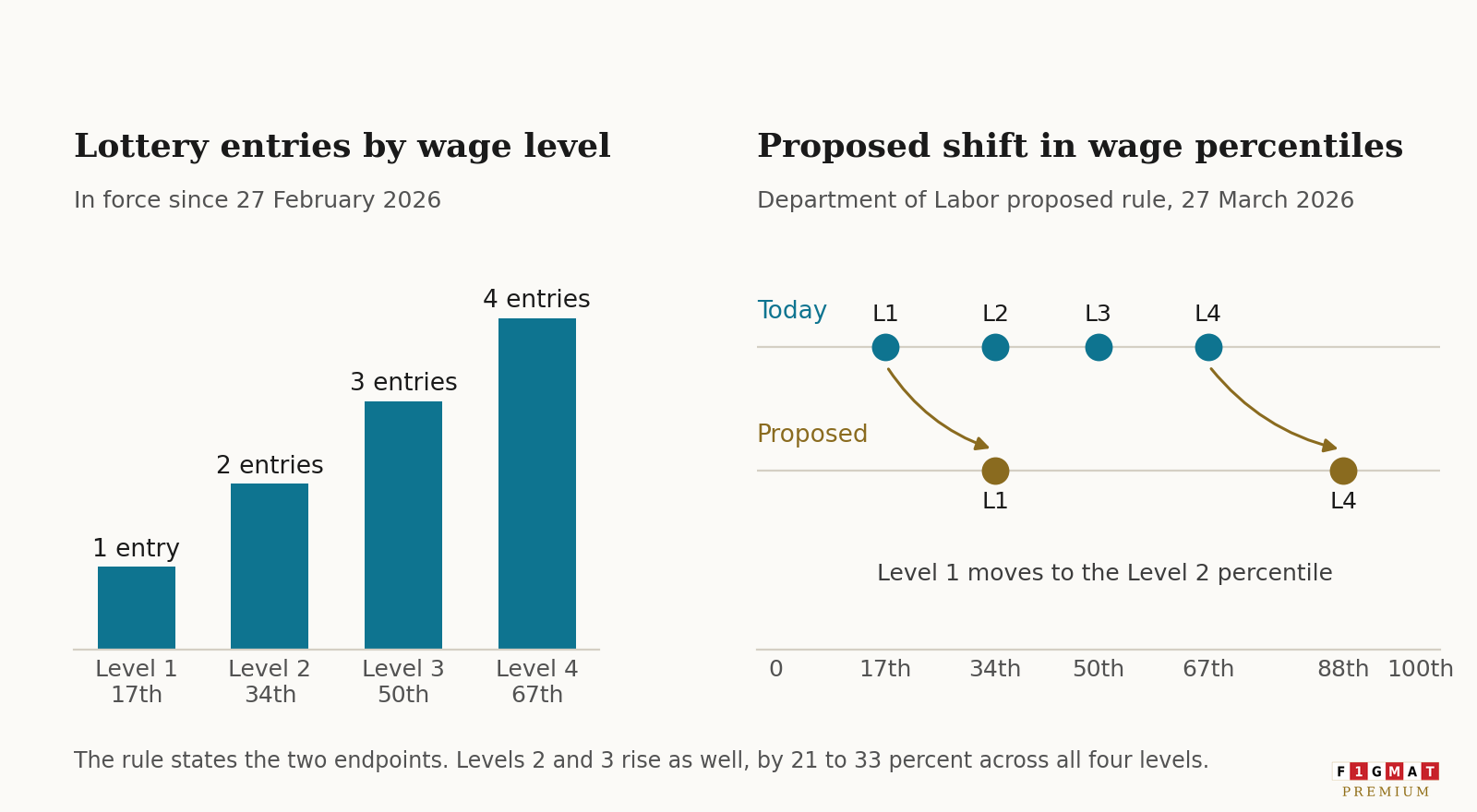
The H-1B lottery system applies once the cap is met.
As of February 27, 2026, the lottery is wage-weighted (Level 1 gets 1 entry, Level 2 gets 2, Level 3 gets 3, Level 4 gets 4) [17].
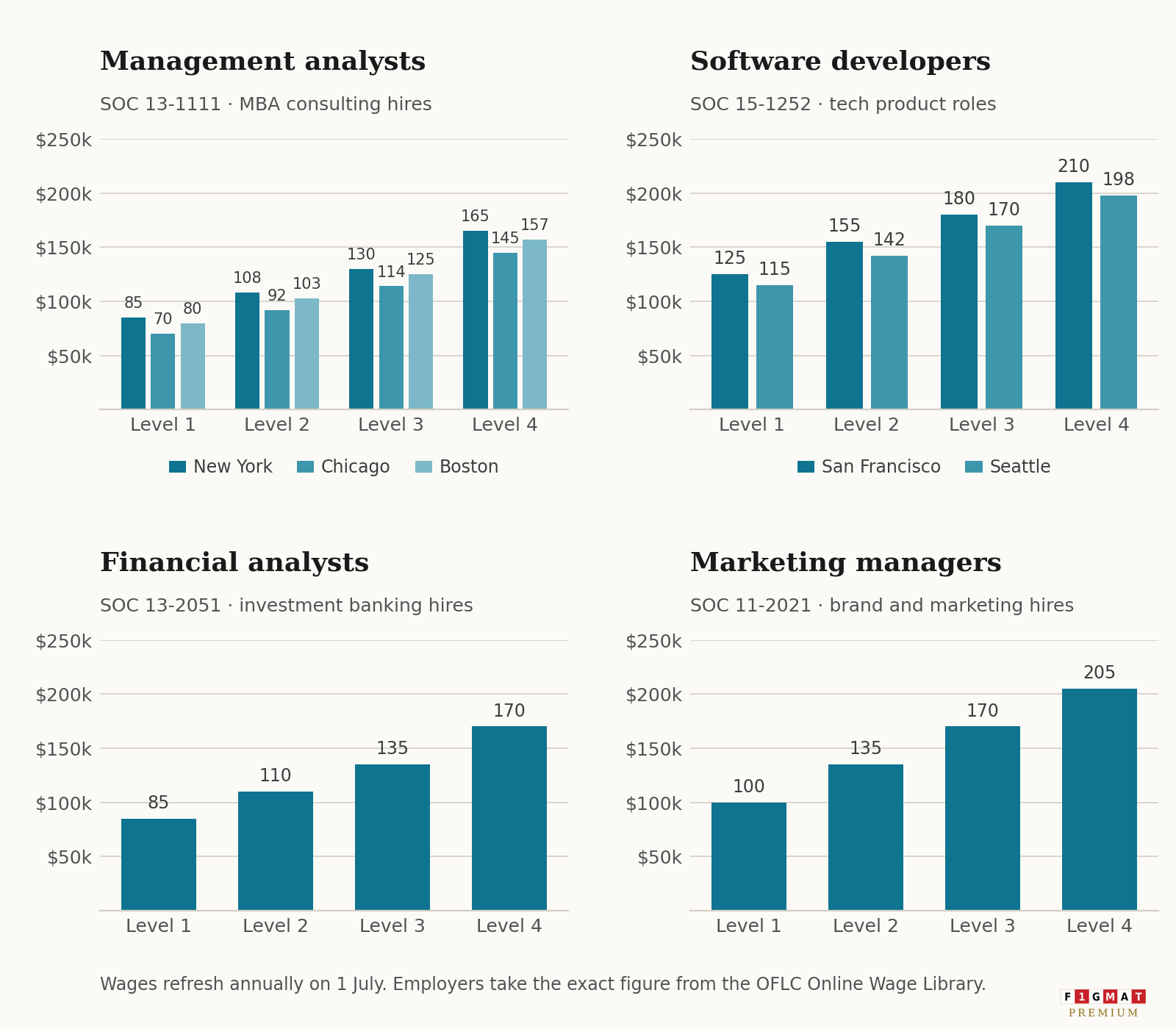
Illustrative dollar wages for MBA-relevant occupations in high-volume metros under the July 2025 – June 2026 wage year (the wage year currently in force through August 2026):
H-1B Wage-Weighted Lottery: How it Works
| Metropolitan Area | Level 1 17th percentile | Level 2 34th percentile | Level 3 50th percentile | Level 4 67th percentile |
|---|---|---|---|---|
| Management Analysts | SOC 13-1111 · Standard classification for MBA consulting hires | |||
| New York-Newark-Jersey City NY-NJ-PA MSA | $85,000 | $108,000 | $130,000 | $165,000 |
| Chicago-Naperville-Elgin IL-IN-WI MSA | $70,000 | $92,000 | $114,000 | $145,000 |
| Boston-Cambridge-Newton MA-NH MSA | $80,000 | $103,000 | $125,000 | $157,000 |
| Software Developers | SOC 15-1252 · Standard classification for tech product and engineering hires | |||
| San Francisco-Oakland-Berkeley CA MSA | $125,000 | $155,000 | $180,000 | $210,000 |
| Seattle-Tacoma-Bellevue WA MSA | $115,000 | $142,000 | $170,000 | $198,000 |
| Financial Analysts | SOC 13-2051 · Standard classification for most investment banking hires | |||
| New York-Newark-Jersey City NY-NJ-PA MSA | $85,000 | $110,000 | $135,000 | $170,000 |
| Marketing Managers | SOC 11-2021 · Standard classification for brand and marketing hires | |||
| New York-Newark-Jersey City NY-NJ-PA MSA | $100,000 | $135,000 | $170,000 | $205,000 |
How to read the table. OEWS assigns four prevailing wage levels to every occupation in every metropolitan area based on the local wage distribution. Level 1 covers the 17th percentile (entry-level pay for the role and area); Level 2 the 34th percentile (qualified); Level 3 the 50th percentile (experienced); Level 4 the 67th percentile (fully competent).
Wages refresh annually on July 1. Employers pull the exact wage from the OFLC Online Wage Library. If the March 27, 2026 DOL prevailing wage NPRM finalizes as proposed, Level 1 moves from the 17th to the 34th percentile and Level 4 moves from the 67th to the 88th percentile.
H-1B Visa: 2027 Numbers
FY 2027 registrations totaled 211,600, a 38.5 percent drop from FY 2026's 343,981 [48].
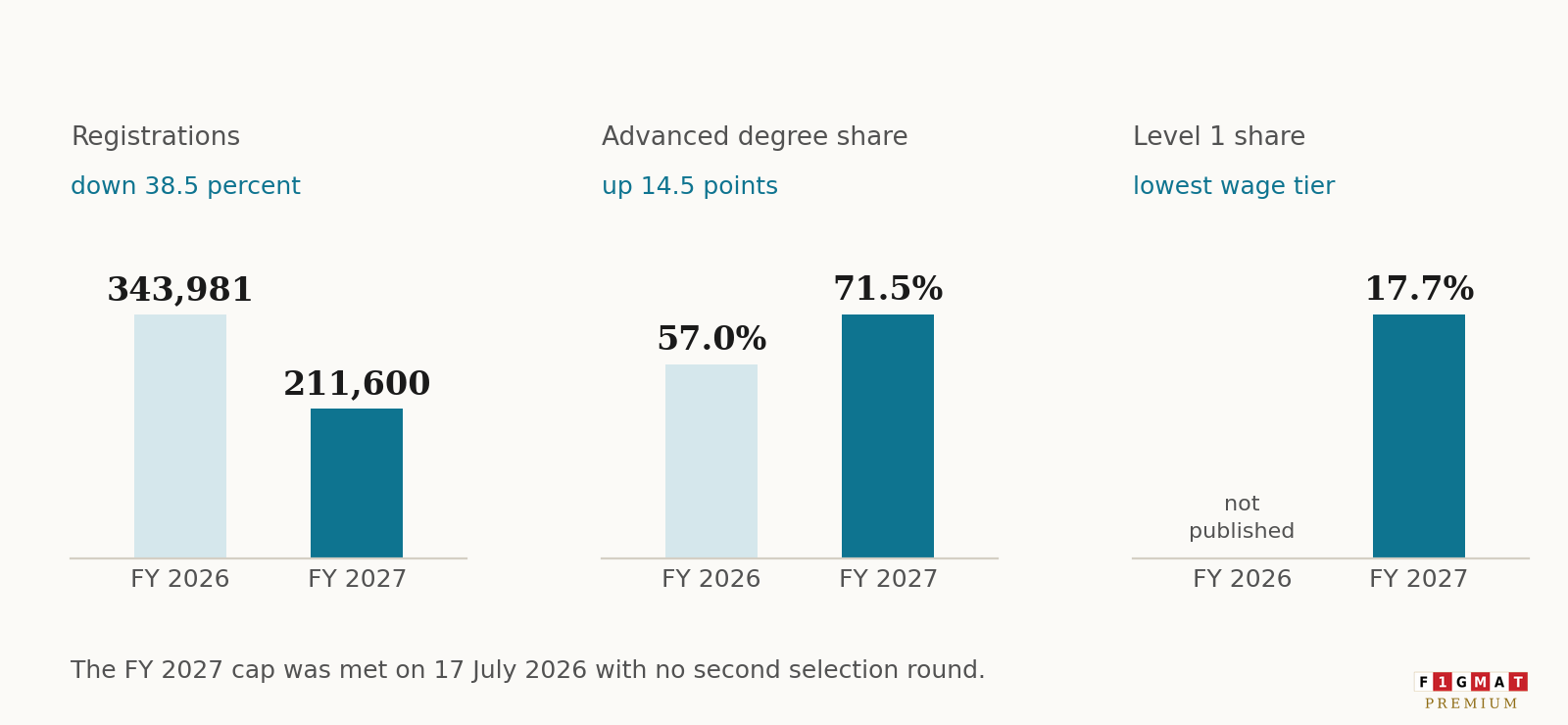
The FY 2027 cap was met on July 17, 2026 with no second selection round [49].
- STEM advantage: STEM graduates have three H-1B lottery attempts across the 36-month OPT, and STEM OPT window, versus one attempt for non-STEM graduates.
- Duration: Initial three years, renewable to a total of six years.
Extensions past six years available under AC21 with approved I-140.
O-1 Visa
The O-1 visa is intended for individuals with extraordinary ability or achievement in the field of sciences, arts, education, business, or athletics.
The extraordinary ability is demonstrated through a combination of published research, named industry awards, paid speaking engagements, original contributions of major significance, high salary, or critical role at distinguished organizations.
Although more exclusive than the H-1B, O-1A is a viable option for MBA graduates who can demonstrate significant accomplishments or leadership in their industry.
- No annual cap and no lottery.
- No minimum education requirement (the standard is achievement, not degree).
- Must renew every three years
- Dual intent (can pursue a green card without prejudicing visa renewals).
- Suitable for MBA graduates with pre-MBA records including Forbes 30 Under 30, published research, named industry awards, or recognized founder track records.
L-1 Visa
The L-1 visa is for individuals working for multinational companies who wish to transfer from an international office to a US branch.
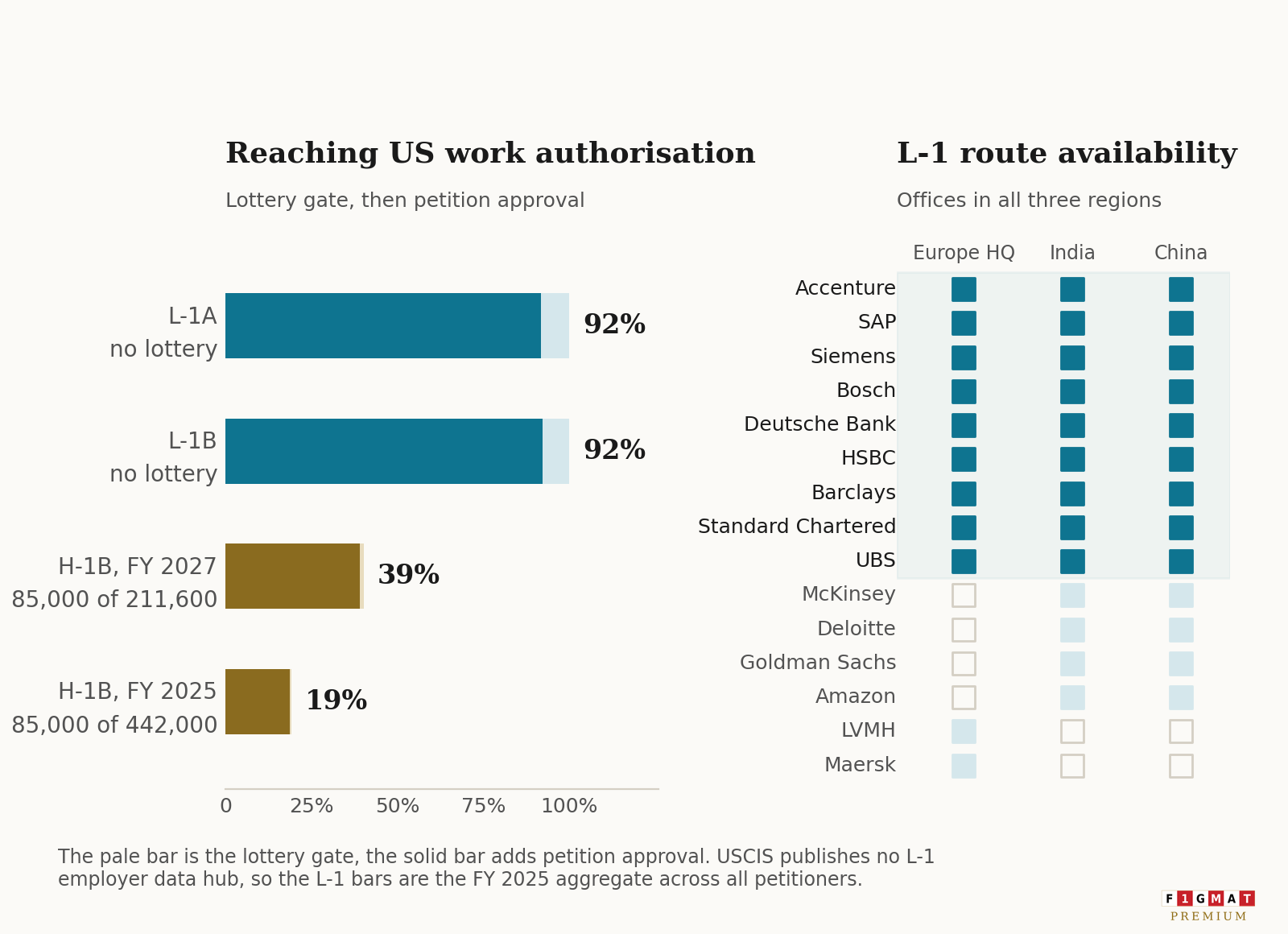
L-1A is for managers and executives (up to 7-year maximum US stay); L-1B is for specialized-knowledge workers (up to 5-year maximum US stay).
- No annual cap and no lottery.
- Dual intent (direct pathway to EB-1C for L-1A holders).
- Widely available through European multinationals with US operations (Siemens, BNP Paribas, LVMH, Roche, Maersk, Spotify).
Corporate structure Advantage: MBB and Big Four Lead
The L-1 category requires that the US and foreign entities have a qualifying corporate relationship (parent, subsidiary, branch, affiliate, or joint venture).
The Big Four operate as separate national member firms that share a global brand.
The qualifying relationship for L-1 purposes runs through documented member-firm agreements rather than a direct parent-subsidiary link, and the internal mobility team handles this documentation.
For MBB firms, the single global partnership structure means the qualifying relationship is easy for L-1 visa evaluation.
If you are from the following companies, strategically pursue Employer sponsorship or transfer a year before application as the potential to convert this advantage to an MBA or Master's admit is high with US visa restrictions.
European Multinationals with US Operations
For applicants planning to transfer to a US office, use the L-1 transfer pipelines available to MBA and Master's graduates who join a European multinational's European headquarters or a top-three European office and complete 12 months of qualifying employment before transferring to a US office of the same employer.
Even with an employment gap of two years that comes with two-year MBA, you still can show 12-months of complete employment as L-1 requires 12 months of continuous employment at a qualifying foreign affiliate in the preceding 3 years.
| Company | European HQ | US Offices |
|---|---|---|
| Germany | ||
| Siemens | Munich | Iselin NJ US HQ, Alpharetta GA, Orlando FL, Cincinnati OH, Buffalo Grove IL, Boulder CO, Norwood MA, Pittsburgh PA Regular L-1A and L-1B pipeline |
| SAP | Walldorf | Newtown Square PA US HQ, Palo Alto CA, San Ramon CA, Bellevue WA, Reston VA, Boston MA, New York NY, Atlanta GA |
| Bosch | Gerlingen | Farmington Hills MI N. Am. HQ, Broadview IL, Charleston SC, Anderson SC, Mount Prospect IL, Sunnyvale CA, Pittsburgh PA |
| Deutsche Bank | Frankfurt | New York NY Americas HQ, Jacksonville FL, Cary NC |
| Allianz | Munich | Minneapolis MN Allianz Life, New York NY Allianz Global Investors, Chicago IL Allianz Trade |
| BMW | Munich | Woodcliff Lake NJ US HQ, Spartanburg SC manufacturing and R&D, Mountain View CA, Chicago IL |
| Mercedes-Benz Group | Stuttgart | Atlanta GA US HQ, Sunnyvale CA R&D North America, Long Beach CA, Farmington Hills MI |
| Volkswagen Group of America | Wolfsburg | Herndon VA US HQ, Chattanooga TN manufacturing, Auburn Hills MI, Belmont CA Electrify America |
| Bayer | Leverkusen | Whippany NJ US HQ, St. Louis MO, Berkeley CA, Cambridge MA, Research Triangle Park NC |
| Merck KGaA (EMD Group in US) | Darmstadt | Rockland MA, Burlington MA, Billerica MA EMD Serono, Philadelphia PA Distinct from US Merck & Co. |
| Adidas | Herzogenaurach | Portland OR N. Am. HQ, Los Angeles CA, New York NY, Boston MA Reebok |
| France | ||
| BNP Paribas | Paris | New York NY Americas HQ, Jersey City NJ, San Francisco CA, Chicago IL |
| LVMH Moët Hennessy Louis Vuitton | Paris | New York NY Americas HQ, Miami FL, Los Angeles CA, Beverly Hills CA, Napa CA Chandon |
| Kering | Paris | New York NY Americas HQ, Los Angeles CA |
| Hermès | Paris | New York NY |
| L'Oréal | Clichy | New York NY US HQ, Berkeley Heights NJ, Clark NJ, Jacksonville FL, Little Rock AR, El Paso TX |
| Sanofi | Paris | Bridgewater NJ US HQ, Cambridge MA, Framingham MA, Waltham MA |
| AXA | Paris | New York NY Equitable Holdings, AXA XL, Charlotte NC, Stamford CT |
| Société Générale | Paris La Défense | New York NY Americas HQ, Jersey City NJ |
| Crédit Agricole | Montrouge | New York NY, Jersey City NJ |
| TotalEnergies | Courbevoie | Houston TX US HQ, Nederland TX, La Porte TX |
| Schneider Electric | Rueil-Malmaison | Nashville TN US HQ, Andover MA, Boston MA, Foxborough MA, Dallas TX, Chicago IL |
| Dassault Systèmes | Vélizy-Villacoublay | Waltham MA, Providence RI, Los Angeles CA |
| Capgemini | Paris | New York NY, Atlanta GA, Chicago IL, Rosemont IL, Charlotte NC, Dallas TX, Houston TX |
| United Kingdom | ||
| HSBC | London | New York NY Americas HQ, Chicago IL, San Francisco CA, Los Angeles CA, Miami FL, Wilmington DE |
| Barclays | London | New York NY Americas HQ, Whippany NJ, Wilmington DE |
| Standard Chartered | London | New York NY, Los Angeles CA, Miami FL |
| AstraZeneca | Cambridge UK | Wilmington DE US HQ, Gaithersburg MD, South San Francisco CA, Waltham MA, New Haven CT |
| GSK (GlaxoSmithKline) | London | Philadelphia PA US HQ, Research Triangle Park NC, Rockville MD, Boston MA, King of Prussia PA |
| Unilever | London and Rotterdam | Englewood Cliffs NJ US HQ, Trumbull CT, Chicago IL, Cincinnati OH, Los Angeles CA |
| BP | London | Houston TX US HQ, Chicago IL, Denver CO, Cherry Point WA |
| Shell | London | Houston TX US HQ, New Orleans LA, Cincinnati OH, Denver CO |
| Rio Tinto | London | Salt Lake City UT Kennecott, Boron CA, Tucson AZ, Denver CO |
| Rolls-Royce Holdings | London | Reston VA, Indianapolis IN, Cincinnati OH |
| Diageo | London | New York NY N. Am. HQ, Norwalk CT, Plainfield IL, Louisville KY, Windsor CT |
| Aviva | London | US operations wound down. Historical presence in Hartford CT and Des Moines IA |
| Netherlands | ||
| Philips (Royal Philips) | Amsterdam | Cambridge MA US HQ, Andover MA, Bothell WA, Pittsburgh PA, Nashville TN, Foster City CA, Colorado Springs CO |
| ASML | Veldhoven | Wilton CT US HQ, San Jose CA, San Diego CA, Chandler AZ, Hillsboro OR |
| ING Group | Amsterdam | New York NY, Wilmington DE |
| Ahold Delhaize | Zaandam | Carlisle PA USA support, Salisbury NC Food Lion, Quincy MA Stop & Shop, Landover MD Giant Food, Scarborough ME Hannaford |
| Heineken | Amsterdam | White Plains NY |
| Randstad | Diemen | Atlanta GA US HQ, Cary NC |
| Switzerland | ||
| Roche | Basel | South San Francisco CA Genentech; primary L-1 pipeline, Nutley NJ, Little Falls NJ, Indianapolis IN Roche Diabetes Care, Pleasanton CA, Tucson AZ Ventana |
| Novartis | Basel | East Hanover NJ US HQ, Cambridge MA Novartis Institutes for BioMedical Research, Fort Worth TX, Morris Plains NJ |
| UBS | Zurich | New York NY Americas HQ, Weehawken NJ, Nashville TN, Stamford CT |
| Credit Suisse (now part of UBS) | Zurich | Historical US operations in New York NY and Raleigh NC, now consolidated under UBS |
| Nestlé | Vevey | Arlington VA US HQ, Solon OH Nestlé USA support, Glendale CA, Rosslyn VA |
| ABB | Zurich | Cary NC US HQ, Auburn Hills MI, Cleveland OH, Houston TX, San Jose CA |
| Zurich Insurance | Zurich | Schaumburg IL US HQ, New York NY |
| Swiss Re | Zurich | Armonk NY Americas HQ, Kansas City MO |
| Italy | ||
| UniCredit | Milan | New York NY |
| Intesa Sanpaolo | Turin | New York NY |
| Ferrari | Maranello | Woodcliff Lake NJ |
| Prada | Milan | New York NY |
| Enel | Rome | Andover MA N. Am. HQ, San Francisco CA, Boston MA |
| Spain | ||
| Santander | Boadilla del Monte | Boston MA US HQ, New York NY, Miami FL, Dallas TX |
| BBVA | Bilbao | Houston TX, New York NY Institutional operations. Retail arm sold to PNC in 2021 |
| Inditex (Zara parent) | Arteixo | New York NY |
| Iberdrola | Bilbao | Orange CT Avangrid US HQ, Rochester NY, Portland OR, Portland ME |
| Sweden | ||
| Spotify | Stockholm | New York NY Americas HQ, Los Angeles CA, Boston MA, Nashville TN, Miami FL |
| Ericsson | Stockholm | Plano TX N. Am. HQ, Santa Clara CA, Bellevue WA |
| IKEA | Leiden and Delft | Conshohocken PA US HQ |
| H&M | Stockholm | New York NY |
| Electrolux | Stockholm | Charlotte NC N. Am. HQ |
| Volvo Group | Gothenburg | Greensboro NC Volvo Trucks and Mack Trucks, Shippensburg PA |
| Denmark | ||
| Maersk | Copenhagen | Florham Park NJ US HQ, Charlotte NC, Norfolk VA, Miami FL, Long Beach CA, Houston TX |
| Novo Nordisk | Bagsværd | Plainsboro NJ US HQ, Seattle WA Novo Nordisk Research Center Seattle, Fremont CA, Watertown MA |
| LEGO Group | Billund | Enfield CT Americas HQ, Boston MA |
| Ørsted | Fredericia | Providence RI Offshore N. Am. HQ, Boston MA, Houston TX |
| Vestas | Aarhus | Portland OR Americas HQ, Louisville CO, Windsor CO |
| Norway | ||
| Equinor | Stavanger | Houston TX US HQ, Austin TX |
| DNV | Høvik | Houston TX, Katy TX, Dublin OH |
| Finland | ||
| Nokia | Espoo | Murray Hill NJ Nokia Bell Labs, Sunnyvale CA, Plano TX, Naperville IL |
| Kone | Espoo | Lisle IL Americas HQ |
| Ireland | ||
| Accenture | Dublin | New York NY, Chicago IL, San Francisco CA, Boston MA, Atlanta GA, Minneapolis MN, Washington DC, Los Angeles CA, Houston TX 40+ US locations total |
| Medtronic | Dublin redomiciled from Minneapolis | Minneapolis MN Operational HQ, Boulder CO, Jacksonville FL, Northridge CA, Warsaw IN |
| Ryanair | Dublin | New York NY limited corporate |
| CRH | Dublin | Atlanta GA Americas HQ |
Indian and Chinese Applicants - US Global Consulting Firms and Tech Companies (Offices)
L-1 Transfer Pipelines: India and China Offices of Global Employers
For applicants planning to use the return to the previous employer after an MBA or Master's, should consider this strategy as the L-1 transfer requires 12 months of continuous employment at a qualifying foreign affiliate in the preceding 3 years before a transfer to a US office of the same employer.
Negotiate with the current employer to return with the condition that you will be employed in a US office. This improves feasibility of your post-MBA goals essay purely from a visa perspective.
Schools would prefer that you have high employability potential.
The L-1 visa requires 12 months of continuous employment at a qualifying foreign affiliate in the preceding 3 years before a transfer to a US office of the same employer.
India
Pre-MBA or Pre-Master's Visa Strategy - India Operations
The MBB and Big Four firms operate in India as an integrated business entity.
An offer letter typically lists one office as the home base but permits case staffing and internal transfers across the full India footprint.
For the L-1 path, USCIS uses the home-base city on the offer letter to establish the qualifying foreign employment relationship.
Take the largest primary hub city where the employer's US mobility team has a documented L-1 pipeline (usually Mumbai for MBB and finance, Bengaluru for tech and analytics).
Indian IT services firms (TCS, Infosys, Wipro, HCL, Cognizant) run their own separate H-1B and L-1 pipelines but tend to file at Level 1 or Level 2 wages and now face heightened USCIS scrutiny.
They are not included in the table above because their MBA hiring is minimal.
| Company | Category / Notes | India Cities |
|---|---|---|
| Management Consulting (MBB) | ||
| McKinsey & Company | MBB Single global partnership; L-1 transfer is particularly clean | Mumbai Primary Hub, Gurugram, Bengaluru, Chennai, Kolkata Chennai is a shared services center of 2,000+ staff |
| Boston Consulting Group (BCG) | MBB | Mumbai Primary Hub, Gurugram, Bengaluru, Chennai, Hyderabad Hyderabad focuses on pharma, manufacturing, technology |
| Bain & Company | MBB | Mumbai Primary Hub, Gurugram, Bengaluru Plus Bain Capability Center (BCN) in Gurugram |
| Big Four (Consulting and Advisory) | ||
| Deloitte | Big Four 100,000+ India employees; 2,353 US H-1B approvals FY 2025 alongside its L-1 pipeline | Mumbai, Bengaluru, Delhi/Gurugram, Hyderabad, Chennai, Pune, Kolkata, Ahmedabad, Coimbatore, Jaipur |
| PwC (PricewaterhouseCoopers) | Big Four Includes Strategy& | Mumbai, Bengaluru, Delhi/Gurugram, Hyderabad, Chennai, Pune, Kolkata, Ahmedabad, Chandigarh, Bhubaneswar |
| EY (Ernst & Young) | Big Four | Mumbai, Bengaluru, Delhi/Gurugram, Hyderabad, Chennai, Pune, Kolkata, Ahmedabad, Jamshedpur, Kochi, Noida |
| KPMG | Big Four | Mumbai, Bengaluru, Delhi/Gurugram, Hyderabad, Chennai, Pune, Kolkata, Ahmedabad, Kochi, Noida, Vadodara |
| Strategy and Specialized Consulting | ||
| Accenture | Strategy & Tech 300,000+ India employees; largest L-1 pipeline in this category | Bengaluru Primary Hub, Hyderabad, Chennai, Mumbai, Pune, Delhi/Gurugram, Kolkata, Coimbatore, Ahmedabad, Indore, Jaipur, Nagpur, Visakhapatnam |
| Kearney | Strategy Formerly A.T. Kearney | Mumbai, Delhi/Gurugram, Bengaluru |
| Oliver Wyman | Strategy | Mumbai, Delhi/Gurugram, Bengaluru |
| Roland Berger | Strategy | Mumbai Primary India office |
| L.E.K. Consulting | Strategy | Mumbai, Chennai, Bengaluru |
| ZS Associates | Strategy & Analytics | Pune, Bengaluru, Gurugram, Chennai, Ahmedabad |
| IBM Consulting | Big Tech Consulting | Bengaluru, Pune, Mumbai, Hyderabad, Chennai, Delhi/Gurugram, Kolkata, Ahmedabad, Kochi |
| Big Tech (US-Headquartered with India Operations) | ||
| Amazon | Big Tech Largest US H-1B and L-1 sponsor overall; 10,000+ H-1B approvals in 2025 | Hyderabad Largest Amazon campus globally, Bengaluru, Gurugram, Chennai, Mumbai, Pune, Delhi |
| Microsoft | Big Tech Regular L-1 pipeline | Bengaluru Primary Hub, Hyderabad, Noida, Gurugram, Mumbai, Pune, Chennai, Kolkata, Ahmedabad |
| Big Tech Historically strong L-1 pipeline from India | Hyderabad Primary Hub, Bengaluru, Gurugram, Mumbai | |
| Meta (Facebook) | Big Tech | Hyderabad, Gurugram, Mumbai, Bengaluru |
| Apple | Big Tech India operations expanding rapidly | Bengaluru, Hyderabad, Mumbai, Delhi |
| IBM | Big Tech 130,000+ India employees; long-established L-1 pipeline | Bengaluru Primary Hub, Pune, Mumbai, Hyderabad, Chennai, Delhi/Gurugram, Kolkata, Ahmedabad, Kochi |
| Oracle | Big Tech | Bengaluru Primary Hub, Hyderabad, Mumbai, Pune, Delhi/Gurugram, Chennai, Ahmedabad |
| Cisco Systems | Big Tech Bengaluru is second-largest Cisco site globally | Bengaluru Primary Hub, Pune, Mumbai, Chennai, Delhi/Gurugram |
| Adobe | Big Tech | Noida Primary Hub, Bengaluru |
| Salesforce | Big Tech | Hyderabad, Bengaluru, Mumbai, Jaipur, Delhi/Gurugram |
| Intel | Big Tech Bengaluru is a major R&D center | Bengaluru Primary Hub, Hyderabad, Pune, Delhi/Gurugram |
| Nvidia | Big Tech | Bengaluru Primary Hub, Hyderabad, Pune, Gurugram |
| Qualcomm | Big Tech | Hyderabad Primary Hub, Bengaluru, Chennai, Noida |
| Dell Technologies | Big Tech | Bengaluru Primary Hub, Hyderabad, Chennai, Mumbai, Pune, Delhi/Gurugram |
| HP Inc. and HPE | Big Tech | Bengaluru, Chennai, Mumbai, Delhi/Gurugram, Pune, Kolkata |
| VMware (Broadcom) | Big Tech | Bengaluru, Pune |
| SAP | Enterprise Software SAP Labs India is one of SAP's largest R&D centers globally | Bengaluru SAP Labs India, Gurugram, Mumbai, Pune, Kolkata |
| ServiceNow, Workday, Snowflake, Databricks | Enterprise Software Growing India footprints | Bengaluru, Hyderabad, Pune |
| Investment Banks and Financial Services | ||
| Goldman Sachs | Investment Bank Bengaluru is Goldman's largest office globally | Bengaluru Largest Globally, Mumbai Investment banking & markets, Hyderabad 2023 opening |
| JPMorgan Chase | Investment Bank Three Global Service Centers | Mumbai India HQ, Bengaluru, Hyderabad |
| Morgan Stanley | Investment Bank | Mumbai India HQ, Bengaluru, Pune |
| Citigroup | Investment Bank | Mumbai India HQ, Bengaluru, Chennai, Pune, Delhi/Gurugram, Kolkata |
| Bank of America | Investment Bank | Mumbai India HQ, Chennai, Gurugram, Hyderabad |
| Barclays | Investment Bank | Chennai, Pune, Noida, Mumbai |
| HSBC | Investment Bank | Bengaluru, Mumbai, Hyderabad, Kolkata, Chennai, Pune, Delhi/Gurugram, Ahmedabad, Coimbatore, Visakhapatnam |
| Deutsche Bank | Investment Bank | Bengaluru, Mumbai, Jaipur, Pune, Delhi/Gurugram |
| UBS | Investment Bank | Mumbai, Hyderabad, Pune |
| Wells Fargo | Bank Large India operations | Bengaluru Primary Hub, Hyderabad, Chennai |
| Standard Chartered | Investment Bank | Mumbai, Bengaluru, Chennai, Delhi/Gurugram |
| Bloomberg | Financial Data | Mumbai India HQ |
| S&P Global, Moody's, Fitch Ratings | Financial Analytics | Mumbai, Gurugram, Hyderabad, Bengaluru |
| Industrial and Diversified Multinationals | ||
| General Electric | Industrial John F. Welch Technology Centre is one of GE's largest R&D sites globally | Bengaluru JFWTC, Gurgaon, Chennai, Pune, Hyderabad |
| Honeywell | Industrial | Bengaluru, Gurugram, Pune, Hyderabad, Madurai |
| Siemens | Industrial L-1 more common for European employees transferring to US Siemens | Mumbai, Pune, Gurugram, Bengaluru, Chennai, Kolkata, Hyderabad, Ahmedabad, Nashik, Vadodara |
| Bosch | Industrial | Bengaluru Primary Hub, Coimbatore, Hyderabad, Chennai, Nashik, Pune |
| Johnson & Johnson | Pharma R&D and commercial roles feed US L-1 transfers | Mumbai, Bengaluru, Hyderabad, Delhi/Gurugram, Chennai |
| Pfizer | Pharma | Mumbai, Chennai, Delhi/Gurugram |
| Merck & Co. | Pharma Distinct from Merck KGaA (EMD Group) | Mumbai, Bengaluru, Delhi/Gurugram |
| Bristol-Myers Squibb | Pharma | Hyderabad, Bengaluru, Mumbai |
| Procter & Gamble | CPG | Mumbai India HQ, Hyderabad, Bengaluru, Delhi/Gurugram |
| Company | Category / Notes | China Cities |
|---|---|---|
| Management Consulting (MBB) | ||
| McKinsey & Company | MBB Single global partnership; L-1 transfer is particularly clean | Shanghai Primary Hub, Beijing, Hong Kong, Shenzhen, Taipei |
| Boston Consulting Group (BCG) | MBB | Shanghai Primary Hub, Beijing, Hong Kong, Shenzhen, Taipei |
| Bain & Company | MBB | Shanghai Primary Hub, Beijing, Hong Kong, Shenzhen |
| Big Four (Consulting and Advisory) | ||
| Deloitte | Big Four | Shanghai, Beijing, Hong Kong, Guangzhou, Shenzhen, Chengdu, Chongqing, Dalian, Hangzhou, Nanjing, Suzhou, Tianjin, Wuhan, Xiamen |
| PwC (PricewaterhouseCoopers) | Big Four | Shanghai, Beijing, Hong Kong, Guangzhou, Shenzhen, Chengdu, Chongqing, Dalian, Hangzhou, Nanjing, Suzhou, Tianjin, Xiamen, Qingdao |
| EY (Ernst & Young) | Big Four | Shanghai, Beijing, Hong Kong, Guangzhou, Shenzhen, Chengdu, Dalian, Hangzhou, Nanjing, Suzhou, Tianjin, Wuhan, Xiamen, Qingdao |
| KPMG | Big Four | Shanghai, Beijing, Hong Kong, Guangzhou, Shenzhen, Chengdu, Chongqing, Dalian, Hangzhou, Nanjing, Suzhou, Tianjin, Xiamen, Qingdao, Fuzhou |
| Strategy and Specialized Consulting | ||
| Accenture | Strategy & Tech Material China operations | Shanghai Greater China HQ, Beijing, Hong Kong, Shenzhen, Guangzhou, Chengdu, Dalian, Xi'an |
| Kearney | Strategy | Shanghai, Beijing, Hong Kong |
| Oliver Wyman | Strategy | Shanghai, Beijing, Hong Kong, Shenzhen |
| Roland Berger | Strategy | Shanghai Primary Hub, Beijing, Hong Kong, Guangzhou |
| L.E.K. Consulting | Strategy | Shanghai, Beijing, Hong Kong |
| IBM Consulting | Big Tech Consulting | Shanghai, Beijing, Guangzhou, Shenzhen, Chengdu, Dalian, Hong Kong |
| Big Tech (US-Headquartered with China Operations) | ||
| Amazon (AWS) | Big Tech AI lab in Shanghai; IoT labs in Shenzhen and Taipei | Beijing Greater China R&D, Shanghai, Shenzhen, Hong Kong, Taipei, Ningxia Ningxia hosts AWS China Region |
| Microsoft | Big Tech Microsoft Research Asia HQ in Beijing | Beijing China HQ, Shanghai, Hong Kong, Shenzhen, Suzhou, Taipei, Wuxi, Guangzhou, Nanjing, Wuhan, Chengdu |
| Big Tech China presence scaled back but operational | Beijing, Shanghai, Shenzhen | |
| Meta (Facebook) | Big Tech Largely blocked to US corporate transfers | Hong Kong Limited APAC ad-sales presence |
| Apple | Big Tech Corporate offices distinct from manufacturing operations | Shanghai Greater China HQ, Beijing, Shenzhen, Hong Kong, Suzhou |
| IBM | Big Tech | Beijing, Shanghai, Dalian, Guangzhou, Shenzhen, Chengdu, Hong Kong, Xi'an, Wuhan, Chongqing |
| Oracle | Big Tech | Beijing, Shanghai, Shenzhen, Guangzhou, Hong Kong, Chengdu, Dalian |
| Cisco Systems | Big Tech | Shanghai, Beijing, Shenzhen, Hangzhou, Chengdu, Guangzhou, Hong Kong |
| Intel | Big Tech | Shanghai Greater China HQ, Beijing, Chengdu, Dalian, Shenzhen, Hong Kong |
| Nvidia | Big Tech China operations restricted by US export controls; corporate offices remain | Beijing, Shanghai, Shenzhen, Hong Kong, Hangzhou |
| Qualcomm | Big Tech | Beijing China HQ, Shanghai, Shenzhen, Xi'an, Hong Kong, Chengdu |
| Dell Technologies | Big Tech | Xiamen Manufacturing & ops, Beijing, Shanghai, Chengdu, Guangzhou, Hong Kong |
| HP Inc. and HPE | Big Tech | Beijing, Shanghai, Chongqing, Hong Kong, Shenzhen, Chengdu, Xi'an |
| SAP | Enterprise Software | Shanghai Greater China HQ, Beijing, Chengdu, Dalian, Hong Kong, Nanjing |
| Investment Banks and Financial Services | ||
| Goldman Sachs | Investment Bank | Hong Kong Asia HQ, Beijing, Shanghai, Shenzhen |
| JPMorgan Chase | Investment Bank | Hong Kong Asia HQ, Beijing, Shanghai, Guangzhou, Shenzhen, Chengdu |
| Morgan Stanley | Investment Bank | Hong Kong Asia HQ, Beijing, Shanghai, Shenzhen |
| Citigroup | Investment Bank | Hong Kong Asia HQ, Shanghai, Beijing, Guangzhou, Shenzhen, Tianjin, Dalian, Chengdu, Hangzhou, Chongqing |
| Bank of America | Investment Bank | Hong Kong, Shanghai, Beijing |
| Barclays | Investment Bank | Hong Kong, Beijing, Shanghai |
| HSBC | Investment Bank Extensive China operations rooted in the bank's Asian heritage | Hong Kong Group HQ, Shanghai, Beijing, Guangzhou, Shenzhen, Chengdu, Chongqing, Hangzhou, Nanjing, Suzhou, Tianjin, Wuhan, Xiamen, Qingdao, Dalian |
| Deutsche Bank | Investment Bank | Hong Kong, Shanghai, Beijing, Guangzhou |
| UBS | Investment Bank | Hong Kong Asia HQ, Beijing, Shanghai |
| Standard Chartered | Investment Bank | Hong Kong, Shanghai, Beijing, Shenzhen, Guangzhou, Chengdu, Chongqing, Dalian, Nanjing, Suzhou, Tianjin, Xiamen |
| Bloomberg | Financial Data | Hong Kong Asia HQ, Beijing, Shanghai |
| S&P Global, Moody's, Fitch Ratings | Financial Analytics | Hong Kong, Beijing, Shanghai |
| Industrial and Diversified Multinationals | ||
| General Electric | Industrial | Shanghai Greater China HQ, Beijing, Chengdu, Shenzhen, Wuhan, Hong Kong |
| Honeywell | Industrial | Shanghai Greater China HQ, Beijing, Suzhou, Nanjing, Chongqing, Xi'an, Hong Kong |
| Siemens | Industrial | Beijing Greater China HQ, Shanghai, Guangzhou, Chengdu, Nanjing, Shenzhen, Suzhou, Tianjin, Wuxi, Hong Kong |
| Bosch | Industrial | Shanghai China HQ, Suzhou, Nanjing, Chengdu, Hangzhou, Beijing, Shenzhen, Hong Kong |
| Johnson & Johnson | Pharma | Shanghai Greater China HQ, Beijing, Suzhou, Hong Kong |
| Pfizer | Pharma | Shanghai, Beijing, Wuhan, Dalian, Hong Kong |
| Merck & Co. | Pharma | Shanghai China HQ, Beijing, Hangzhou, Hong Kong |
| Bristol-Myers Squibb | Pharma | Shanghai China HQ, Beijing, Hong Kong |
| Procter & Gamble | CPG | Guangzhou Greater China HQ, Beijing, Shanghai, Chengdu, Hong Kong |
| Chinese-Headquartered Companies (with US Operations) | ||
| Lenovo | Chinese Tech Dually headquartered in Beijing and Raleigh NC; regular Chinese-to-US L-1 pipeline | Beijing China HQ, Shanghai, Shenzhen, Chengdu, Wuhan, Hong Kong |
| Alibaba Group | Chinese Tech US L-1 pipeline exists but faces increased scrutiny | Hangzhou HQ, Beijing, Shanghai, Shenzhen, Guangzhou, Hong Kong, Chengdu |
| Tencent | Chinese Tech Similar scrutiny to Alibaba | Shenzhen HQ, Beijing, Shanghai, Guangzhou, Chengdu, Hong Kong |
| ByteDance (TikTok) | Chinese Tech Among the most heavily scrutinized Chinese-to-US L-1 pipelines in 2025-2026 | Beijing HQ, Shanghai, Shenzhen, Hangzhou, Guangzhou, Hong Kong, Singapore |
| Baidu | Chinese Tech | Beijing HQ, Shanghai, Shenzhen, Chengdu, Hong Kong |
| Xiaomi | Chinese Tech US operations reduced | Beijing HQ, Shanghai, Nanjing, Wuhan, Hong Kong |
| Huawei | Chinese Tech Restricted under US national security actions; L-1 pipeline effectively closed | Shenzhen HQ, Beijing, Shanghai, Chengdu, Wuhan, Hangzhou, Xi'an, Hong Kong |
L-1A Scrutiny - Indian IT Firms
The L-1A category has faced substantial scrutiny since 2024 following an EB-1C fraud enforcement campaign focused on IT services companies.
Several Indian IT firms (Cognizant, TCS, Capgemini) have raised the minimum internal seniority threshold for L-1A sponsorship to Senior Manager or higher to reduce approval risk.
L-1B (specialized knowledge) - A Similiar scrutinity.
For MBA graduates evaluating L-1 opportunities, verify with the employer's mobility team whether the specific role qualifies at your seniority level.
Second, joining the India or China office of a US-headquartered firm requires a 12-month minimum tenure at the foreign affiliate before the US transfer.
Some firms (McKinsey, BCG, Bain, Goldman Sachs, JPMorgan) explicitly build this into MBA associate rotation programs.
Others (most Big Tech) require the graduate to accept a full-time role at the foreign office with an internal understanding that a US transfer will follow.
Get the transfer commitment in writing at the offer stage before planning for your MBA.
TN Visa
The TN (Trade NAFTA, retained under the successor USMCA) visa is specifically for citizens of Canada and Mexico under the United States-Mexico-Canada Agreement. It allows qualified professionals to work in the US in designated roles from the USMCA professional list, with no annual cap on the number of visas issued [13].
The USMCA professional list includes 63 occupations, several of which are directly relevant for MBA and Master's graduates: Management Consultant, Economist, Accountant, Mathematician (which includes Statistician), and Computer Systems Analyst [13].
Management Consultant is the primary post-MBA fit for graduates entering strategy consulting at McKinsey, Bain, BCG, Deloitte, EY-Parthenon, or Accenture Strategy.
These positions must be temporary and non-routine (the applicant cannot fill a permanent staff management role). The USCIS Policy Update PA-2025-05 (issued June 4, 2025) tightened this standard by applying a "supernumerary" test that requires the consultant to address a specific, time-bounded business problem [34].
Second, if the US employer is a management consulting firm, the foreign national is admitted only to temporarily fill what is otherwise a permanent position [34].
Management Consultant is the most heavily scrutinized TN category, and applications require careful documentation of the temporary project scope.
Modern job titles absent from the 1994 list (Product Manager, Data Scientist, Marketing Manager, Cloud Architect) do not qualify unless the actual duties fit within one of the 63 listed categories.
E-3 Visa
The E-3 visa type is exclusive to Australian citizens and permits them to work in the US in a specialty occupation (the same specialty-occupation definition used for H-1B). It offers unique benefits including no annual lottery competition (the 10,500 annual allocation is rarely exhausted), the possibility of indefinite renewals in two-year increments, and dual intent.
For Australian MBA graduates, E-3 is the preferred post-graduation work visa.
H-1B1 Visa
Similar to the H-1B visa, the H-1B1 is tailored for citizens of Chile and Singapore as part of free trade agreements.
The annual allocation is 6,800 (1,400 reserved for Chilean nationals, 5,400 for Singaporean nationals), of which historically fewer than 800 combined are used.
The application process is far less competitive than the standard H-1B, providing a reliable pathway for eligible candidates from these two countries.
Cap-Exempt H-1B
H-1B petitions filed by universities, university-affiliated nonprofits, government research organizations, or qualifying nonprofit research organizations bypass the annual cap entirely.
There is no lottery.
Petitions can be filed at any time of year, and the H-1B beneficiary can hold concurrent employment at a cap-subject employer once selected in a future lottery.
For MBA and Master's graduates with research-adjacent skills (data scientists, computational economists, healthcare analysts, public policy researchers), a cap-exempt H-1B from a university research institute can be a transitional employer that preserves H-1B eligibility while the worker pursues a self-petitioned green card path.
H-1B, the Specialty Occupation Visa
The H-1B is the principal post-graduation work visa for MBA and Master's graduates. It allows a US employer to sponsor a foreign worker in a "specialty occupation" (a role requiring at least a bachelor's degree in a specific field) for an initial three years, renewable to a total of six years.
The visa is subject to an annual cap of 65,000 plus a 20,000 advanced-degree exemption for US master's and doctoral graduates, for a total of 85,000 new H-1B visas per fiscal year.
The H-1B path has changed substantially since January 2025. The principal changes are:
- Wage-weighted lottery (effective February 27, 2026):DHS replaced the purely random selection process with a weighted lottery. Each registration receives entries based on the offered wage relative to the Department of Labor's four-tier Occupational Employment and Wage Statistics (OEWS) scale. Level 1 gets 1 entry, Level 2 gets 2, Level 3 gets 3, Level 4 gets 4 [17]. FY 2027 registrations totaled 211,600, a 38.5 percent drop from FY 2026's 343,981 [48]. Of selected beneficiaries, 71.5 percent hold a US advanced degree (up from 57 percent in FY 2026), and only 17.7 percent of selected registrations were in the lowest OEWS Level 1 wage category [48]. The cap was met on July 17, 2026 with no second selection round [49].
- $100,000 proclamation fee (Proclamation 10973, September 19, 2025): This applies to new H-1B petitions filed at or after September 21, 2025 where the beneficiary was outside the US without a valid H-1B visa, or where the petition requested consular processing [2].
Vacated by the US District Court for the District of Massachusetts on June 8, 2026 in State of California v. Mullin [25].
First Circuit denied the government's motion to stay that order on July 24, 2026 [26].
As of August 23, 2026, USCIS is not collecting the fee. The proclamation, on its own terms, expires September 20, 2026 unless renewed [2].
Merits appeal briefing before the First Circuit concludes October 16, 2026 [26].
- Expanded vetting (effective December 15, 2025):H-1B and H-4 (dependent spouse) applicants now undergo comprehensive online presence review [47].
News Update: June 2025 to August 23, 2026
The fourteen months from June 2025 to August 2026 reshaped the US visa system for international graduate students more than any single period since 2017.
The second Trump administration combined presidential proclamations, USCIS rulemaking, State Department directives, ICE enforcement, and Supreme Court and federal appellate rulings to change every stage of the international student admission process, from F-1 visa issuance to OPT to H-1B sponsorship to permanent residency.
First Travel Ban Restored: Proclamation 10949 (June 4, 2025)
President Trump signed Presidential Proclamation 10949, "Restricting the Entry of Foreign Nationals To Protect the United States From Foreign Terrorists and Other National Security and Public Safety Threats," on June 4, 2025 [1]. The proclamation took effect June 9, 2025 and restored the original Trump 1 travel ban framework, restricting entry from 19 countries lacking adequate screening and vetting information.
The 19 countries: Afghanistan, Burma, Chad, Republic of the Congo, Equatorial Guinea, Eritrea, Haiti, Iran, Libya, Somalia, Sudan, Yemen, Burkina Faso, Mali, Niger, South Sudan, Laos, Sierra Leone, and Syria. The Palestinian Authority travel documents were also subject to full restrictions.
Visa Integrity Fee of $250 (Public Law 119-21, July 4, 2025)
The "One Big Beautiful Bill Act," signed into law on July 4, 2025, added a Visa Integrity Fee of $250 per nonimmigrant visa issuance [10].
The fee applies to F-1 student, J-1 exchange, H-1B worker, and B-1/B-2 visitor visas, on top of the $185 Machine-Readable Visa application fee and (for students) the $350 SEVIS I-901 fee.
Total US government fees per F-1 visa issuance reach $785, with the integrity fee adjusting annually for inflation starting in fiscal year 2026 [10].
Mandatory In-Person F-1 Interviews (Effective October 1, 2025)
The State Department rolled back pandemic-era interview waivers in June 2025 and made in-person interviews mandatory for almost every F-1 applicant, including renewals, effective October 1, 2025 [44].
Appointment wait times have grown at consulates in India, Nigeria, and several Asian countries.
Schools generally recommend booking the appointment the day the I-20 arrives.
Social Media Vetting Across F, M, J, H-1B, and H-4 (June 2025 to March 2026)
A State Department cable dated June 18, 2025 requires F, M, and J visa applicants to set social media accounts to public and disclose every username used in the past five years on Form DS-160 [39].
Consular officers conduct a comprehensive online presence review and look for "hostile attitudes toward our citizens, culture, government, institutions, or founding principles."
On December 3, 2025, the State Department announced expanded vetting for H-1B and H-4 applicants, effective December 15, 2025 [47].
A further expansion on March 30, 2026 added 14 additional categories including K-1 fiancé and religious worker visas [46].
H-1B Proclamation Fee of $100,000 (Proclamation 10973, September 19, 2025)
President Trump signed Presidential Proclamation 10973, "Restriction on Entry of Certain Nonimmigrant Workers," on September 19, 2025 [2].
The proclamation required a $100,000 supplemental fee on new H-1B petitions filed at or after 12:01 a.m. Eastern on September 21, 2025 if the beneficiary was outside the United States without a valid H-1B visa, or if the petition requested consular notification, port-of-entry notification, or preflight inspection.
USCIS clarified on October 20, 2025 that the fee did not apply to existing H-1B holders re-entering, to petitions filed before September 21, 2025, or to change-of-status, extension, or amendment petitions for individuals already inside the US in valid nonimmigrant status.
The national interest exception was reserved for "extraordinarily rare" cases.
The proclamation, on its own terms, is a 12-month restriction set to expire on September 20, 2026 unless extended or renewed by the administration [2].
Court Decision Vacating the $100,000 Fee (June 8, 2026)
On June 8, 2026, Judge Leo T. Sorokin of the US District Court for the District of Massachusetts granted summary judgment for California and 19 other state attorneys general, ruling the $100,000 H-1B fee unlawful [25].
The court found the payment functioned as a tax that Congress had not authorized, and noted that the proclamation exceeded executive authority under the Administrative Procedure Act, and also violated separation of powers.
The case caption at ruling was State of California v. Noem; it has since been re-captioned State of California, et al. v. Mullin, et al. following the March 2026 DHS Secretary change [25][51].
In parallel litigation, the US District Court for the District of Columbia (Chamber of Commerce and Association of American Universities v. Trump) upheld the fee in late 2025; that decision is on appeal before the DC Circuit Court of Appeals, which held oral argument in March 2026 [29].
A third case in the Northern District of California is pending.
Government Appeal, Administrative Stay, First Circuit Stay Denial (June 11 to July 24, 2026)
The status of the $100,000 fee shifted twice in the six weeks after the D. Mass. ruling:
- June 11, 2026:The administration filed a notice of appeal to the First Circuit Court of Appeals, Docket No. 26-01699.
- June 12, 2026:Judge Sorokin partially stayed his own June 8 ruling, granting an administrative stay pending First Circuit review which led USCIS to resume collecting the fee for qualifying H-1B petitions.
- June 18, 2026:The government filed an emergency stay motion with the First Circuit.
- July 24, 2026:A three-judge panel of the First Circuit DENIED the government's motion to stay the D. Mass. order [26].
The panel held that the government had not made a strong showing that it was likely to succeed on the merits of its appeal, specifically finding that the Immigration and Nationality Act does not expressly authorize the fee, and Congress did not clearly authorize the executive branch to impose a $100,000 fee.
The D. Mass. vacatur is reinstated and remains in effect nationwide while the underlying appeal proceeds.
As of August 23, 2026, USCIS is not collecting the $100,000 H-1B fee.
The merits appeal remains pending before the First Circuit, with briefing scheduled to conclude October 16, 2026.
The government may seek emergency relief from the Supreme Court, and the circuit split between D. Mass. (against the fee) and D.D.C. (for the fee) raises the likelihood of eventual Supreme Court review.
Additionally, Proclamation 10973 by its own terms expires September 20, 2026 unless the administration extends or renews it.
Wage-Weighted H-1B Lottery (Effective February 27, 2026)
DHS finalized a rule on December 29, 2025 that replaces the purely random H-1B lottery with a weighted selection process [17].
Each registration receives entries based on the offered wage under the Department of Labor's four-tier OEWS scale: Level 1 gets 1 entry, Level 2 gets 2, Level 3 gets 3, Level 4 gets 4. The rule took effect February 27, 2026 and governed the FY 2027 lottery (registration March 4-19, 2026; selection notices March 31, 2026).
Actual FY 2027 registrations totaled 211,600, a 38.5 percent year-over-year drop from FY 2026's 343,981 [48].
USCIS data released in May 2026 shows 71.5 percent of selected beneficiaries hold a US advanced degree (up from 57 percent in FY 2026) and only 17.7 percent of selected registrations were in OEWS Level 1 (the lowest wage category) [48].
USCIS confirmed on July 17, 2026 that the FY 2027 cap was met with no second selection round [49].
Proposed Prevailing Wage Increase (March 27, 2026)
The Department of Labor published a proposed rule on March 27, 2026 titled "Improving Wage Protections for the Temporary and Permanent Employment of Certain Foreign Nationals in the United States" [19].
The proposal raises minimum required wages across all four OEWS levels by approximately 21 to 33 percent, with Level 1 moving from the 17th percentile to the 34th percentile where Level is the lowest income group.
Combined with the wage-weighted lottery, the change pushes H-1B toward senior and high-salary roles and away from MBA graduates in mid-tier positions.
The public comment period closed in May 2026; the final rule is expected in the second half of 2026.
Travel Ban Expansion to 39 Countries: Proclamation 10998 (Effective January 1, 2026)
Presidential Proclamation 10998, "Restricting and Limiting the Entry of Foreign Nationals to Protect the Security of the United States," was signed on December 16, 2025 and took effect at 12:01 a.m. EST on January 1, 2026 [3].
The proclamation expanded the June 4, 2025 Proclamation 10949 framework in response to the November 26, 2025 shooting of two National Guard members in Washington D.C. by a former Afghan special forces soldier granted asylum in March 2025.
The expansion adds 20 partially restricted countries to the original 19 fully restricted list, for a total of 39 countries subject to travel restrictions.
Partial restrictions apply to Angola, Antigua and Barbuda, Benin, Burundi, Cote d'Ivoire, Cuba, Dominica, Gabon, The Gambia, Malawi, Mauritania, Nigeria, Senegal, Tanzania, Togo, Tonga, Turkmenistan, Venezuela, Zambia, and Zimbabwe.
Lawful permanent residents and dual citizens traveling on an unrestricted passport are exempt from both proclamations [1][3].
Diversity Visa Lottery Suspension (December 18-19, 2025)
Following the December 13, 2025 shooting at Brown University and the murder of an MIT professor, in which the suspect was identified as a Portuguese national who obtained US permanent residence through the DV-2017 lottery, DHS Secretary Kristi Noem ordered USCIS to suspend all DV processing on December 18-19, 2025 at the President's direction.
On December 23, 2025, the State Department followed with an announcement suspending all DV visa issuance at US embassies and consulates worldwide.
As of August 23, 2026, the suspension continues, and the DV-2027 registration period has not opened.
The DV-2027 visa application period remains open from October 1, 2026 to September 30, 2027 by statute.
Immigrant Visa Pause for 75 Countries (Effective January 21, 2026)
Separately from Proclamations 10949 and 10998, the State Department paused all immigrant visa issuance for 75 countries beginning January 21, 2026.
The pause affects employment-based green card processing at consulates but does not change F-1, J-1, H-1B, O-1, TN, or E-3 nonimmigrant issuance for these countries.
Trump v. Barbara Supreme Court Ruling on Birthright Citizenship (June 30, 2026)
On June 30, 2026, the Supreme Court ruled in Trump v. Barbara that the administration's earlier attempt to deny US citizenship to children based on their parents' immigration status violated the Fourteenth Amendment [24].
The Court held that the Constitution extends the privilege of citizenship to children born to parents in the United States "for whom no extraterritorial fiction applies."
The ruling constrains but does not fully close off executive action on birthright citizenship.
For MBA and Master's applicants planning to start a familin the US during F-1 or H-1B status, the ruling preserves the pre-existing framework under which US-born children of F-1 and H-1B parents receive automatic US citizenship at birth.
Public Charge Rule Rescission (July 16-20, 2026) - IMPACT on Financial Aid
On July 16, 2026, DHS rescinded the 2022 Biden-era public charge inadmissibility regulation.
The rule was formally published in the Federal Register on July 20, 2026 at 91 FR 45324 (DHS Docket USCIS-2025-0304) and takes effect on September 18, 2026 [20].
USCIS issued policy guidance PA-2026-09 explaining how officers will make public charge determinations [35].
Under the new framework, USCIS officers exercise broader discretion in applying a "totality of the circumstances" review using the five statutory factors under INA §212(a)(4)(B) (age, health, family status, financial resources, and education or skills), and may consider receipt of a wider range of means-tested public benefits [9][35].
Applications properly postmarked or electronically submitted before September 18, 2026 remain under the 2022 rules (which considered only cash assistance and long-term institutionalization).
Applications postmarked or submitted on or after September 18, 2026 are subject to the new framework, and receipt of any means-tested public benefit (including SNAP, Medicaid, housing assistance, and financial aid for college) after that date may be considered against the applicant.
USCIS is publishing a revised Form I-485; older editions submitted after September 18, 2026 will be rejected [20][35].
Duration of Status Final Rule Published (July 17, 2026, Effective September 15, 2026)
DHS published the Duration of Status Final Rule in the Federal Register on July 17, 2026 at 91 FR 44976, titled "Establishing a Fixed Time Period of Admission and an Extension of Stay Procedure for Nonimmigrant Academic Students, Exchange Visitors, and Representatives of Foreign Information Media" [15]. The 156-page rule takes effect on September 15, 2026, 60 days after publication.
The rule replaces Duration of Status with a fixed admission period tied to the program end date on the Form I-20 or DS-2019, not to exceed 4 years, plus a 30-day period for arrival and an additional 30-day period for departure.
Students needing additional time must file Form I-539 with USCIS to request an extension of stay, subject to biometric vetting, background checks, and fraud screening.
English Language Training programs are capped at 24 months of admission. The rule also introduces new restrictions on program changes and school transfers, and applies to F, J, and I non-immigrants [15].
Transition provisions: F-1 students admitted with Duration of Status before September 15, 2026 can remain in the United States until the Program End Date listed on their Form I-20 or the end of their post-completion OPT or STEM OPT extension, whichever comes first, not exceeding November 14, 2030 [15].
Students who has been affected by the Grandfathered rule, retain the 60-day post-completion grace period until they travel and re-enter or obtain an extension.
The rule is classified as a major rule subject to Congressional Review Act procedures.
Lawsuit Filed Against Duration of Status Rule (August 18, 2026)
On August 18, 2026, eight higher-education associations and unions filed a motion for preliminary injunction in the US District Court for the District of Massachusetts, challenging the Duration of Status Final Rule.
The case is Presidents' Alliance on Higher Education and Immigration et al. v. US Department of Homeland Security et al., 1:26-cv-13799 [27].
Plaintiffs are NAFSA, the Presidents' Alliance on Higher Education and Immigration, the Association of Independent Colleges and Universities in Massachusetts (AICUM), the American Federation of Teachers, Graduate Labor Organization (AFT Local 6516), the UAW, UAW Local 2322, and the NewsGuild-CWA. Counsel are Dana McSherry and Paul Hughes of McDermott Will & Emery [27].
A ruling on the preliminary injunction is expected before September 15.
August 6, 2026 Executive Orders on Birthright Citizenship
President Trump signed two executive orders on August 6, 2026, five weeks after the Trump v. Barbara ruling, seeking to narrow the birthright citizenship framework within the space the Supreme Court left available [7].
The first order, "Continuing to Protect the Meaning and Value of American Citizenship," denies citizenship to children born in the US when neither parent is a citizen and one parent is a foreign government employee, an alien enemy tied to a designated terrorist group, someone who obtained US birth through a commercial surrogacy or fraud-related transaction, or a resident of a US territory where citizenship is not conferred by federal statute.
The second order, "Ending Birth Tourism," directs the State Department and DHS to deny or revoke visas, block entry, and pursue enforcement against foreign nationals and facilitators who travel to the US for the primary purpose of obtaining US citizenship for a child.
For MBA and Master's applicants planning to start a family in the US while on F-1 or H-1B status, the orders do not affect the pre-existing framework that grants citizenship to US-born children of F-1 and H-1B parents [24].
August 2026 Visa Bulletin
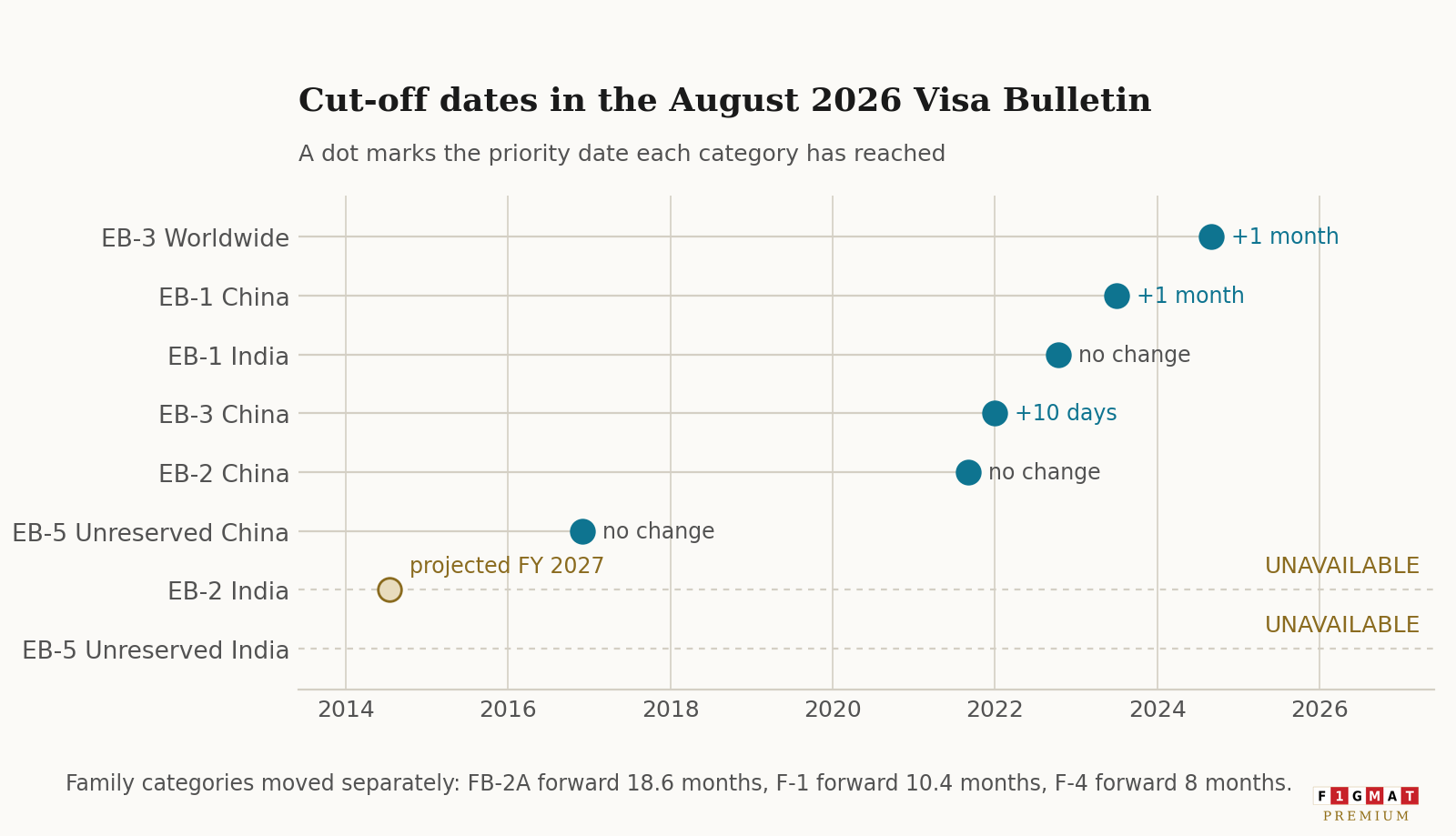
The State Department published the August 2026 Visa Bulletin on July 20, 2026 with continued restriction for India [43].
EB-2 India remains Unavailable for the remainder of FY 2026, and the State Department warns EB-2 in general may retrogress or become Unavailable in the coming months.
EB-1 India remains at October 15, 2022 with a State Department warning that EB-1 India may become Unavailable in coming weeks due to high demand.
EB-1 China advanced one month to July 1, 2023.
EB-2 China remained at September 1, 2021.
EB-3 China advanced 10 days to January 1, 2022.
EB-3 Worldwide advanced one month to September 1, 2024.
EB-5 Unreserved China remained at December 1, 2016.
EB-5 Unreserved India remained Unavailable.
All EB-5 set-asides (Rural, HUA, Infrastructure) remain Current for every country.
In Family-Sponsored categories, FB-2A advanced approximately 18.6 months for most countries, F-1 advanced 10.4 months, and F-4 advanced 8 months.
The State Department indicates that when FY 2027 begins on October 1, 2026, EB-2 India will likely reset to at least July 15, 2014 [43].
OPT and STEM OPT: The Post-Graduation Work Authorization International Graduates Depend On
OPT (Optional Practical Training) is the work authorization F-1 students use to work in the United States after graduation while they figure out the longer-term visa path.
For international MBA and Master's applicants from India, China, and Europe, OPT is the single most important post-graduation mechanism in US immigration law, because it is the bridge between an F-1 visa and any of the longer-term options (H-1B, O-1, L-1, EB-2 NIW, EB-5, or marriage-based green card). It is also the part of the system the second Trump administration has signaled it intends to restrict.
What OPT Is and Who Qualifies
OPT is a category of employment authorization created by Department of Homeland Security regulation under 8 CFR 214.2(f)(10), not by statute [12].
The regulatory rather than statutory basis matters because DHS has the authority to modify or eliminate OPT through notice-and-comment rulemaking without congressional action.
F-1 students who complete a US degree at a SEVP-certified school can apply for OPT to work in a field directly related to their degree.
For MBA and Master's applicants:
- OPT is granted for 12 months per education level. One period of 12 months is available for a master's degree, one separate period of 12 months for a doctoral degree. A second master's degree at the same level does not produce a fresh OPT window.
- OPT does not require an H-1B sponsor, an employer petition, or a labor certification. The student applies directly to USCIS using Form I-765 (Application for Employment Authorization).
- OPT lets the student work for any employer, change employers, work part-time, work as a contractor, work for multiple employers simultaneously, or self-employ, in a field related to the degree.
- The work must be related to the field of study.
SEVP officials and USCIS Fraud Detection and National Security Directorate (FDNS) officers verify this through site visits and through the SEVIS record (Student and Exchange Visitor Information System, the federal database that tracks F-1 students and the work they perform on OPT).
- OPT exists in two forms: pre-completion OPT (used during the program, typically as paid summer internships) and post-completion OPT (used after graduation).
Pre-Completion OPT vs Post-Completion OPT
Pre-completion OPT is used during the degree program.
Most MBA and Master's students do not use pre-completion OPT, because the more flexible alternative for in-program internships is CPT (Curricular Practical Training, the work authorization tied to an academic course or curriculum requirement).
Pre-completion OPT counts against the 12-month total at half-time for part-time work during the academic year, or full-time for summer breaks.
Post-completion OPT is used after graduation.
For MBA and Master's graduates, this is the operative version.
A graduate who uses zero pre-completion OPT during the program has the full 12 months available post-graduation.
A graduate who uses six months of full-time pre-completion OPT (atypical for MBA and Master's students) has six months remaining post-graduation.
CPT, can be used during summer internships in a two-year MBA. It does not reduce post-completion OPT eligibility.
A student can complete a summer associate program on CPT and still file for the full 12-month post-completion OPT after graduation. This is the standard MBA sequence: CPT during the summer between year one and year two, then post-completion OPT starting after May graduation.
One important caveat applies to CPT - Twelve months or more of full-time CPT eliminates post-completion OPT eligibility entirely.
For most MBA students this is not a binding constraint, because a single summer of full-time CPT amounts to roughly three months.
For Master's students at programs that use rotational CPT or year-round CPT (some "Day-1 CPT" programs at smaller universities), the 12-month threshold becomes a real risk, and Day-1 CPT history is now reviewed by USCIS at H-1B and green card adjudication stages.
The Standard 12-Month OPT
Every F-1 graduate of a US master's or MBA program is eligible for 12 months of post-completion OPT, regardless of degree field.
For non-STEM degrees, this is the only OPT window the graduate gets. The 12 months function as a one-shot bridge to H-1B, a green card path, or departure from the US.
The 12-month clock starts on the OPT start date approved by USCIS on Form I-797 (the approval notice) and on the Employment Authorization Document (EAD), Form I-766, that USCIS issues.
The graduate selects a requested start date when filing Form I-765, and USCIS typically approves the requested date if the filing falls within the allowed window.
The start date must fall within the post-completion grace period after the program end date.
That grace period is 60 days for students admitted with Duration of Status before September 15, 2026, and 30 days for students admitted for a fixed period on or after September 15, 2026 under the new Duration of Status Final Rule (subject to the pending preliminary injunction motion filed August 18, 2026).
For non-STEM MBA graduates, the 12-month window matches up against one H-1B lottery cycle.
The lottery runs in March each year, with selections announced by March 31 and H-1B start dates of October 1.
A May 2026 MBA graduate starting OPT in July 2026 has a single H-1B lottery attempt in March 2027 before the OPT runs out in July 2027.
Under the wage-weighted lottery in FY 2027, actual Level 2 registrations dropped substantially from the FY 2026 baseline.
The FY 2027 cap was met on July 17, 2026 with no second selection round, and 71.5 percent of selected beneficiaries held US advanced degrees.
Selection rates in future years depend on whether the $100,000 fee is renewed after September 20, 2026 and how registration volume responds.
The non-STEM graduate has one shot regardless.
The 24-Month STEM OPT Extension
The STEM OPT extension was created by the DHS STEM OPT Interim Final Rule of 2008 and expanded to its current 24-month form by the May 10, 2016 STEM OPT Final Rule under the Obama administration [14].
The extension allows F-1 students who complete a STEM-designated degree to extend post-completion OPT by 24 additional months on top of the standard 12, for a cumulative 36 months of post-graduation work authorization.
Eligibility requires:
- Featured on the DHS STEM Designated Degree Program List (studyinthestates.dhs.gov).
- Employment with an E-Verify-enrolled US employer (E-Verify is the federal electronic employment-eligibility verification system; not every employer is enrolled, which constrains STEM OPT employer selection)
- A formal training plan documented on Form I-983
- The employer's commitment to provide training comparable to that given to similarly-situated US workers.
For MBA and Master's graduates of STEM-designated programs, the 24-month extension produces 36 cumulative months of OPT, which converts to three H-1B lottery attempts.
Cumulative odds across three attempts are higher for STEM OPT extension candidates, but the wage-weighted lottery introduced February 27, 2026 concentrates selection probability at OEWS Levels 3 and 4.
STEM Designation in MBA and Master's Programs
How MBA Programs Got STEM Designation
MBA programs are not historically STEM.
The traditional MBA CIP code (52.0201, Business Administration and Management, General) is not on the DHS STEM list.
Schools moved their MBA programs to STEM-eligible CIP codes (most commonly 52.1301 Management Science, 52.1302 Business Statistics, or 52.1399 Management Sciences and Quantitative Methods, Other) to give international students access to the 24-month extension.
The University of Rochester's Simon Business School moved its entire MBA to STEM in 2018, the first top program to do so.
Most M7 programs followed between 2018 and 2022.
Harvard Business School was the last M7 holdout, finally moving its entire MBA to STEM designation effective with the Class of 2025 (announced July 24, 2024).
As of August 2026, every top-25 US MBA program has at least one STEM-eligible pathway, though some require a specific track, major, or concentration.
The M7 STEM Status (August 2026)
| School | STEM Coverage |
|---|---|
| Harvard Business School | Full MBA STEM-designated (effective Class of 2025) |
| Stanford GSB | Full MBA STEM; MSx (one-year management) also STEM |
| Wharton (UPenn) | Partial. Specific majors only: AI for Business, Business Analytics, Business Economics and Public Policy, Business and Sustainability, Finance, Operations Information and Decisions, Quantitative Finance, Statistics, Actuarial Science |
| Chicago Booth | Full MBA STEM (every concentration qualifies) |
| Northwestern Kellogg | Full MBA STEM. Part-time MBA, Executive MBA, Master in Management, and MMM (MBA + MS in Design Innovation) also STEM |
| MIT Sloan | Full MBA STEM (every track and elective qualifies) |
| Columbia Business School | Full MBA STEM. Executive MBA also STEM |
Wharton is the only M7 program where the choice of major determines STEM eligibility. For a Wharton international applicant who wants the 24-month extension, the practical implication is that the major selection (typically declared in the second year) is not flexible. The student must complete one of the listed STEM majors.
Top 8 to 25 STEM Status (August 2026)
| School | STEM Coverage |
|---|---|
| NYU Stern | Full MBA STEM. Andre Koo Technology and Entrepreneurship MBA (one-year) also STEM |
| Berkeley Haas | Full MBA STEM. Evening, Weekend, and Executive MBA also STEM |
| Dartmouth Tuck | Partial. Management Science track only |
| Yale SOM | Full MBA STEM (requires Management Science concentration completion) |
| Cornell Johnson | Two-Year Management Science MBA, One-Year Management Science MBA, Johnson Cornell Tech MBA, all STEM |
| Michigan Ross | Partial. Management Science track only |
| Duke Fuqua | Partial. Management Science and Technology Management track in Daytime and Accelerated Daytime MBA |
| UVA Darden | Partial. Management Science track only |
| CMU Tepper | Full MBA STEM (longest-standing STEM MBA among top programs) |
| USC Marshall | Full MBA STEM |
| Texas McCombs | Full MBA STEM |
| UCLA Anderson | Full MBA STEM |
| Emory Goizueta | Full One- and Two-Year MBA, Evening MBA, all STEM |
| Indiana Kelley | Full MBA STEM |
| UNC Kenan-Flagler | Full MBA STEM |
| Vanderbilt Owen | Full MBA STEM |
| Notre Dame Mendoza | Full MBA STEM |
| Washington Foster | Full MBA STEM |
| Rice Jones | Full MBA STEM |
| Georgia Tech Scheller | Full MBA STEM |
| BU Questrom | Full MBA STEM |
| Maryland Smith | Partial. STEM tracks available |
| Rochester Simon | Full MBA STEM (first top program to do so, 2018) |
The pattern is clear: every full-time MBA program in the top 25 either has full STEM designation or has at least one STEM-eligible track.
The variation matters for school selection because partial-STEM programs (Wharton, Tuck, Darden, Ross, Fuqua) constrain major selection for international students who need the 24-month extension.
Master's Programs: STEM by Default in Most Quantitative Fields
For Master's applicants, most quantitative master's programs at US business schools have STEM-eligible CIP codes by default:
- Master's in Business Analytics: STEM at MIT, Columbia, NYU Stern, USC Marshall, UCLA Anderson, Texas McCombs, Wharton, Duke Fuqua, Georgia Tech Scheller, and essentially every program with "Analytics" or "Data" in the title.
- Master's in Financial Engineering / Computational Finance: STEM at CMU Tepper, Berkeley Haas, UCLA Anderson, Cornell Tech, NYU Tandon, Columbia, Princeton, and similar quantitative finance master's programs
- Master's in Data Science: STEM at every US program (the CIP code itself is on the DHS list).
- Master's in Computer Science: STEM at every US program.
- Master's in Statistics, Operations Research, Applied Mathematics: STEM at every US program.
- Master's in Management Information Systems: STEM at almost every US program.
- Master's in Finance: Variable. Many programs sit on STEM-eligible CIP codes (Princeton, MIT MFin, Vanderbilt MS Finance, Washington University Olin, USC Marshall MSF), but some remain on the non-STEM Finance General code.
- Master's in Marketing: Variable. Most programs are non-STEM, with exceptions for programs that emphasize marketing analytics or marketing science (Columbia MS in Marketing Science, USC Marshall MS in Marketing).
- Master's in Management (MiM): Variable. The trend toward STEM at quantitative MiM programs (Kellogg, Duke Fuqua, Emory Goizueta).
Why This Matters for Indian, Chinese, and European Applicants
For an MBA applicant from India or China, the choice between a full-STEM program (any M7 except Wharton, plus Booth, Kellogg, MIT, Columbia, Stanford, HBS) and a partial-STEM program (Wharton, Tuck, Darden, Ross, Fuqua) has substantial downstream implications for the H-1B lottery math.
The full-STEM choice triples the lottery attempts available during OPT, which is the single most consequential variable in the post-graduation work plan after admission itself.
For European applicants, the STEM question is less binding because EB-2 is Current for every European country, which means the EB-2 NIW path can produce a green card during the standard 12-month OPT window without needing the STEM extension or the H-1B lottery.
How to Verify STEM Status Before Applying
The school's website and admissions materials are the right starting point but are sometimes out of date. The authoritative checks for an MBA or Master's program's STEM status:
The CIP code on the Form I-20: The Form I-20 (Certificate of Eligibility for Nonimmigrant Student Status) issued by the school's international student office lists the primary CIP code for the specific program [61]. The code must be on the DHS STEM Designated Degree Program List, which is published at studyinthestates.dhs.gov and updated periodically [61].
• The school's international student services office directly: Ask for the CIP code in writing and confirm it is on the current DHS STEM list. Some schools have multiple programs under similar names with different CIP codes (a "STEM track" and a "non-STEM track" at the same school).
• Conversation with current international students at the program: Ask whether they have applied for or received the 24-month STEM OPT extension under the program's current CIP code.
The CIP codes below are the codes each program has assigned to its full-time MBA on the Form I-20 as of the current cycle.
Two four-digit family codes cover most of the field.
52.1301 (Management Science, General) is the standard STEM code adopted by schools that reclassified their entire MBA under the STEM umbrella.
52.1399 (Management Sciences and Quantitative Methods, Other) is the alternative STEM code used by a smaller set of programs.
The default non-STEM MBA code is 52.0201 (Business Administration and Management, General), and it still applies to specific tracks at schools where only certain majors qualify.
CIP Codes at M7 Programs
| School | CIP Code on I-20 | Scope and Notes |
|---|---|---|
| Harvard Business School | 52.1399 | Entire MBA reclassified to Management Sciences and Quantitative Methods CIP effective Class of 2025 [61] |
| Stanford GSB | 52.1301 | Full MBA STEM; MSx (one-year management) also STEM under 52.1301 |
| Wharton (UPenn) | 52.0201 (default) | Non-STEM by default. STEM majors carry separate CIPs: 30.7102 Business Analytics; 27.0501 Statistics; 52.1304 Actuarial Science; 52.1301 for Management Science and Business Economics and Public Policy [61] |
| Chicago Booth | 52.1301 | Full MBA STEM since 2020; every concentration qualifies |
| Northwestern Kellogg | 52.1301 | Full MBA STEM. Part-time MBA, Executive MBA, MiM, and MMM also STEM under the same CIP |
| MIT Sloan | 52.1301 | Full MBA STEM; every track and elective qualifies |
| Columbia Business School | 52.1301 | Full MBA STEM. Executive MBA also STEM under the same CIP |
CIP Codes at Top 20 US MBA Programs (Ranks 8 through 25)
| School | CIP Code on I-20 | Scope and Notes |
|---|---|---|
| NYU Stern | 52.1301 | Full MBA STEM. Andre Koo Technology and Entrepreneurship MBA (one-year) also STEM under 52.1301 |
| Berkeley Haas | 52.1301 | Full MBA STEM; Evening, Weekend, and Executive MBA also STEM. Berkeley memo cites 52.1301 Management Science as the aligned code [62] |
| Dartmouth Tuck | 52.0201 / 52.1301 | Partial: 52.0201 by default, 52.1301 for Management Science track completers |
| Yale SOM | 52.1301 | Full MBA STEM. Requires completion of the Management Science concentration for the STEM CIP to attach on the I-20 |
| Cornell Johnson | 52.1301 | Two-Year Management Science MBA, One-Year Management Science MBA, and Johnson Cornell Tech MBA all under 52.1301 |
| Michigan Ross | 52.0201 / 52.1301 | Partial: 52.0201 by default, 52.1301 for Management Science track completers |
| Duke Fuqua | 52.0201 / 52.1301 | Partial: Management Science and Technology Management track in Daytime and Accelerated Daytime MBA carries 52.1301 |
| UVA Darden | 52.0201 / 52.1301 | Partial: 52.0201 by default, 52.1301 for Management Science track completers |
| CMU Tepper | 52.1301 | Full MBA STEM; longest-standing STEM MBA at a top program |
| USC Marshall | 52.1301 | Full MBA STEM. Marshall registrar memo cites 52.1301 Management Science as the aligned code for all MBA tracks [63] |
| Texas McCombs | 52.1301 | Full MBA STEM |
| UCLA Anderson | 52.1301 | Full MBA STEM |
| Emory Goizueta | 52.1301 | Full One- and Two-Year MBA and Evening MBA under 52.1301 |
| Indiana Kelley | 52.1301 | Full MBA STEM |
| UNC Kenan-Flagler | 52.1301 | Full MBA STEM |
| Vanderbilt Owen | 52.1301 | Full MBA STEM |
| Notre Dame Mendoza | 52.1301 | Full MBA STEM |
| Washington Foster | 52.1301 | Full MBA STEM |
| Rice Jones | 52.1301 | Full MBA STEM |
| Georgia Tech Scheller | 52.1301 | Full MBA STEM |
| Rochester Simon | 52.1301 | Full MBA STEM; first top program to move to STEM in 2018 |
Three practical notes on reading the table. First, the CIP code on the I-20 is what matters; the code printed on the diploma or transcript does not affect STEM OPT eligibility.
Second, at partial-STEM programs (Wharton, Tuck, Darden, Ross, Fuqua), the STEM CIP attaches only when the student completes the specific track or major requirements, which usually means declaring the major or track early enough that the international student office can issue an updated I-20 before graduation.
Third, CIP assignments are subject to periodic review by both the school and the DHS STEM Designated Degree Program List; verify the current CIP with the international student office at the point of admission acceptance rather than at graduation.
For partial-STEM programs (Wharton, Tuck, Darden, Ross, Fuqua), the choice of major or track is the decisive variable.
The application should confirm in advance that the desired major is on the STEM-eligible list, and the student should plan to complete the major requirements early enough that the school can issue the I-20 with the correct CIP code at the right time.
Switching tracks late in the program can disqualify the STEM extension.
The OPT Application Process and Timeline
The mechanical sequence for post-completion OPT differs depending on whether the student is subject to Duration of Status (admitted before September 15, 2026) or the new fixed-period admission framework (September 15, 2026 forward):
- Day 90 before program end date: Earliest day to file Form I-765 (Application for Employment Authorization) with USCIS. Filing earlier produces a longer USCIS processing window before the OPT start date, which reduces the risk of a gap.
- Grace period after program end date: 60 days for students admitted with Duration of Status before September 15, 2026 (grandfathered under the new final rule). 30 days for students admitted for a fixed period on or after September 15, 2026. USCIS accepts OPT applications only within the grace period, which is also used for transfer to a new SEVP-certified program or departure from the US.
- OPT start date: Selected by the student on Form I-765, must fall within the grace period after the program end date. The student cannot work for a US employer before the start date, even if the EAD has been received.
- USCIS processing time: Typically 3 to 5 months for Form I-765.
- EAD card receipt: USCIS mails the EAD (Form I-766, the physical Employment Authorization Document card) once the application is approved. Work can begin on the start date listed on the EAD.
The filing fee for Form I-765 rose from $1,685 to $1,780 in 2026.
The same form is used for the 24-month STEM OPT extension, filed within 90 days before the standard OPT end date.
USCIS rejects applications with incorrect fees, and rejection during the narrow filing window can void eligibility.
For MBA graduates with a May graduation date, the practical schedule under Duration of Status (grandfathered) is: February to early March file I-765; May or June receive EAD with July 1 start date; July through following June is the 12-month OPT window; March of OPT year is the first H-1B lottery attempt; April through June of the OPT year is the STEM OPT extension filing window for STEM-eligible graduates.
Under the new fixed-period framework with a 30-day grace period, the filing window compresses substantially.
Students who file Form I-765 later in the pre-graduation window face substantially less buffer if USCIS issues a Request for Evidence or if documentation delays arise.
Students admitted before September 15, 2026 retain the 60-day grace period until they travel and re-enter or their program ends, so a Class of 2028 admit entering the US on F-1 status in fall 2026 (before the effective date) keeps the 60-day framework through their entire program.
H-1B Cap-Gap Extension
The H-1B cap-gap extension is the rule that bridges the gap between OPT expiration and H-1B start date for students whose H-1B is selected in the lottery. Under 8 CFR 214.2(f)(5)(vi), an F-1 student whose H-1B is approved with a change-of-status request and an October 1 start date has automatic extension of F-1 status and OPT employment authorization through September 30, even if the OPT EAD expires before then.
For MBA and Master's graduates, cap-gap is the structural protection against the awkward case where OPT runs out in June or July but the H-1B does not start until October 1.
Without cap-gap, the student would have to stop working in June or July and wait three months in F-1 status before resuming work on H-1B.
Cap-gap applies only to H-1B petitions filed with a request for change of status. It does not apply to H-1B petitions filed for consular notification (where the student would need to leave the US, attend an interview at a US consulate, and re-enter on H-1B).
As of August 23, 2026, the $100,000 H-1B fee attached to consular-notification petitions is not being collected following the First Circuit's July 24, 2026 stay denial in State of California v. Mullin [26].
That position may change if the Supreme Court grants emergency relief or if the administration renews the underlying Proclamation 10973 after its September 20, 2026 expiration by its own terms [2].
The change-of-status path continues to avoid the fee entirely under either scenario, making cap-gap valuable as a strategic mechanism to keep the H-1B path inside the US.
Unemployment Limits During OPT
OPT comes with a hard cap on unemployment days.
A graduate on standard 12-month OPT cannot accumulate more than 90 days of unemployment without losing OPT eligibility.
The cap rises to 150 days for graduates on the 24-month STEM OPT extension (90 days from the original OPT plus 60 additional days during the extension period).
The 90-day or 150-day clock counts every day the graduate is not employed for at least 20 hours per week in a field related to the degree.
Volunteering and unpaid internships count as employment if they are related to the degree and meet the 20-hour-per-week threshold.
Self-employment counts if the graduate has registered the business, has the necessary licenses, is actively engaged in business activity, and the work is related to the degree.
USCIS does not check unemployment days continuously, but the SEVIS record (which the school's Designated School Official or DSO updates based on employment reports) is the primary documentation.
Exceeding the unemployment cap voids OPT and triggers SEVIS termination, which ends F-1 status and starts an unlawful-presence clock.
For graduates whose first post-MBA job ends within OPT (layoffs in tech, consulting up-or-out, startup failures), the unemployment clock becomes a planning constraint on job search timing.
STEM OPT Employer and Reporting Requirements
STEM OPT carries reporting and compliance requirements that the standard 12-month OPT does not:
- E-Verify enrollment: The employer must be enrolled in E-Verify, the federal employment-eligibility verification system. Many small companies and US offices of foreign companies are not enrolled, which constrains employer choice.
- Form I-983 training plan: Both the student and an authorized representative of the employer must sign the I-983, which outlines specific training goals, supervisor identity, training methods, and how the training relates to the STEM degree. The I-983 is submitted to the school's DSO, not directly to USCIS.
- Periodic reporting:The student must report to the DSO every six months confirming continued employment, current address, current employer, and any changes.
- Wage and working conditions: STEM OPT employment must include terms and conditions, including wage, commensurate with those of similarly-situated US workers.
- Site visits: DHS site visits to STEM OPT employer worksites have increased substantially since the May 12, 2026 ICE enforcement campaign announcement.
For employer selection during the post-MBA job search, the practical implication is that STEM OPT-eligible employers are a substantially narrower set than the universe of US employers.
Consulting firms (McKinsey, Bain, BCG, Deloitte, EY-Parthenon), large tech firms (Google, Meta, Microsoft, Amazon, Apple), large banks (Goldman Sachs, JPMorgan, Morgan Stanley, Citi), and most large US corporations are E-Verify enrolled and have established STEM OPT compliance processes.
Smaller employers, foreign-headquartered firms with limited US presence, and pre-Series A startups often are not.
Trump 1's OPT Record (2017 to 2021)
The first Trump administration probed OPT through multiple administrative channels but did not succeed in restricting it through formal rulemaking.
The actions taken and their outcomes: EO 13788 Buy American Hire American directed federal agencies to protect US workers; the May 2018 unlawful presence memo was later enjoined by federal courts; 2018-2020 site visits increased; WashTech v. DHS (May 2020) challenged OPT authority and was upheld by the DC Circuit in 2022 [30]; the November 2020 proposal to reduce the grace period from 60 to 30 days was not finalized.
OPT survived, with somewhat more enforcement friction and slower processing, but no fundamental change.
Trump 2's OPT Actions and Pending Changes (2025 to August 23, 2026)
The second Trump administration has moved with substantially more focus on OPT. The actions and statements through August 23, 2026:
May 21, 2025: USCIS Director nominee Joseph Edlow noted in Senate confirmation testimony that OPT exists by regulation rather than statute, and that DHS therefore has the authority to modify or eliminate it through rulemaking without congressional action.
August 27, 2025: Duration of Status Proposed Rule published, including the 30-day grace period shortening [16]. OMB submission May 5, 2026. OIRA review completed June 17, 2026.
Fall 2025 Unified Agenda: Rulemaking entry RIN 1653-AA97 opened on practical training regulations, signaling intent to publish a Notice of Proposed Rulemaking specifically on OPT and STEM OPT changes.
January 9, 2026: Then-Secretary Noem letter to Senator Schmitt confirming DHS re-evaluation of OPT and the 24-month STEM OPT extension [38].
March 23-24, 2026: DHS Secretary change. Kristi Noem was ousted following the Minnesota shootings of Alex Pretti and Renee Good by federal immigration agents. Markwayne Mullin (R-OK) was confirmed by the Senate 54-45 on March 23, 2026 and sworn in March 24, 2026 [51]. Noem was reassigned as Special Envoy for the Shield of the Americas. The OPT review continues under Mullin.
May 12, 2026: ICE announced identification of more than 10,000 fraud cases across OPT employers. Acting ICE Director Todd M. Lyons: "More actions are forthcoming." [50]
2026 fee increase: The OPT application fee rose from $1,685 to $1,780.
July 17, 2026:Duration of Status Final Rule published in Federal Register at 91 FR 44976, effective September 15, 2026 [15]. Rule replaces D/S with fixed admission period not exceeding 4 years plus 30 days post-completion grace, subject to Congressional Review Act. F-1 students admitted before September 15, 2026 grandfathered with 60-day grace through November 14, 2030 or program completion, whichever comes first.
August 18, 2026: Coalition of eight higher-education associations and unions filed suit challenging the Duration of Status Final Rule in D. Mass. (Presidents' Alliance v. DHS, 1:26-cv-13799), seeking preliminary injunction before September 15 effective date.
Expected late 2026: OPT-specific NPRM under RIN 1653-AA97. Expected to cover one or more of: narrower STEM OPT extension eligibility, additional employer reporting, prevailing-wage compliance similar to H-1B, shorter STEM OPT period (12 or 18 months), or elimination for certain fields.
Day-1 CPT scrutiny: USCIS and ICE have increased scrutiny of Day-1 CPT programs (used by some graduate students to maintain US employment after exhausting OPT). Day-1 CPT history is now reviewed at H-1B and green card adjudication stages.
Pending Legislation and Competing Bills
Three bills in the 119th Congress warrant tracking for post-graduation work impact.
HR 2315, the Fairness for High-Skilled Americans Act of 2025:Would terminate the OPT program entirely.
Rep. Paul Gosar (R-AZ) introduced it on March 25, 2025 with 11 Republican co-sponsors [52]. Co-sponsor count has grown to more than 30 as of August 2026, including one Democrat (Rep. Donald Norcross, D-NJ-1, added April 27, 2026).
The bill was referred to the House Judiciary Committee on the day of introduction and remains pending in committee with no markup or committee action. Analysts estimate roughly 25 percent passage probability; Senate passage would require 60 votes.
American White-Collar Worker Jobs Act of 2026 (introduced March 2026):A broader package that would end OPT, shorten H-1B duration, eliminate dual intent, and remove the H-1B-to-green-card pathway [53]. The bill has not passed either chamber.
Keep Innovators in America Act:A competing pro-OPT bill designed to strengthen OPT's statutory footing [54]. The bill would give OPT explicit congressional backing rather than leaving it as a DHS regulatory creation. If enacted, the Trump 2 rulemaking pathway to modify or restrict OPT would face substantially higher legal hurdles.
The three bills face institutional dynamics that pull in opposite directions. OPT termination has support from restrictionist advocacy groups. OPT preservation has institutional support from higher education, tech and consulting employers, and the US Chamber of Commerce. Most likely outcome: incorporation of one or another provision into a larger immigration package rather than standalone passage.
OPT Termination vs. OPT Preservation
OPT termination has support from restrictionist advocacy groups
OPT preservation has institutional support from the US higher education sector, US employers in tech and consulting, and the US Chamber of Commerce.
Most likely legislative outcome - incorporation of one or another bill into a larger immigration package.
Key takeaways
- F-1 application - A screening stage: Since 6 September 2025, applicants must interview in their country of nationality or residence, which ends the practice of applying in a third country with shorter queues.
- Current employer is a visa asset: The L-1 needs 12 months of continuous employment at a qualifying foreign affiliate within the preceding three years, which a two-year program does not affect. Use MBB, BigTech, and Big Four employment to your visa advantage
- INA §212(e) is the clause that catches dual-degree and exchange applicants: It requires certain J-1 holders to return home for two years before they can move to H-1B, H-4, L-1, L-2 or an immigrant visa, and it runs by statute rather than by policy.
- Permanent residence is a longer and separate problem from the work visa: From 18 September 2026, the rescinded public charge framework lets officers weigh receipt of a wider range of means-tested benefits, including college financial aid, under a totality-of-the-circumstances review.
- Three bills will decide OPT: HR 2315 and the American White-Collar Worker Jobs Act of 2026 would end OPT, while the Keep Innovators in America Act would give it statutory footing.
References
- Proclamation 10949: Restricting the Entry of Foreign Nationals To Protect the United States From Foreign Terrorists (June 4, 2025, 19-country ban effective June 9, 2025) ↩ ↩
- Proclamation 10973: Restriction on Entry of Certain Nonimmigrant Workers (September 19, 2025, $100,000 H-1B fee expiring September 20, 2026) ↩ ↩ ↩ ↩ ↩
- Proclamation 10998: Restricting and Limiting the Entry of Foreign Nationals (December 16, 2025, expansion to 39 countries effective January 1, 2026) ↩ ↩
- Executive Order 14159: Protecting the American People Against Invasion (January 20, 2025)
- Executive Order 14161: Protecting the United States from Foreign Terrorist and Other National Security Threats (January 20, 2025)
- Executive Order 14351: The Gold Card Program (September 19, 2025)
- Continuing to Protect the Meaning and Value of American Citizenship, and Ending Birth Tourism (Executive Orders, August 6, 2026) ↩
- Proclamation 10043: F and J restrictions for Chinese nationals tied to military-civil fusion entities (May 29, 2020, continued under Trump 2)
- Immigration and Nationality Act (sections 101(a)(15)(F), 101(a)(15)(H), 202(b), 203(b), 203(c), 212(a)(4), 212(e)) ↩ ↩ ↩
- One Big Beautiful Bill Act, Public Law 119-21 (July 4, 2025, $250 Visa Integrity Fee on nonimmigrant visa issuances) ↩ ↩ ↩ ↩
- EB-5 Reform and Integrity Act of 2022, Public Law 117-103 (March 15, 2022)
- 8 CFR 214.2(f)(10): the OPT regulatory framework ↩
- 8 CFR 214.6: TN framework incorporating the USMCA Appendix 2 professional occupations list ↩ ↩
- STEM OPT Final Rule, 81 FR 13040 (May 10, 2016, establishing the 24-month extension) ↩ ↩
- Duration of Status Final Rule, 91 FR 44976 (July 17, 2026, 156 pages, effective September 15, 2026) ↩ ↩ ↩ ↩ ↩ ↩
- Duration of Status Proposed Rule, 90 FR 42070 (August 27, 2025, RIN 1653-AA95, docket ICEB-2025-0001) ↩
- Wage-Weighted H-1B Selection Final Rule, 90 FR 60864 (December 29, 2025, effective February 27, 2026) ↩ ↩ ↩
- H-1B Modernization Rule, 89 FR 103054 (December 18, 2024, priority date retention protections)
- DOL Prevailing Wage NPRM: Improving Wage Protections (March 27, 2026, proposed 21 to 33 percent OEWS increase) ↩
- Public Charge Final Rule, 91 FR 45324 (July 20, 2026, docket USCIS-2025-0304, effective September 18, 2026) ↩ ↩
- DHS EB-5 Proposed Rule, 91 FR 40676 (July 2, 2026, 358 pages, comments close August 31, 2026)
- DHS Discretionary EAD NPRM (June 5, 2026, comment period closed August 4, 2026)
- OPT Practical Training Reform NPRM, RIN 1653-AA97 (expected late 2026, Spring 2025 Unified Agenda) ↩
- Trump v. Barbara (Supreme Court, June 30, 2026, Fourteenth Amendment citizenship ruling) ↩ ↩
- State of California v. Mullin (D. Mass., June 8, 2026, Judge Leo T. Sorokin vacating the $100,000 H-1B fee) ↩ ↩ ↩
- First Circuit stay denial in State of California v. Mullin, No. 26-01699 (July 24, 2026, merits briefing closes October 16, 2026) ↩ ↩ ↩ ↩
- Presidents' Alliance on Higher Education and Immigration v. DHS, 1:26-cv-13799 (D. Mass., filed August 18, 2026, Duration of Status challenge) ↩ ↩ ↩
- Dorcas International Institute of Rhode Island v. USCIS, 1:26-cv-00132-JJM-PAS (D.R.I., final judgment June 11, 2026, PM 602-0193 not vacated)
- US Chamber of Commerce and Association of American Universities v. Trump (D.D.C., late 2025, $100,000 H-1B fee upheld) ↩
- Washington Alliance of Technology Workers v. DHS, 24 F.4th 1002 (DC Cir. 2022, OPT and STEM OPT authority upheld) ↩
- Trump v. Hawaii, 585 U.S. 667 (June 26, 2018, Proclamation 9645 upheld)
- Behring Regional Center LLC v. Wolf (N.D. Cal., June 22, 2021, EB-5 Modernization Rule vacated)
- USCIS Policy Manual, Volume 6, Part F, Chapter 5 (January 15, 2025 update on extraordinary ability and NIW)
- USCIS Policy Update PA-2025-05: Professionals under the USMCA (June 4, 2025, Management Consultant supernumerary test) ↩ ↩
- USCIS Policy Manual PA-2026-09: Public Charge framework (July 2026, effective September 18, 2026) ↩ ↩ ↩
- USCIS Policy Memorandum: Adjustment of Status is a Matter of Discretion and Administrative Grace (May 21, 2026)
- USCIS Policy Memoranda PM 602-0192, PM 602-0193, PM 602-0194, and PA 2025-26 (hold and review of high-risk country and DV adjustment applications)
- Letter from DHS Secretary Kristi Noem to Senator Eric Schmitt (January 9, 2026, released February 26, 2026, OPT and 24-month STEM OPT re-evaluation) ↩
- State Department cable on social media disclosure for F, M, and J applicants (June 18, 2025, Form DS-160) ↩ ↩
- State Department third-country national interview directive (September 6, 2025) ↩
- Secretary Rubio directive on Chinese student visa revocations in critical fields (May 28, 2025)
- Public Notice 12555, Revised Exchange Visitor Skills List, 89 FR 97567 (December 9, 2024, list cut from 82 to 45 countries) ↩ ↩
- August 2026 Visa Bulletin (US Department of State, published July 20, 2026) ↩ ↩
- State Department policy on mandatory in-person consular interviews for F-1 applicants including renewals (October 1, 2025) ↩ ↩
- State Department DV-2027 announcement (November 5, 2025, $1 registration fee and April 10, 2026 passport requirement)
- State Department expansion of social media vetting to 14 additional visa categories (March 30, 2026) ↩
- State Department announcement of expanded H-1B and H-4 vetting (December 3, 2025, effective December 15, 2025) ↩ ↩
- USCIS FY 2027 H-1B lottery results (May 2026, 211,600 registrations, 38.5 percent drop from 343,981, 71.5 percent advanced degree, 17.7 percent OEWS Level 1) ↩ ↩ ↩ ↩ ↩
- USCIS confirmation that the FY 2027 H-1B cap was met with no second selection round (July 17, 2026) ↩ ↩ ↩
- ICE announcement identifying more than 10,000 OPT employer fraud cases (May 12, 2026, Acting Director Todd M. Lyons) ↩
- DHS Secretary transition (March 23 to 24, 2026, Markwayne Mullin confirmed 54-45, Kristi Noem reassigned as Special Envoy for the Shield of the Americas) ↩ ↩
- HR 2315, Fairness for High-Skilled Americans Act of 2025 (introduced March 25, 2025 by Rep. Paul Gosar, 30-plus co-sponsors, pending in House Judiciary) ↩
- American White-Collar Worker Jobs Act of 2026 (introduced March 2026) ↩
- Keep Innovators in America Act (competing bill giving OPT explicit congressional backing) ↩
- Critical and Emerging Technologies List Update (White House OSTP, February 12, 2024, 18 CET categories)
- Matter of Dhanasar, 26 I&N Dec. 884 (AAO 2016, three-prong NIW test)
- Lawfully case-tracking platform: EB-2 NIW approval rate near 44 percent for regularly-processed petitions (March 2026)
- NAFSA: Association of International Educators (lead plaintiff in Presidents' Alliance v. DHS)
- AILA practice alerts on Duration of Status, Public Charge, and the $100,000 H-1B fee
- Ogletree Deakins immigration client alerts, Fragomen, and Berry Appleman & Leiden
- HBS MBA Program Is Now STEM Designated (Harvard Business School, July 24, 2024, CIP 52.1399 from the Class of 2025) ↩ ↩ ↩ ↩
- UC Berkeley Haas CIP Code Memo for the MBA (CIP 52.1301 Management Science, General) ↩
- USC Marshall verification letter for the STEM OPT extension (CIP 52.1301) ↩
- DHS STEM Designated Degree Program List (400-plus CIP codes including 52.1301, 52.1302, 52.1304, 52.1399, 30.7101, 30.7102)
- NCES Classification of Instructional Programs, 2020 Edition (definition of CIP 52.1301)