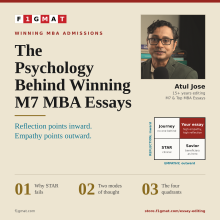
In this episode of Winning MBA Admissions Tips Podcast, Atul Jose builds a reflection-empathy matrix for M7 MBA essays and shows where most drafts fall on it.
Atul starts with the STAR framework, a Situation-Task-Action-Result structure built for behavioral interviews, and explains why essays built on it blur together when an admissions committee reads them back to back.
Atul then walks through a consultant client's draft for a school where women applicants have been underrepresented.
Schools stereotype male applicants for high agency and risk-taking and female applicants for high agency and empathy, and the client's draft worked against her.
Every paragraph followed STAR, and the essay read like an autopsy of her own career, with herself inserted as a variable.
Atul draws on the two modes of human thought: paradigmatic thinking, the mode that categorizes and verifies events, and narrative thinking, the mode that builds meaning from human intentions. He argues that neither mode should form the core of an MBA essay.
Van Laer and colleagues' 2014 transportation theory supplies the missing piece, since a reviewer has to enter the applicant's world and feel the constraints and setbacks as their own.
Atul closes by sorting essays into four quadrants.
The STAR essay scores low on reflection and low on empathy.
The journey essay reflects on the applicant's life with no other person in view.
The savior narrative makes the beneficiary the hero and pushes the applicant to the side.
The high-reflection, high-empathy essay keeps the applicant as the hero while giving the supporting characters full weight.
For help balancing reflection and empathy in your drafts, see F1GMAT's Essay Editing Service