From Q3 2024 to Q3 2025, geopolitics shifted from a background risk to a primary force shaping the structure of the global technology industry. The clearest divergences unfolded across the United States, China, Europe, and emerging Asia, each moving according to distinct industrial strategies, security concerns, and AI adoption priorities.
State-Wise (United States): AI Investments and Strengths
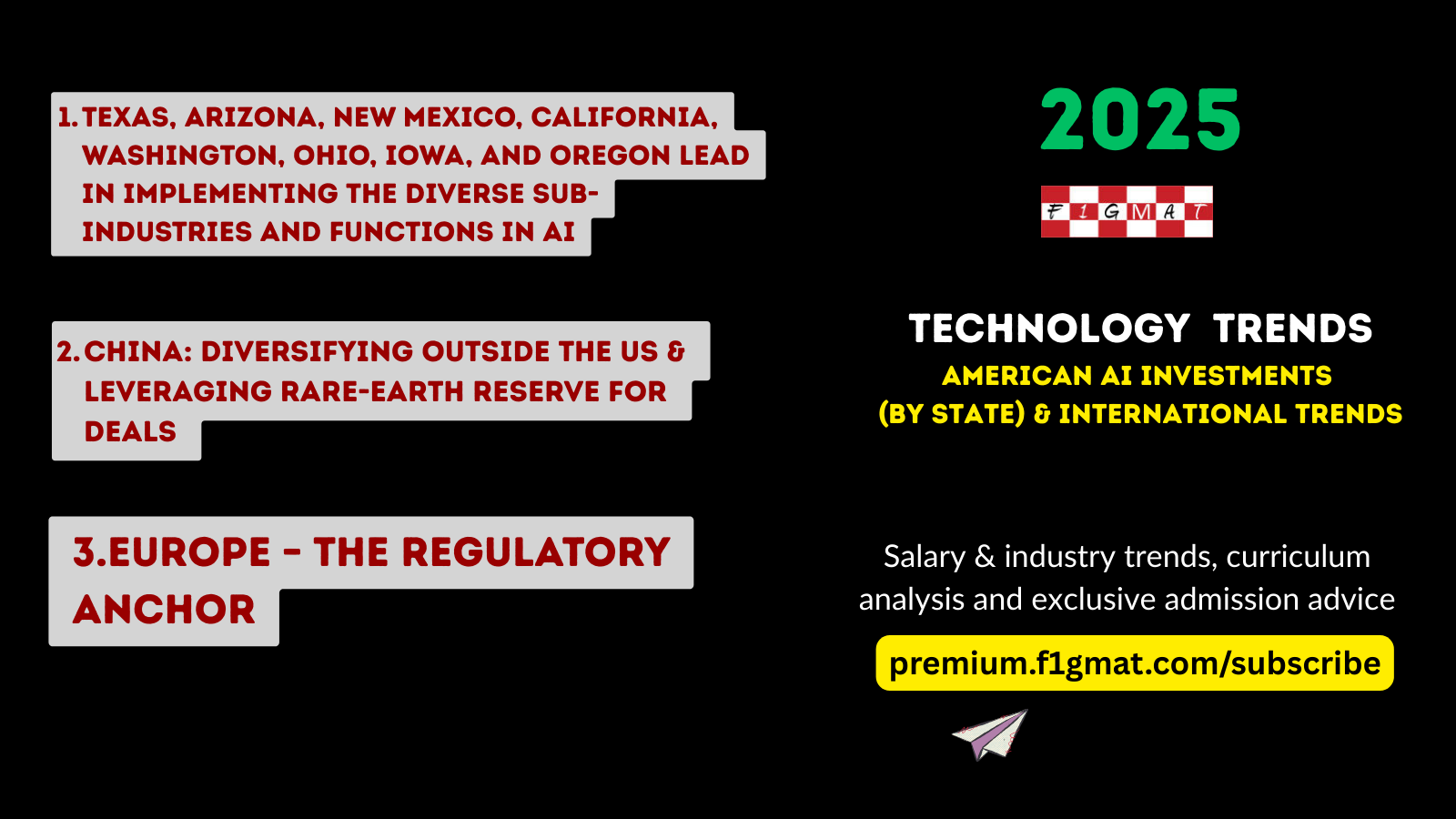
The United States became the epicenter of AI, semiconductor, and data-center investment. In 2025, it generated the largest share of global IPO proceeds and led capital formation for AI infrastructure. This investment boom had clear regional footprints. States such as Texas, Arizona, and New Mexico absorbed the bulk of semiconductor reshoring, driven by CHIPS Act incentives and the clustering of TSMC, Intel, Samsung, and emerging packaging facilities. At the same time, the Pacific Northwest and Northern Virginia remained the fastest-growing data-center markets, reflecting hyperscaler CapEx that exceeded $75 billion in Q2 2025.
California and Washington continued to dominate AI model development and cloud engineering talent, while Ohio, Iowa, and Oregon emerged as new GPU-dense data-center hubs due to lower energy costs and more flexible permitting. U.S. regulators also tightened scrutiny of Chinese hardware and cloud providers, forcing supply chains to shift toward domestic manufacturing or nearshoring partners in Mexico, Vietnam, and India. By Q3 2025, regional tech ecosystems inside the U.S. no longer grew uniformly; they expanded around infrastructure capacity, energy availability, and national-security–aligned supply-chain planning.
China: Diversifying Outside the US & leveraging rare-earth reserve for Deals
China intensified its strategy of technological self-reliance. Export controls on Nvidia GPUs accelerated domestic chip development and pushed Chinese firms to expand into Southeast Asia, the Middle East, and Africa. The rare earth reserve helped China counter the pressure from the US to slow down its global ambitions. The tug-of-war created a more visible bifurcation in the global tech stack: a U.S.-aligned cloud-AI infrastructure versus a China-aligned, state-directed ecosystem focused on domestic resilience.
Europe – the Regulatory Anchor
Europe assumed a different role, acting as the regulatory anchor of the global technology economy. With the AI Act, DMA, DSA, and DORA, Europe shaped how AI, cybersecurity, and digital markets needed to be governed, even though capital intensity lagged behind the U.S. Its influence grew not through scale but through rule-setting, making it a global compliance hub for ESG assurance, AI safety, and secure cloud architectures.
India Balancing Consumer and Enterprise Technology
Across emerging Asia, India stood out as both a consumer and enterprise technology hub. Apple recorded its highest value growth in India in Q3 2025, and global IT services consolidated operations around Indian talent hubs.
Southeast Asia – Growth Opportunities & Proxy for China
Southeast Asia attracted accelerating data-center investment as firms diversified away from China and sought regulatory flexibility, although China had strategically nearshored several companies to the region to navigate the tariffs imposed by the US.