F1GMAT · https://premium.f1gmat.com/consulting/trends/2025/agile-consulting ·
 Add F1GMAT as a preferred source on Google, opens Google in a new tab
 See more of F1GMAT's MBA admissions research in Google's Top Stories by making us a preferred source on Google.
A third long-term shift in consulting is in how the service is bought and sold.
Q1 2025 data shows a 38% rise in demand for “sprint-based consulting” models, with 2–6 week, pre-scoped engagements replacing some traditional multi-month strategy projects.
Nearly 52% of Fortune 1000 clients prefer hybrid arrangements where consultants provide design and analytics while clients execute a large share of implementation.
By Q2 2025, this preference hardened into a value mandate.
Implementation Tracking – Goal behind Agile Consulting
Clients are willing to pay premium rates, but insist on measurable value, for example, ESG-linked advisory where customers pay 9.7% more for services was perceived as sustainable, or AI projects where cost savings and revenue upticks can be tracked were much more feasible are two such examples.
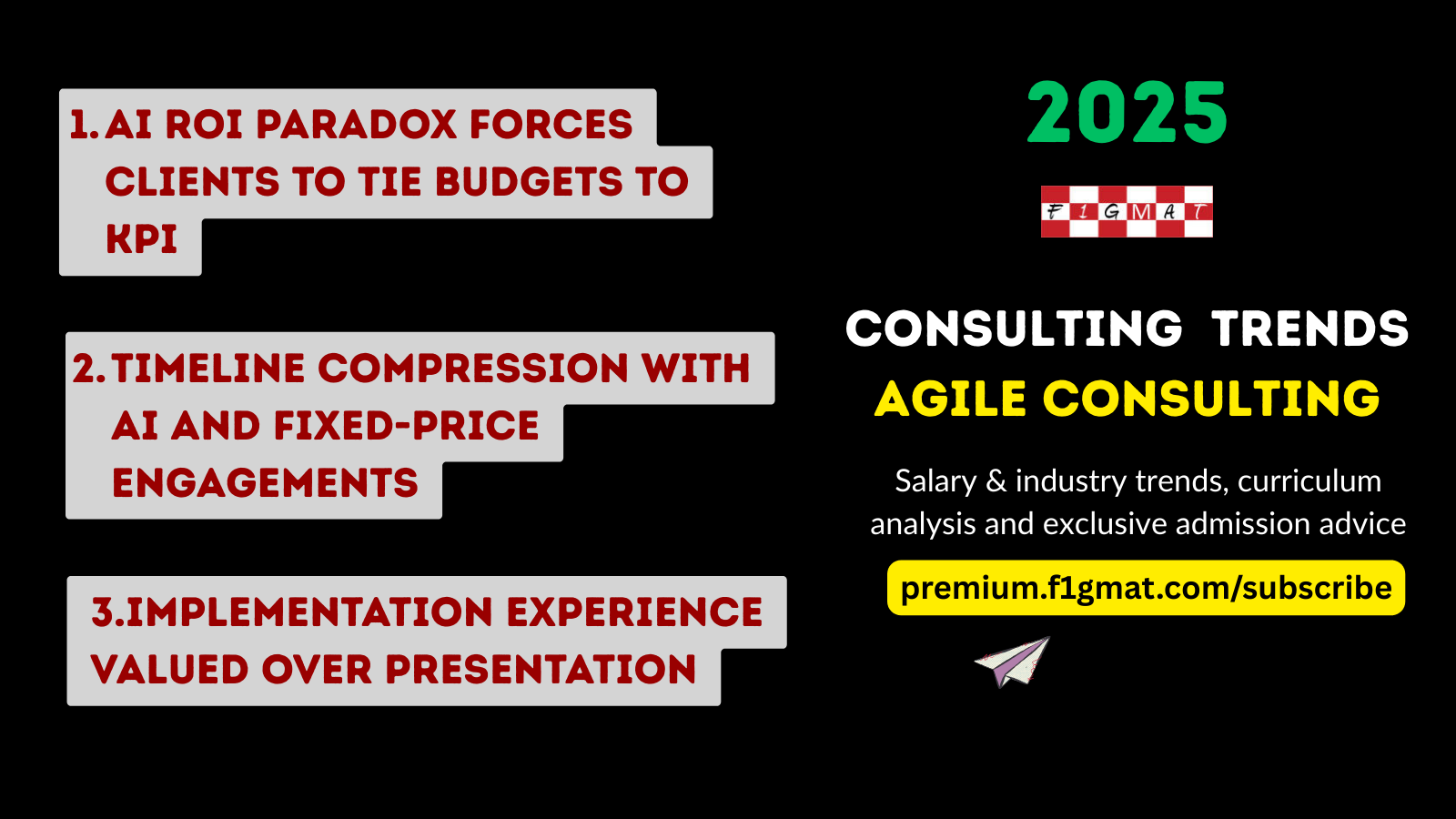
Timeline Compression with AI and Fixed-Price Engagements
Firms begin experimenting with modular offerings and value-based pricing; Bain and EY pilot fixed-price transformation “modules” delivered in tight timelines, while BCG and Accenture push internal AI tools specifically to compress analysis and improve the economics of these shorter projects.
Q3 2025 conditions make this trend unavoidable.
AI ROI Paradox Forces Clients to Tie Budgets to KPI
With the AI ROI paradox front and centre, clients explicitly tie budgets to KPI movement, churn reduction, cycle-time compression, uplift in cross-sell, or working-capital improvement.
Outcome-based and gain share models don’t fully replace time-and-materials, but they become common in AI, operations, and commercial transformation, forcing firms to take execution risk that historically rested almost entirely with the client.
Implementation Experience Valued Over Presentation
Consultants are increasingly assessed on speed, practicality, and numeracy. Storytelling and slide-making still matter, but they’re not enough; firms want people who can define metrics, work with experimentation frameworks (A/B testing, pilots), and link recommendations directly to P&L impact. This favours post-MBAs with strong quant or product/ops exposure, and non-MBA candidates who have built or run initiatives, not just analysed them.